


March 16, 2026, 5:54 pm | Read time: 7 minutes
When it comes to the best training methods, there are many answers. It’s more about asking the right question. In a 2025 study, researchers provide insights into which exercise is best suited to achieve maximum biceps growth. The result may also be applicable to other muscles.
Follow the FITBOOK channel on WhatsApp now!
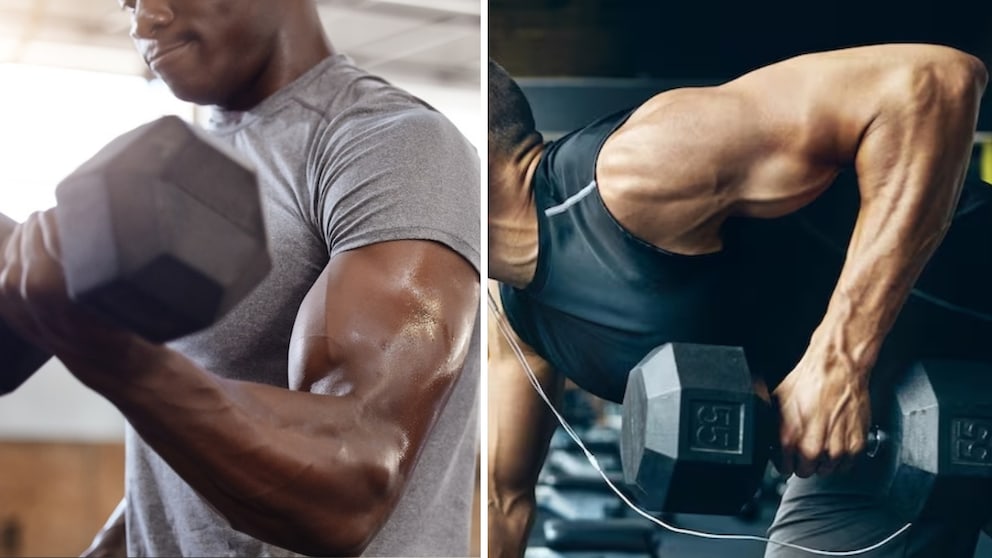
A well-defined biceps is the goal of many recreational athletes. But what’s the best way to achieve it? To answer this question, Brazilian researchers from the Universidade Federal Do Rio de Janeiro compared two classic exercises.1 The biceps curl was pitted against dumbbell rowing. There’s a significant difference here, as the biceps curl is an isolated exercise targeting only the biceps. Dumbbell rowing is a compound exercise involving multiple muscle groups. It not only engages the biceps but also the upper back muscles and shoulders. The study’s result is clear: Biceps curls are more effective than dumbbell rowing–at least when it comes to the impact on the biceps.
How the Two Exercises Were Compared
Although the study, with only 25 participants, is considered relatively small, its design allows for optimal comparability. All participants trained one arm exclusively with biceps curls and the other with dumbbell rowing, using the same number of repetitions. The study consisted of two parts. In the first part, the muscle circumference was measured and compared after a single training session with trained athletes. In the second part, untrained individuals underwent an eight-week workout. Here’s how the study was detailed:
Part 1 of the Study: Trained Participants
Sixteen trained men completed a workout consisting of four sets of eight to twelve repetitions to muscle failure. One arm performed biceps curls, while the other did dumbbell rowing. The muscle circumference was measured afterward.
Part 2 of the Study: Untrained Participants
Nine untrained men followed an eight-week training program. They trained twice a week with four to six sets and eight to twelve repetitions per set. Again, one arm was trained with the isolated exercise, the other with the compound exercise. At the end of the training program, muscle growth was measured and compared.
Biceps Curls vs. Dumbbell Rowing–These Are the Results
The data analysis for trained individuals favors biceps curls: After a single training session to muscle failure, the biceps was larger after curls with the dumbbell than after rowing with the dumbbell. The thickness of the biceps was about 19 percent larger near the shoulder and 16 percent larger near the elbow than before the exercise. With dumbbell rowing, the increase was only 13 percent at the upper and 12 percent at the lower end of the biceps. According to the researchers, the difference between the two exercises was particularly significant at the upper end of the biceps near the shoulder.
The second part of the study confirms this picture: After the eight-week training program, biceps curls led to muscle growth of about five percent in the upper biceps area and eleven percent in the lower area for untrained individuals. Dumbbell rowing resulted in comparable growth of the upper biceps, also five percent, but had almost no effect on the lower area, with only one percent growth. Thus, biceps curls lead to significantly better muscle growth in this body part overall.
It should be noted that only trained men were examined in the first part of the study and only untrained men in the second part. This raises the question of how the individual results would turn out if the groups were mixed. Including women would also be sensible. And, of course, the question remains whether the result can be easily transferred to other muscles.
How the Study’s Co-Author Interprets the Results on FITBOOK
“Our results suggest that isolation exercises–like the dumbbell curl–can provide a more direct and complete stimulus for specific muscles, such as the elbow flexors. This is because they engage the muscle over a greater range of motion and mechanical tension specific to this joint,” explained Prof. Thiago Motta, co-author of the study, in response to a FITBOOK inquiry. However, the researcher also emphasized that both isolation and compound exercises are generally effective for hypertrophy.
But: “Isolation exercises allow for greater mechanical load throughout the entire movement of the target muscle and reduce the influence of synergistic muscles that take on part of the work in compound exercises. For two-joint muscles like the biceps brachii, this direct tension over the entire length likely explains the greater and more uniform hypertrophy we observed with the dumbbell curl compared to rowing.”
However, generalizing the study’s findings to other muscles is not possible. “The effects of exercises on regional hypertrophy depend on specific biomechanical properties (range of motion, moment arm, joint angle, muscle length extension), the functional role of the muscle (single or two-joint), and its architectural structure (fiber orientation, pennation angle, tendon insertions),” the researcher emphasized on FITBOOK. “Since these properties vary between muscles and exercises, an exercise that emphasizes a particular region of a muscle may not have this effect on another muscle. Therefore, muscle- and exercise-specific studies are necessary before these results can be applied to other body parts.”
Forget Bicep Curls! This Exercise Tones Your Upper Arms
Expert Recommends Optimal Number of Bicep Curls for Muscular Arms
What a Personal Trainer Says About the Study Results
Personal Trainer Jörn Giersberg views the study results with nuance. Especially for smaller muscle groups like the biceps, isolated exercises can indeed be attributed higher effectiveness: “For a small muscle group like the biceps, I can generally confirm this–at least compared to certain compound exercises like one-arm rowing,” said Giersberg. However, this cannot be universally applied to every exercise: “Underhand pull-ups, for example, engage the biceps significantly more–the situation is quite different there.”
Isolation Exercises Alone Are Not Enough
Giersberg warns against relying solely on isolation exercises:
“Working only with isolation exercises is not enough. Without compound exercises, the foundation is missing.” Especially when it comes to load, isolated exercises quickly reach their limits: “With biceps curls, only relatively light weights can be moved–this is not enough in the long run to achieve real muscle growth.”
Large Muscle Groups Need Basic Exercises
The larger the muscle group, the more important complex exercises become, Giersberg emphasizes.
“For glutes, legs, back, or chest, basic exercises like squats or bench presses are needed–because significantly higher loads can be worked with here.”
Isolated exercises like dumbbell flys are useful but not sufficient:
“Alone, they cannot develop the quality of a chest muscle–the basic load is simply missing.”
The Strength of Isolation Exercises Lies in Targeted Load
Nevertheless, Giersberg sees advantages in targeted muscle engagement:
“Isolation exercises work very precisely–they target the muscle directly without other muscle groups intervening supportively.” This allows the muscle to be more exhausted and utilized at specific points. But even here, the rule applies: “You won’t reach your goal in the long term with isolation exercises alone.”
Why Basic Exercises Are Indispensable
Even if isolation exercises can be more effective at specific points, Giersberg maintains his stance: “Compound exercises are the foundation of any training. They build strength, muscle density, and quality–no isolation exercise can replace that.”
Moreover, the supposed superiority of isolated exercises cannot be generalized:
“Biceps curls can be more effective than one-arm rowing–but not compared to close-grip pull-ups. The thesis that isolation exercises are generally better cannot be upheld,” said the personal trainer.
What to Consider When Training
There is much to be said for compound exercises like bench presses, squats, pull-ups, or dumbbell rowing (FITBOOK reported). With just a few basic exercises, nearly the entire body can be trained. Especially for those with little time for training, the whole body musculature can be stimulated in a short time. Compound exercises also result in higher energy expenditure and burn more calories, as more muscles are moved. Lastly, the entire body is trained evenly, leading to a beautiful and natural physique rather than emphasizing only individual muscle parts.
However, as the current study shows, isolation exercises also have their place. Especially when you want to stimulate specific muscle parts for growth, they are the first choice. Arnold Schwarzenegger already knew this and revealed to his fans the arm workout that made him Mr. Universe (FITBOOK reported). Spoiler: Biceps curls played a central role. Ideally, training should not only consist of compound exercises but also include isolated exercises alternately to achieve targeted growth in specific muscle parts. As always, variety in training is one of the keys to success.