

February 6, 2023, 10:13 am | Read time: 5 minutes
Bulgarian Split Squats, also known as Rear-Foot Elevated Split Squats, are excellent for training the leg muscles. But what does the exercise have to do with Bulgaria? FITBOOK explores the origin, proper execution, common mistakes, and variations of Bulgarian Split Squats.
The exercise Bulgarian Split Squats translates to split Bulgarian squats. The split refers to the fact that, unlike the classic squat, primarily either the left or right leg is engaged. This strength exercise is ideal for training the legs and glutes. What benefits do Bulgarian Split Squats offer, what should you pay attention to in terms of technique, what are common mistakes, and what variations are there for beginners and advanced practitioners?
Overview
Origin of Bulgarian Split Squats
The Bulgarian Split Squat was reportedly used by Bulgarian weightlifters. They are said to have started using this variation instead of the classic squat in the 1980s. However, there are doubts about this version. It is more likely that an assistant coach of the Bulgarian weightlifting team claimed this during a U.S. trip, as stated on the Your Personal Strength Institute website. Regardless of how the Bulgarians trained, the name for the exercise, where one leg is placed on an elevated platform while the other leg rests on the ground in front of the body, gradually caught on.
Execution and Technique
Here is a step-by-step guide:
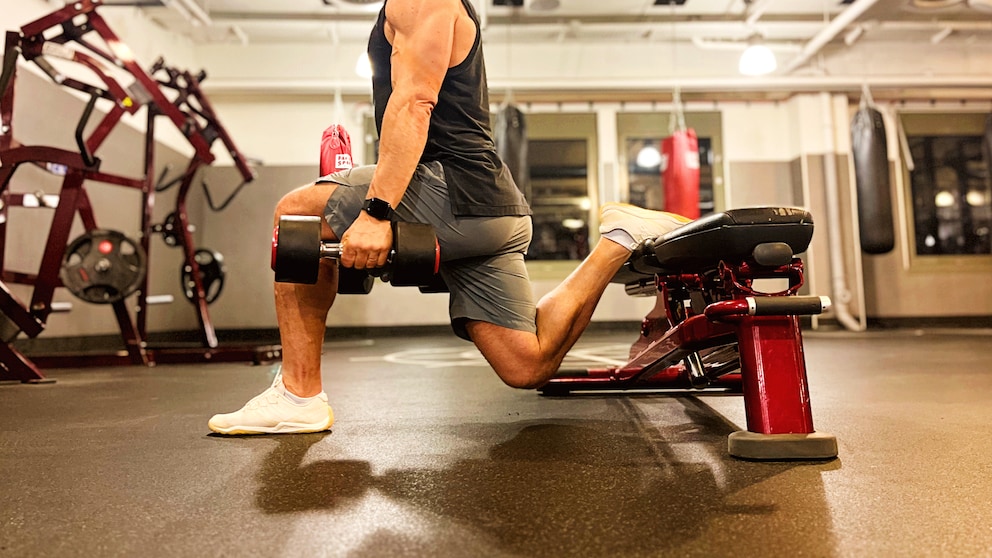
- Stand in front of a bench or stool and place the back foot with the instep on the bench.
- The front foot should be about a meter away from the bench.
- Hold a dumbbell or kettlebell in each hand next to the body.
- Bend the front leg into a squat while the back foot remains on the bench. Simultaneously, lower the upper body until the front leg forms a 90-degree angle.
- Push the body back to the starting position with the front leg.
- Repeat the movement until the desired number of repetitions is reached.
Additionally, keep in mind:
- The front knee should not extend too far over the toes.
- The back should remain straight.
- The body weight should be distributed over the heels, not the toes.
- The back knee should not touch the ground.
Maintaining an upright posture and controlled movement is crucial to avoid injuries and maximize the effectiveness of the exercise.
Muscles Targeted by Bulgarian Split Squats
Primarily trained are:
- Thigh muscles (quadriceps, adductors)
- Gluteal muscles (gluteus maximus)
Additionally targeted are:
- Calf muscles (gastrocnemius and soleus)
- Core muscles (abdominal and back muscles), which provide stabilization
By engaging the leg muscles, the exercise can also help improve leg extension and flexion and reduce the risk of lower extremity injuries.
Benefits of the Exercise
- Improvement of leg strength
- Improvement of muscular balance in the leg area
- Improvement of hip mobility
- Improvement of posture
Common Mistakes in Bulgarian Split Squats
Bulgarian Split Squats are a very effective leg exercise, but they can be easily performed incorrectly. Here are some of the most common mistakes.
- Leg distance: One of the most common mistakes in Bulgarian Split Squats is having the front and back legs too close together. This can cause the front knee to extend over the toes and reduce the effectiveness of the exercise. To avoid this, the front leg should be about a meter away from the bench. Ideally, the front leg should form a right angle at the lowest point of the exercise.
- Too little weight: This can result in the muscles not being sufficiently challenged, making the exercise less effective. As a rule of thumb, the weight should be heavy enough to remain challenging while maintaining proper form.
- Uncontrolled movement: This can lead to injuries. Therefore, the movement should ideally be performed slowly.
- Rounded back: A curved back places incorrect stress on the spine. This can lead to back pain and injuries. Therefore, keep your gaze forward and consciously maintain an upright back.
Variations
There are several alternative exercises that train similar muscles.
For Beginners
- Half Bulgarian Split Squat: This exercise involves performing only half of the movement to reduce intensity.
- Bulgarian Split Squats without weights: To learn the technique and basic stability, it can be helpful to initially forgo weights.
- Lunges: They similarly train the thigh and gluteal muscles.
- Split Squats with and without weights: Here, the back leg is not elevated, so you lower and push up from a lunge position.
- Single-leg leg press: This machine allows targeted training of one leg and engages similar muscles as the Bulgarian Split Squat.
For Advanced Practitioners
- Bulgarian Split Squat Jump: In this variation, you jump off with the front leg and return to the starting position.
- Step-ups: This exercise is performed on a step or stool and engages similar muscles as the split Bulgarian squat.
- Single-leg squats or pistols: This exercise requires a similar movement to the Bulgarian Split Squat and also trains the thigh and gluteal muscles.
It is important to note that the selection of alternative exercises depends on individual goals, abilities, and the training plan.
7 Effective Squat Variations for Strong Legs and a Firm Butt
What Are the Benefits of the Goblet Squat? Advantages and Proper Execution
Workout with the Bulgarian Split Squat
The rest between sets and exercises is 60 seconds each:
- Bulgarian Split Squat: 3 sets x 12 repetitions per leg
- Step-up: 3 sets x 12 repetitions per leg
- Good Mornings: 3 sets x 12 repetitions
- Crunch: 3 sets x 12 repetitions
Additionally, this high-intensity 6-minute workout with a chair also incorporates Bulgarian Split Squats.
Conclusion on the Bulgarian Split Squat
Bulgarian Split Squats are an excellent exercise for training leg and glute muscles. They are suitable for improving leg strength, muscular balance in the leg area, hip joint mobility, and posture. It is important to pay attention to correct technique and gradually increase the weight to avoid injuries. For beginners, there are simpler variations, while advanced practitioners can increase the weight or try more challenging variations.