

February 3, 2023, 6:58 am | Read time: 6 minutes
Goblet squats are highly effective for strengthening leg muscles and the core. But what is the origin of the exercise, which translates to “chalice squat”? Which muscles are specifically targeted? And what should be considered regarding execution and technique? FITBOOK answers the most important questions and presents variations for beginners and advanced practitioners.
Many have likely observed the goblet squat in the gym. It involves holding a weight in front of the torso while performing squats. This squat variation offers several advantages. FITBOOK explains which muscle groups are involved and what to watch out for. We also reveal common mistakes in the goblet squat.
Overview
Origin of the Goblet Squat
The goblet squat is named after the way the additional weight–such as a kettlebell or dumbbell–is held during a squat: like a goblet. This type of squat was introduced by American strength coach and athlete Dan John in 2002 and has since become a very effective exercise.
Execution of the Goblet Squat
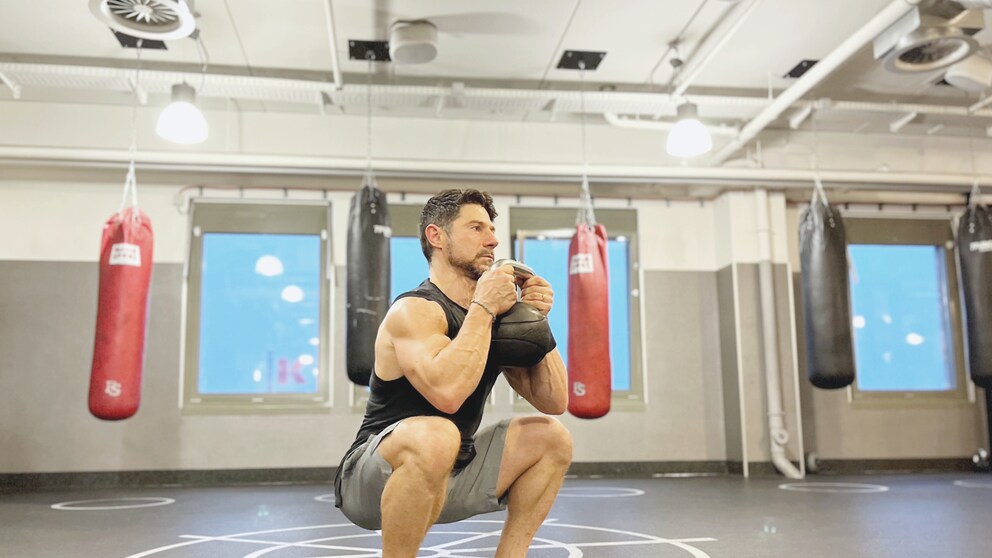
- The goblet squat begins in an upright position, with feet shoulder-width apart and the weight held in front of the chest.
- Inhale as you bend your knees and lower your body as if sitting on a chair.
- The elbows remain between the knees during the movement.
- The knees should only extend over the toes enough to keep the heels from lifting.
- The torso remains upright, and the gaze is directed forward.
It’s also important that the knees do not collapse inward during the movement and that the pelvic floor remains engaged. The lower back should have a slight arch, while the neck should ideally remain relaxed. Exhale as you return to the starting position.
The goblet squat can be integrated as either a fundamental exercise or an additional exercise in a training program and is suitable for both beginners and advanced practitioners.
Muscles Targeted by the Goblet Squat
Primarily, the legs are trained. The main muscles targeted are:
- Thighs: The quadriceps are engaged when extending the knee, and the hamstrings are engaged when bending the knee.
- Calves: The gastrocnemius and the soleus are stretched when lowering the body and engaged when extending.
- Glutes: The gluteus maximus is engaged when lowering and extending the body.
Additionally, the goblet squat also strengthens the core and back muscles, as they are activated during the exercise to stabilize the spine and maintain an upright posture.
Secondary muscles trained include:
- Shoulders: The shoulder girdle is activated to hold the weight in front of the chest.
- Arms: The biceps are activated to hold and control the weight.
It’s important to note that the load on the secondary muscles varies depending on the execution of the exercise and the weight used. Correct technique and progressive load increase are necessary to achieve the best results. Overall, the goblet squat is a complex and versatile exercise that engages many muscles of the body, making it a good choice for comprehensive and effective training.
What Does the Goblet Squat Offer? An Overview of Benefits
- Improvement of leg strength
- Improvement of hip joint mobility
- Strengthening of the core and back muscles
- Improvement of posture

Common Mistakes
The exercise can also be easily performed incorrectly. Here are some of the most common mistakes:
- Knees collapsing inward: A common mistake in the goblet squat is the knees collapsing inward when lowering. This can lead to injury under load and reduce the effectiveness of the exercise. To avoid this, ensure the knees always point in the same direction as the toes.
- Torso leaning forward: This can lead to overexertion and thus reduce the effectiveness of the exercise. Therefore, it’s essential to keep the torso upright and the gaze forward.
- Incorrect breathing: Another common mistake in the goblet squat is holding the breath during the eccentric movement, i.e., while lowering. This can reduce oxygen supply and cause dizziness. Correct: inhale while lowering, exhale while rising.
- Weight too heavy: This can lead to incorrect technique and potential injury. Ideally, choose a weight that allows for controlled movement to ensure correct technique.
- Lack of pelvic floor engagement: If the pelvic floor is too relaxed, the risk of injury increases, and the effectiveness of the exercise is reduced. Therefore, keep the pelvic floor engaged throughout the exercise.
https://oembed/fitbook/affiliate/9240a7077cb6b530c02aed57731762913b62d94da10d1fc6fe695b4ca4cacefe/900b495e-d27d-429e-892a-029abf95d223/embed
Goblet Squat: Variations for Beginners and Advanced
For Beginners
For beginners, it’s advisable to reduce the weight and increase repetitions to improve technique. Another variation for beginners is the half goblet squat, where only half of the movement is performed to reduce the load. In other words, you don’t go all the way down into a squat or fully extend.
If it’s difficult to squat deeply, you can set a marker for the lowest hip position by sitting on a medicine ball or bench (goblet box squat). For limited calf muscle mobility, the cyclist goblet squat is suitable, where the heels are elevated.

For Advanced
One way to increase intensity is by increasing the weight of kettlebells or dumbbells. Possible variations include:
- Goblet sumo squat: Compared to regular goblet squats, the leg stance is widened, and the knees point outward. This emphasizes the quadriceps and also trains the adductors.
- Front squat: where the weight is held on the chest instead of in front of the chest.

Landmine Squats: The Exercise for Ultimate Leg Muscles
Bulgarian Split Squats: The Ideal Exercise for Legs and Glutes
Mini-Workout with the Goblet Squat
Perform consecutively; the rest between sets and exercises is 60 seconds each.
- Goblet squat: 3 sets x 12 reps
- Lunges: 3 sets x 12 reps per leg
- Plank: 3 sets x 30 seconds
- Russian twist: 3 sets x 12 reps per side
Also interesting: Lose weight with the FITBOOK training plan “Fat Away in 12 Weeks”
Conclusion on the Goblet Squat
The goblet squat is a highly effective exercise for the leg muscles and core. It improves leg strength, hip joint mobility, and contributes to good posture when performed correctly. It’s important to practice the technique first and gradually increase the weight to avoid injuries. For beginners, there are simple variations, while advanced practitioners can increase the weight or switch to more complex variations to increase intensity.