

March 22, 2023, 7:02 am | Read time: 6 minutes
The landmine squat, also known as the lumberjack squat, is an effective barbell exercise for the lower body. It is a variation of the traditional squat that uses a so-called “landmine” device. FITBOOK discusses the benefits of the exercise, common mistakes, and variations.
When it comes to lower body training with a barbell, most people immediately think of classic squats or lunges. These are fundamental and important exercises for strengthening the legs, glutes, and lower back. One way to vary lower body training is with landmine squats (or lumberjack squats). Advantage: They can be performed by beginners and experienced strength athletes alike.
Overview
Origin of the Landmine Squat
The landmine device was invented in the late 1990s by Bert Sorin, a former hammer thrower. It has little in common with its explosive namesake, except that it is anchored to the ground. Sorin was looking for a way to prepare for his competitions outside the throwing area. The landmine squat is one of many functional exercises possible with the device. Over the last decade, the exercise, also called lumberjack squats, has become increasingly popular among strength athletes and in recreational sports.
If no landmine is available
While most gyms now have a landmine device, if one is not available, you can alternatively place the barbell in a corner of the room. It is important that the end does not slip.
Execution and Technique of the Landmine Squat
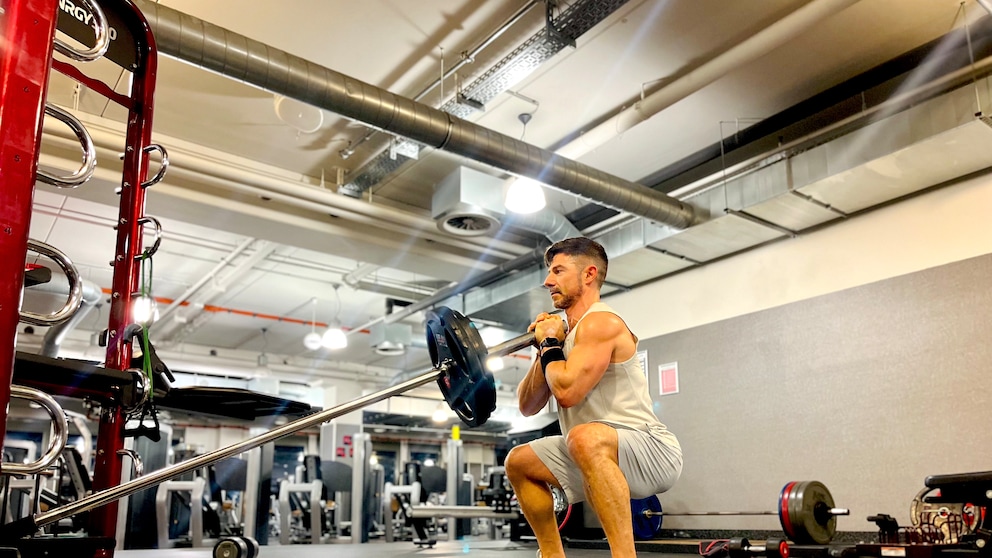
Instructions for the correct execution of landmine squats:
- Place the barbell in the landmine device or alternatively in a corner of the room.
- Stand sideways to the barbell, grasp the thick end of the bar with both hands and bring it in front of your body. The hands are at the outermost point of the bar and grip it so that the fingers overlap.
- Position your feet slightly wider than shoulder-width apart and turn your toes slightly outward.
- Establish the distance to the bar–not too close and not too far, so that the body can lean slightly against the hands.
- Bend your knees and lower your body by moving your hips back. The body weight is evenly distributed over both feet.
- Keep your upper arms and elbows close to your sides, and hold your forearms close to your chest to stabilize the barbell.
- The movement ends when the thighs are parallel to the floor and the elbows slightly touch the knees. A touch is not strictly necessary.
- Then push up to return the body to the starting position.
Keep your back straight throughout the exercise and direct your chest forward.
Muscles Targeted by Landmine Squats
The primary muscles targeted by landmine or lumberjack squats are:
- Thigh muscle (m. quadriceps femoris)
- Gluteal muscle (m. gluteus maximus)
- Lower back (m. erector spinae)
The secondary muscles targeted include:
- Calves (m. gastrocnemius and m. soleus)
- Shoulders (m. deltoideus)
- Arm flexors (m. biceps brachii)
Benefits of the Exercise
- Builds lower body strength
- Improves posture and stability
- Reduces injury risk due to guided movement
Common Mistakes
- Rounded back: The back should not round at any point. This can lead to spinal injuries. Therefore, keep your chest and gaze directed forward throughout the movement.
- Knees are overloaded: The knees should not extend too far over the toes to avoid overloading the knee joint. Ideally, the angle is 90 degrees, and the weight is evenly distributed on both feet.
- Distance to the bar: If the feet are placed too close or too far apart, the execution of the movement is disrupted. The correct distance is characterized by the feet always maintaining contact with the ground and the elbows being able to touch the knees in the end position.
- Too much weight: If you have difficulty getting the barbell into the starting position, you should definitely reduce the training weight. Too much weight can lead to wrist injuries and negatively affect the quality of the technique.
- Incorrect arm position: In the end position of the landmine squat, the elbows (almost) touch the knees. It is not beneficial for posture if the elbows pass by the knees or are in front of them. This can be avoided by keeping the arms close to the body during the movement.
- Incorrect grip: The hands should not grip the bar in an offset manner, as this can cause one shoulder to fall forward and affect the movement. Instead, the barbell should be gripped so that the fingers overlap, ideally interlocking.
Also interesting: Workout for legs and jumping power with parkour athlete Benni Grams
Variations of the Landmine Squat
For Beginners
- Landmine Squats with Bench: An elevation can make it easier to assume the starting position of the landmine or lumberjack squat. A weight bench or a plyo box can be used as aids.
- Landmine Hack Squats: In this variation, the barbell is placed on the neck, and the gaze is directed away from the bar. You stand with your back to the landmine device. This relieves the arms and back, focusing on the leg muscles.
- Goblet Squats: This exercise uses a kettlebell. The goblet squat is part of the front squat group, allowing training with lighter weights.
For Advanced
- Double Landmine Squats: This variation requires two barbells and two landmine devices. Each end of a barbell is gripped with one hand. This exercise is more challenging than the classic landmine or lumberjack squat because the movement must be stabilized to the sides by the lateral and oblique abdominal muscles.
- Single Arm Landmine Squats: Here, the end of the barbell is gripped with only one hand. The free arm is extended to the side. The lateral and oblique abdominal muscles are heavily engaged.
- Landmine Jump Squats: This variation is identical in movement to the classic landmine squat. However, the movement is performed at a high tempo, so the feet briefly leave the ground. When executed correctly, it is a plyometric exercise.
With back squats, you can really kickstart calorie burning.

Squats: Proper Technique and Variations for Advanced Practitioners
Workout with the Landmine Squat
Perform in sequence; the rest between sets is 60 seconds each.
- Landmine Squats: 3 sets x 10 reps
- Kettlebell Swings: 3 sets x 15 reps
- Step-ups: 3 sets x 12 reps per leg
- Romanian Deadlifts: 3 sets x 12 reps
Also interesting: 5 reasons why the hip thrust is an underrated exercise
Conclusion on Landmine Squats
Landmine squats are an excellent exercise for strong legs. This squat variation is one of the compound movements that engage multiple muscle groups simultaneously, providing an effective way to build strength and stability.