

October 28, 2024, 3:27 am | Read time: 5 minutes
The quadriceps femoris muscle is the only extensor in the knee joint and consists of four parts. FITBOOK explains the anatomy of the thigh muscle, its functions, and suitable exercises for strengthening and stretching.
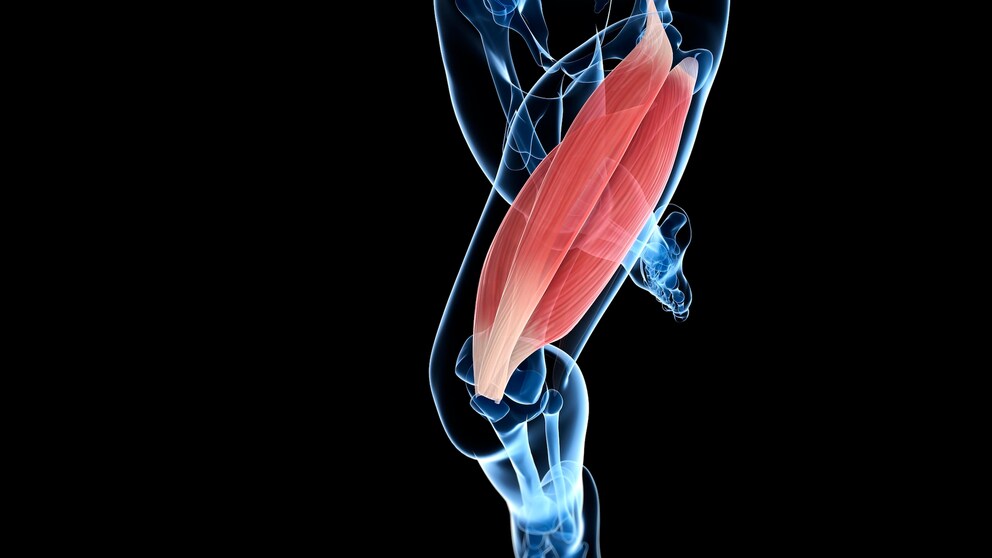
Translated from Latin, musculus quadriceps femoris means four-headed muscle of the thigh. It is composed of the rectus femoris, vastus lateralis, vastus intermedius, and vastus medialis. The quadriceps plays an important role in all movements that require knee extension, such as climbing stairs or jumping. More on anatomy and functions–and how to train and stretch it.
Follow the FITBOOK channel on WhatsApp now!
Overview
Anatomy of the Musculus Quadriceps Femoris
As mentioned earlier, the quadriceps consists of four muscle parts, each with different origins but a common insertion.
Origin
- Rectus femoris: Originates at the anterior inferior iliac spine, a bony structure of the pelvis.
- Vastus lateralis: Originates at the greater trochanter of the femur.
- Vastus intermedius: Originates at the front of the femur.
- Vastus medialis: Originates medially on the femur, on the inner side of the femur.
Insertion
All four muscle parts insert via the quadriceps tendon at the patella (kneecap) and via a common end tendon (patellar ligament) at the tibial tuberosity.
Functions of the Musculus Quadriceps Femoris
- Extension in the knee joint: This is the most important function of the quadriceps.
- Flexion in the hip joint: This function is only performed by the rectus femoris, as it is the only one of the four parts that acts on both the knee and hip joints.
Also interesting: 4 effective exercises for the outer thigh
Special Features of the Musculus Quadriceps Femoris
The quadriceps performs best when the hip is fully extended. It also stabilizes the patella in the groove. Unlike the three vastus muscles, which tend to weaken, the rectus femoris tends to shorten.
Squats or Deadlifts: Which Strength Exercise Is Better for You
Pendulum Squat: How the Effective Machine-Assisted Squat Works
Exercises for the Quadriceps
Strengthening the musculus quadriceps femoris occurs in all exercises that involve knee extension. Here is a selection with and without equipment or weights.
With Bodyweight
Squats
Squats are among the best-known bodyweight exercises. They effectively train the quadriceps. There are several variations: such as jumping, very wide (sumo squats), particularly deep, etc.
Lunges
Lunges are also a good bodyweight exercise that focuses on the front thigh muscles. As a variation, you can perform jumping lunges in place.
With Equipment
Leg Extension Machine
The leg extension machine allows for isolated training of the quadriceps femoris. Both legs can be extended simultaneously or individually against resistance–usually a pad at the feet. Important: The knee joint should align with the machine’s axis of rotation, and the feet should be free to move.
Leg Press
The leg press primarily trains the quadriceps, but the hamstrings, gastrocnemius, and gluteus maximus also act as synergists. Ideally, the feet, knees, and hips should form a line of movement. A variation is to perform it with one leg.
With Dumbbells
In principle, all bodyweight exercises for the quadriceps can be intensified with dumbbells. For example, lunges can be performed with dumbbells. Below are more exercises with weights for the front thigh muscles.
Front Squats
Here, squats are performed with a barbell in front of the body. Here’s how:
- Grip the bar in a clean grip (palms up, fingertips under the bar, elbows high) or cross grip (arms crossed, hands on opposite shoulders, elbows high) and rest it on the front deltoids and chest.
- Stand with feet shoulder-width apart, toes slightly outward. Keep your back straight, eyes forward.
- Perform a squat. Important: Knees should track in the direction of the slightly outward-pointing toes; inhale on the way down and exhale on the way up.
Back Squats
- Rest the bar on the rear deltoids and middle trapezius muscles.
- Stand with feet shoulder-width or slightly wider, toes slightly outward. Keep your torso upright, eyes forward.
- Perform a squat.
Landmine Squats
- Secure one end of the barbell in a landmine attachment, load the other end with a weight plate of choice (or none!).
- Grip the bar with both hands and hold it in front of your chest.
- Stand with feet shoulder-width apart, toes slightly outward. Keep the bar in front of your chest, elbows slightly bent.
- Perform a squat.
Also interesting: Landmine Squats–the exercise for ultimate leg muscles
Goblet Squats
- Hold a kettlebell or dumbbell in front of your chest, both hands on the weight.
- Stand with feet shoulder-width apart, toes slightly outward. Keep the weight close to your body, elbows down.
- Perform a squat.
Also interesting: What does the Goblet Squat do? Benefits of the exercise and proper execution
With Cable
Leg Extension with Ankle Strap
Here’s how:
- Attach an ankle strap to a low point on the cable machine and load with a weight of choice.
- Place the strap around the ankle of the leg to be trained.
- Position yourself at a safe distance from the cable machine to create tension on the cable.
- Keep the standing leg slightly bent, and the other leg with the strap bent.
- Extend the leg.
Stretching Exercises for the Musculus Quadriceps Femoris
An effective way to stretch the quadriceps is by bending the knee while standing.
Here’s how:
- Stand upright and grab the foot of the same leg behind your body with your hand.
- Gently pull the foot toward the buttocks until a stretch is felt in the front thigh.
- Then switch sides and repeat the process.