

May 15, 2026, 3:26 pm | Read time: 5 minutes
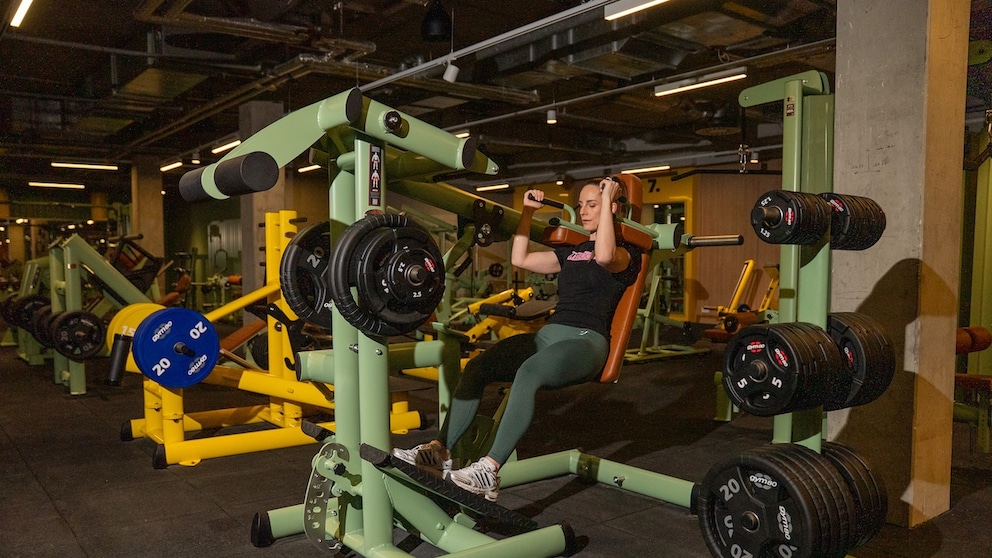
Want to train one of the strongest muscles in your body to its fullest potential? Voilà–the Pendulum Squat might be the best exercise for your quadriceps. The quadriceps cover most of the front of the thigh and form the foundation for stable walking, running, and jumping. In recent years, the Pendulum Squat has become increasingly common in German gyms–FITBOOK editor Michel Winges explains the exercise on the machine.
Follow the FITBOOK channel on WhatsApp now!
The Hallmark–High Activation
Anyone who has already tried the exercise will have noticed that the weight to be moved is generally significantly less than with comparable exercises like the Hack Squat or the Leg Press–and yet it feels heavier. This already reveals the potential benefits of the Pendulum Squat.
Moving more weight does not automatically mean more muscle growth. It can often mean that the target muscle is less challenged. But how can this be explained?
In any exercise, the so-called target muscle is never working alone. In bench pressing, it would be the chest; in deadlifting, the back extensors; and in the leg press, the quadriceps. These are the muscles that do most of the work and are usually the ones you want to target. However, in larger compound exercises, not only do the target muscles work, but secondary muscles and stabilizers also assist. For example, in bench pressing, the triceps and front shoulder are involved; in deadlifting, the quadriceps and abdominal muscles; and in the leg press, the hamstrings and glutes. The more muscles that assist in an exercise, the more weight can generally be moved, but this can also shift the focus away from the target muscle. Depending on execution and individual strengths, secondary muscles can take over too much focus, hindering muscle growth in the target muscle.
What Can Be Concluded?
The Pendulum Squat targets the quadriceps excellently, mainly due to its unique resistance curve. While the leg press and Hack Squat distribute resistance evenly along a linear path, the Pendulum Squat follows an arc path. This means that in the deepest position–right where the quadriceps are most stretched–the resistance is also highest. The arc movement also distributes pressure more gently over the knee joint, which is why you might find the Pendulum Squat to be more knee-friendly than comparable machines.
Jake Boly, a fitness trainer from the U.S., also describes on his portal “That Fit Friend” that Pendulum Squats are a good way “to reintroduce athletes to lower extremity exercises without overloading the knees and ankles.” And if you browse fitness forums, you’ll get the impression that fitness enthusiasts are amazed by this machine.
For Leg Strength: How Training on the Hackenschmidt Machine Works
What Are the Benefits of the Goblet Squat? Advantages and Proper Execution
Correct Execution
Assume Position
- First: If you have never tried the exercise before, you should not add any weight plates initially.
- Place your feet about hip-width apart on the footplate, with your toes slightly pointing outward. Lean your back firmly against the pad and ensure your hips are snugly positioned.
- Firmly grip the machine’s handles, disengage the safety hook, and stand stable before taking on the weight.
Exercise Execution
- Slowly and controlled, lower yourself into a squat. Take two to four seconds for this. The slower the lowering phase, the longer the muscle is under tension, and the greater the training stimulus.
- Keep your back and hips firmly against the pad throughout and ensure your heels do not lift off the plate.
- Once in the deepest position, push yourself back up evenly and controlled. Consciously engage the quadriceps.
- Once at the top, do not fully extend your legs but maintain a slight residual tension in the muscle. This keeps the quadriceps continuously under load and makes the set more effective.
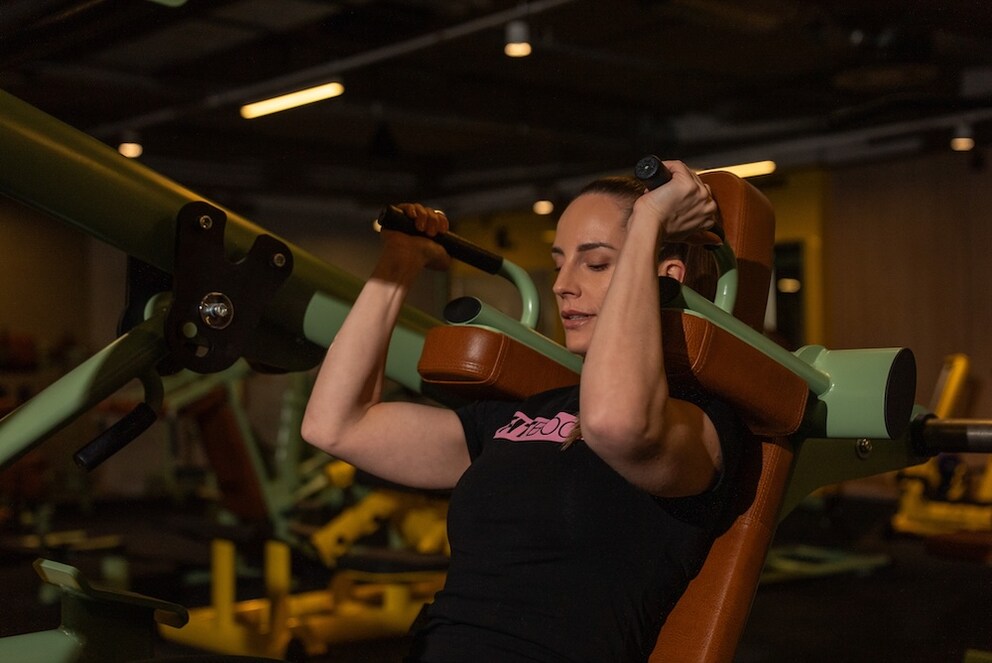
Which Muscles Does the Pendulum Squat Engage?
When discussing which muscles are engaged in an exercise, there are generally three categories: the primary target muscles, the secondary muscles, and stabilizers and auxiliary muscles. The Pendulum Squat engages a variety of muscles, which we will break down below.
Primarily, the generous footplate allows you to shift your focus precisely. High or low, narrow or wide–each variation changes which muscles work harder. A low foot position allows the knees to move further forward, placing more demand on the quadriceps. A high foot position, on the other hand, shifts the load more onto the glutes and hamstrings. The same applies to stance width. A narrow stance emphasizes the outer thigh, while a wide stance involves the inner thigh more.
Primary Target Muscles
The most engaged muscle is the quadriceps. It consists of four so-called heads that form the front of the thigh. Particularly the vastus medialis, also known as the “tear muscle” due to its drop-like shape, located on the inner thigh, is heavily engaged. The rectus femoris is also noteworthy, as it is more effectively loaded in the Pendulum Squat than in many other squat variations.
Secondary Muscles
Three muscle groups primarily come into play as support. Firstly, during the lowering phase, the hamstrings on the back of the thigh are active. Depending on preference, these can be further engaged by placing the feet higher. Additionally, the gluteal muscle plays an important role: it contributes a significant portion of the force when pushing out of the deepest position. Meanwhile, the adductors on the inner thighs form the third crucial muscle group, continuously providing lateral stability.
Stabilizers and Auxiliary Muscles
Although the machine supports the back, the core muscles work isometrically throughout to stabilize the pelvis and keep the body neutral under load. The calf muscles also provide support, ensuring a stable base on the footplate and preventing the heels from lifting. Finally, the gluteus medius plays a role, a smaller gluteal muscle that contributes to hip stability and is particularly engaged when you slightly push the knees outward during the movement.