

February 3, 2026, 6:02 pm | Read time: 4 minutes
The Hackenschmidt machine is one of the most popular leg exercises in the gym. On FITBOOK, you’ll learn how to perform the exercise correctly, how it compares to the leg press and the classic barbell squat, and the benefits each offers.
The Correct Execution
Assume Position
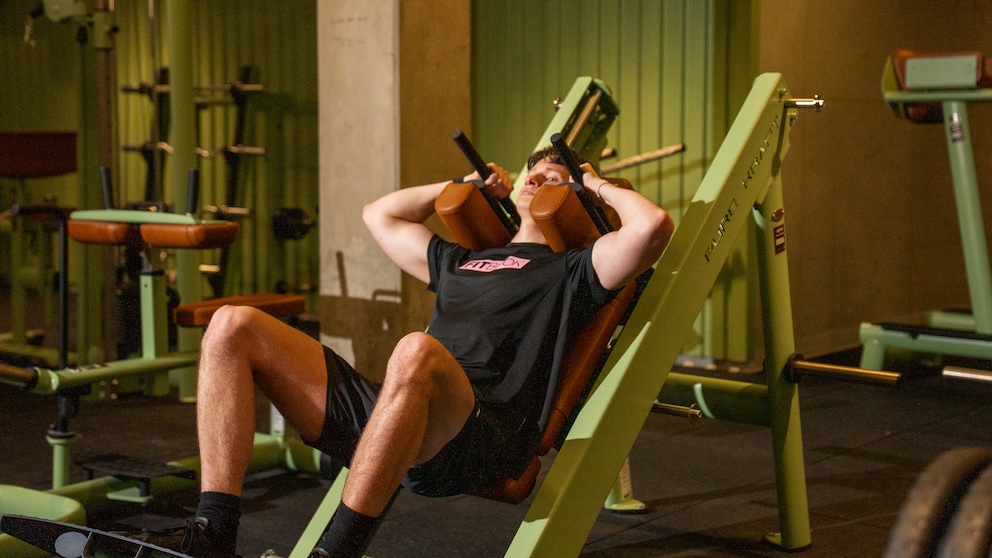
- Stand on the footplate of the Hackenschmidt machine and position your shoulders under the designated pads. Keep your back upright and fully against the back pad without arching.
- Your feet should be shoulder-width apart on the plate and slightly turned outward (this is the standard stance). Ensure your heels remain stable throughout the movement. Keep your gaze forward.
- Press the weight slightly upward, release the safety, and keep your knees slightly bent in the starting position.
Movement Sequence
- Control the bending of your knees and lower your body. Keep your back, buttocks, and shoulders consistently on the pad; the movement should be smooth and without momentum.
- Go as deep as your flexibility allows while maintaining tension in your legs. Alternatively, lower until there’s about a right angle between your upper and lower leg.
- Then push yourself back up through your heels until you reach the starting position, without fully straightening your knees.
Breathing: Inhale while lowering and exhale while pushing up.
Pendulum Squat: How the Effective Machine-Assisted Squat Works
4 Variations for Leg Press Exercises
The Different Foot Positions
When asked, “What is the correct foot position on the Hackenschmidt machine?” there is no one-size-fits-all answer. It depends on your training goals and what feels best for you. Here are three variations recommended by FITBOOK:
Shoulder-Width and Slightly Wider – The Standard
With a shoulder-width to slightly wider foot position, the load is distributed more evenly. In addition to the quadriceps, the gluteal muscles and adductors are more engaged. This variant is considered a good standard by many because it combines strength development and control.
Higher on the Plate
Placing your feet higher on the plate shifts the focus more towards the glutes and hamstrings. At the same time, the knees are somewhat relieved, as they push forward less during the downward movement.
Narrower and More Central
When the feet are narrower and more central on the plate, the emphasis shifts more to the front thigh. The quadriceps take on a larger share of the work, while the glutes and adductors are less involved.
The Exercise’s Effectiveness
What Does the Hackenschmidt Train?
The Hackenschmidt machine targets several muscle groups. Primarily and most strongly, it works the quadriceps, which consist of four muscle heads on the front of the thigh. All four parts are engaged because the movement is primarily through knee extension. Additionally, the gluteal muscles, especially the gluteus maximus, are involved. The back extensor along the spine and the adductors on the inner thighs also contribute, ensuring the pelvis and upper body remain stable during the exercise.
Is the Hackenschmidt Machine Better Than the Leg Press?
It’s not a straightforward answer. The leg press is more guided and allows many to target the leg muscles very specifically with minimal technical effort. The Hackenschmidt machine is more similar to squats and requires more stabilization work, such as through the back extensor and adductors, in addition to the quadriceps and glutes. What is “better” depends on the goal: a more isolated leg stimulus or a more holistic movement sequence. Often, it’s most effective to include both exercises in your routine or to alternate regularly to create different stimuli.
Hackenschmidt Machine or Barbell Squats?
The choice is ultimately yours. You can either prioritize a free movement sequence, which requires a lot of core and balance work in addition to the legs, such as with barbell squats. Or you can opt for a guided, beginner-friendly variant, where the quadriceps can be loaded very directly and with high weights—like on the Hackenschmidt machine. For building massive leg strength and thigh muscles, the Hackenschmidt is excellent, but it doesn’t replace the technique and balance training of free squats.