

October 30, 2025, 3:59 pm | Read time: 7 minutes
The leg press is likely one of the most popular classic training machines. However, it’s often observed that only the same exercise is performed on it. But the leg press machine can do much more! FITBOOK fitness editor Janine Riedle explains other variations of the leg press to bring more variety to your workout.
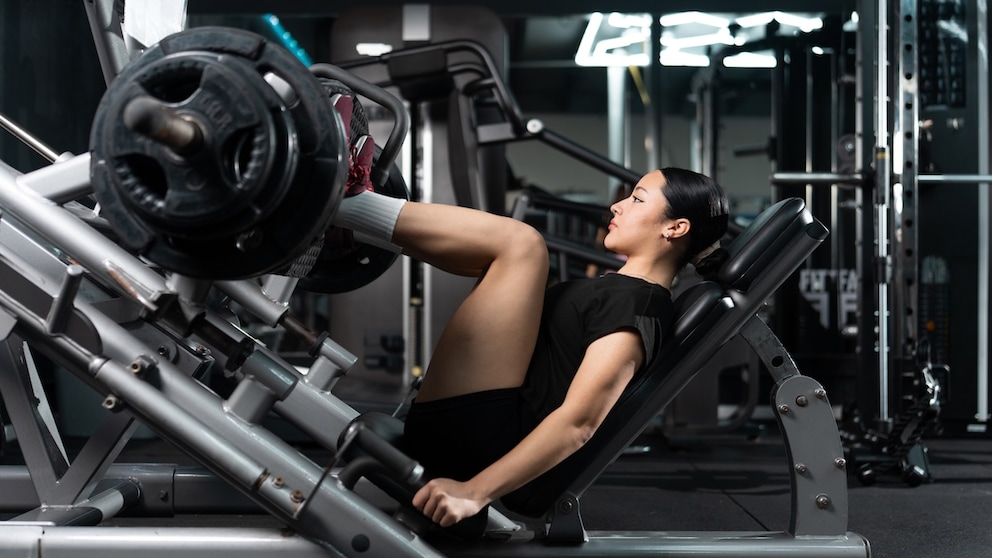
The feet are placed either wide, centered, at the top, or at the bottom of the plate. Then you push yourself or the platform away. That’s how the leg press works. But not only can you target different muscle groups more or less by the placement of your feet, but you can also activate specific muscles in the glute and leg area on the leg press through completely different exercise executions.
Different Leg Press Machines
A leg press is not just a leg press—depending on the gym, there are different machines you can train on. Generally, there are three different types of machines:
- 45-degree leg press
- Classic horizontal leg press
- Vertical leg press
The choice of the right training machine depends on which muscles you want to strengthen and which exercise you want to perform. With the vertical leg press, fitness also plays a role, as the exercise is intensified by the vertical execution. Therefore, this machine is more suitable for advanced users who can perform the exercise correctly.
With the 45-degree leg press and the classic horizontal leg press, different glute and leg muscles are trained depending on the exercise and foot positioning. Both presses are easy to use but differ in seat orientation and individual comfort. Some people find the lying variant more intense due to the plate’s inclination. With the 45-degree leg press, you load the weight using weight plates, while with the horizontal variant, you fix the weight.
Below, we explain exercise variations that can be performed on the 45-degree and horizontal leg press, as these are available in most gyms, while the vertical leg press is not always present. Therefore, many trainees use the Smith machine to create a vertical setup.
The Classic Leg Press
If you want to perform the classic leg press, you should first consider which muscles you want to strengthen, because the positioning of your feet on the plate depends on that, regardless of which of the two machines you use.
No matter how you place your feet, this exercise primarily trains the quadriceps (M. quadriceps femoris), the hamstrings (M. biceps femoris), and the gluteus maximus. The erector spinae and the adductor magnus assist.
General Execution
It’s important to always set the machine correctly. This means: The entire back is against the seat back, and the glutes do not leave the seat. In this position, place your feet on the plate—the knees should be bent at a 90-degree angle. If this is not the case, adjust the seat either closer to or further from the plate. On some machines, you can also adjust the backrest. When positioning the legs, the knees and feet should always point slightly outward.
When exhaling, push your legs through to push the plate or seat away, depending on the machine. Push from the heels until the legs are almost fully extended—do not fully extend due to a high risk of injury! Now inhale and move your legs back to the starting position in a controlled manner.
Foot Position
Narrow Stance
The feet are placed in the middle of the plate, close together. This stance primarily trains the abductors, located on the side of the leg or hip.
Wide Stance
To focus on the adductors (inner thigh), position the feet more than hip-width apart on the plate.
High Stance
The rear thigh and glute muscles are trained even more intensively on the leg press when the feet are placed at the top of the plate about hip-width apart.
Low Stance
The feet are placed at the bottom of the plate, hip-width apart. This low position particularly trains the front thigh muscles.
Variations
To make the exercise even more intense, you can perform so-called pulses. Hold the position where the legs are about halfway extended—the point where it is particularly strenuous. Once you find this point, pulse the legs in short, quick movements back and forth. Another option is to hold the most strenuous position for a few seconds.
Single-Leg Leg Press
The same principles apply to the single-leg leg press as to the classic version: The back is pressed against the backrest, and the glutes remain on the seat throughout the exercise. The upper and lower leg of the positioned leg form a 90-degree angle. The free leg is placed on the floor or, if there is space on the machine, on the leg press.
The movement sequence is exactly like the two-legged exercise. When exhaling, extend the leg almost fully; when inhaling, return to the starting position. After completing all repetitions with one leg, switch to the other leg. Only then is a set complete.
Foot Position
Narrow Stance
Even with the single-leg press, the position of the foot affects which muscles are more engaged. The more centered the foot is positioned, the more the training stimulus for the abductors increases.
Wide Stance
When the foot is placed wide, at the side edge, it particularly strengthens the adductors.
Side Leg Press
The side leg press is particularly useful for those who want to train their lateral thigh and glute muscles. To do this, sit sideways on the seat, pressing, for example, the right side of the upper body completely against the backrest while leaning slightly forward. The right glute remains on the seat and does not lift during the movement; the right thigh is also on it, and the knee is bent. The left leg is placed on the plate, and here too, the knee and foot should point slightly outward.
Now extend your left leg almost fully while exhaling. When inhaling, return to the starting position. After completing your individual repetitions, turn to the left side and perform the exercise again. Then a set is complete.
For Leg Strength: How Training on the Hackenschmidt Machine Works
Pendulum Squat: How the Effective Machine-Assisted Squat Works
Calf Raises
Not only can the thighs and glutes be trained on the leg press, but also the calves. To do this, set the seat or plate so that the legs are almost fully extended. Then position your feet at the very bottom of the plate, so only the front part is on it, and the heels hang in the air.
From this position, extend the foot so that only the toes are on the plate. Exhale while doing this. Then return to the starting position when inhaling.
Mistakes to Avoid
To keep the risk of injury as low as possible and the exercise effective, some mistakes should be avoided:
Partial movements: Many athletes do not perform the movement fully. Often, too much weight is the cause. Choose a moderate weight to perform the movement correctly.
- With too much weight, many tend to only half-extend their legs—thus not utilizing the full range of motion. Therefore, choose a weight that allows you to perform the leg press correctly and with full extension.
- However, the legs should never be fully extended! Otherwise, knee joint injuries can occur.
- The glutes and back should not leave the seat or backrest. This can otherwise lead to pain.
- The legs must be kept stable throughout the exercise. Instability can reduce the training effect and cause injuries.
- The feet should always be correctly positioned and should not point too far outward or inward.