


July 13, 2025, 3:17 pm | Read time: 5 minutes
You’re at the gym, the barbell rests on your shoulders, and suddenly it’s not just the weight you feel, but also the thought: “Can I even do this?” FITBOOK knows how to perform back squats technically clean and safe, and how everyone can find their optimal weight with a simple rule of thumb.
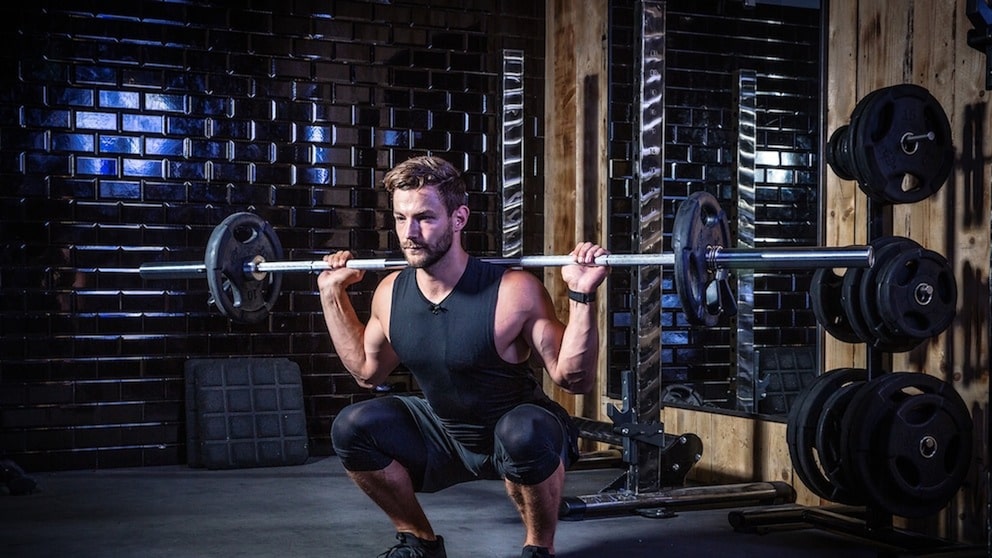
Squats are a prime example of full-body exercises that activate all the major muscle groups in our body: thighs, glutes, and core. For those looking to take it a step further, the back squat is the way to go. The barbell rests on the upper back, which not only increases intensity but also elevates body tension to a new level. The back squat is more than just a heavy counterpart to the free squat because it rewards with noticeable strength gains. A professional shows how to perform the exercise correctly.
Overview
Targeted Muscle Groups
Back squats are one of the most effective exercises for developing strength, muscle mass, and body stability. The exercise targets many muscle groups simultaneously, making it suitable for efficient training with visible progress. The muscles targeted, in order of intensity, are:
- Thigh muscles
- Gluteal muscles
- Core muscles
Calorie Burn Higher Than Many Other Strength Exercises
In back squats, the core muscles work significantly more than in the classic squat, allowing you to work on your six-pack. Because: Only those who tense their abdominal and back muscles can maintain the necessary body tension with additional weight. Additionally, the thigh and gluteal muscles are more heavily engaged, resulting in a higher calorie burn–of course, depending on the weight–than many other strength exercises.
How Much Weight Should I Add? Rule of Thumb
Barbells are, of course, not all the same weight. The classic studio version meets the Olympic standard and weighs 20 kilograms, though there are also 10-kilogram bars. Those trying the back squat for the first time should grab a course barbell and initially load it with two five-kilogram weights. You can find an overview of barbells here.
Once the technique is mastered, more weight can be added. The rule is: The barbell weight should be heavy enough that the last three to five repetitions in the third set become a real challenge.
Also interesting: How to perform deadlifts with a barbell correctly
Back Squats – Execution
“Squats are bad for the knees”–you hear that all too often. To these critics, we say: No! Squats are not harmful to the knee joints–if performed with the correct technique. Especially with additional weight–as in our video variant with a barbell–this becomes even more important. Incorrect execution can indeed lead to joint pain. Therefore, you should definitely watch the execution once with fitness professional Erik Jäger, now a coach at Peloton, in the video above.
Step-by-Step Guide: How to Perform Back Squats Correctly
- Starting Position
- The weight rests firmly in the neck-shoulder area
- The upper body is straight, and you grip the barbell with both hands as firmly as possible
- The feet are shoulder-width apart and slightly turned outward
- Lowering
- Now tighten the abs, and keep your gaze forward
- While taking a deep breath, slowly lower into a squat, keeping the upper body as straight as possible
- Push the knees outward while lowering and in the bottom position–and importantly: Keep the lower back straight!
- Ideally, go as deep as possible
- Keep the heels on the ground the entire time
Note: Do not initiate the movement with your knees! Instead, you should first bend your hips and slightly push your buttocks backward.
Note: If your knees extend significantly beyond your toes when lowering, your upper body is too far forward. Background: The center of gravity should always be on the middle to back part of the foot.
- Pushing Up
- With a straight back, push yourself powerfully upward
- Tighten the glutes
- Extend the hips
- Keep your gaze forward
- Repeat
Note: Often observed, especially among beginners, are knees buckling inward. This is usually due to a weak gluteus medius. This muscle is part of the glutes and is responsible for abducting the hip to the side. To specifically strengthen the muscle, we recommend bodyweight squats with a resistance band around the knees or side planks.
Optimal Number of Repetitions
The additional weight allows for targeted control of training intensity. For effective muscle growth, it is recommended to complete three sets of 10 to 12 repetitions. Take a short break between sets.
Also interesting: How to perform shoulder presses correctly

Landmine Squats: The Exercise for Ultimate Leg Muscles
Squats: Proper Technique and Variations for Advanced Practitioners
Other Squat Variants with Additional Weight
Landmine Squats (Lumberjack Squat)
In the landmine squat, also known as the lumberjack squat, a so-called “landmine” device is used: It allows a barbell to be fixed at one end while the other end remains free to move. Targeted muscles: thigh muscles, gluteal muscles, lower back. Secondary muscles: calves, shoulders, arm flexors.
Goblet Squats
In the goblet squat, additional weight is used–such as a kettlebell or dumbbell.
Targeted muscles in the goblet squat: thigh muscles, calves, gluteal muscles. Secondary muscles: shoulder girdle, biceps.
Conclusion
Back squats are one of the most effective exercises for developing strength, muscle mass, and body stability–ideal for anyone looking to become stronger in the long term. With moderate weight and proper technique, back squats are also doable for beginners. Especially with supervision or a structured training plan, you can progress in a controlled manner.