


November 28, 2026, 4:29 pm | Read time: 4 minutes
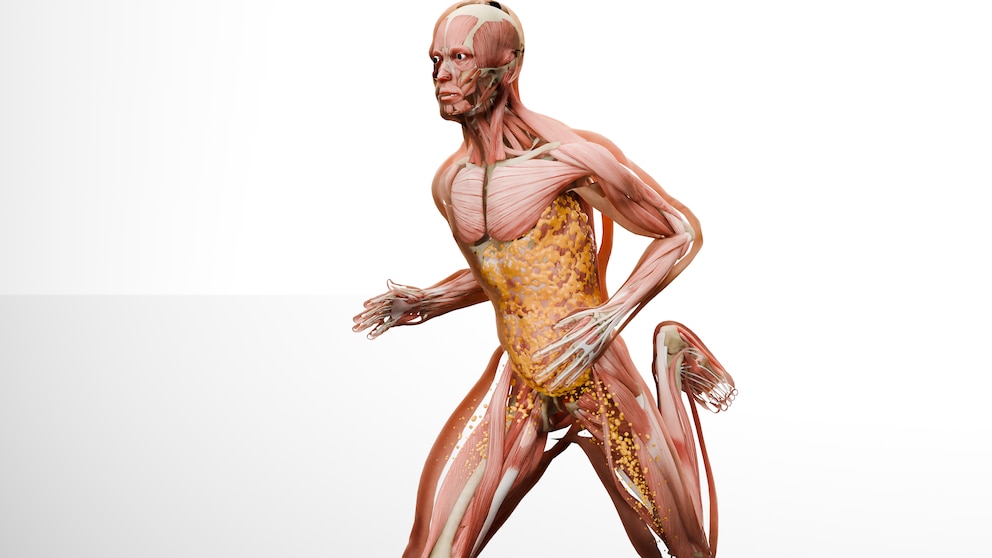
More than half of adults in Germany are considered overweight. Consequently, there is a high demand for weight-loss injections. However, researchers are actively seeking additional ways to treat obesity. One of these: our muscles.
Exercise can help with weight loss, but the effects on the scale alone are often disappointing. But what impact does muscle growth itself have on our body fat? Henning Wackerhage addressed this question during a lecture at the Fitness Science Congress at the IST University in Düsseldorf, which I recently attended. His topic: the effects of muscle growth against obesity. Wackerhage is a professor at the Technical University of Munich and, along with Hanna Taipaleenmäki, is a spokesperson for the DFG research group HyperMet, which, among other things, investigates how muscle growth affects our metabolism.
What Makes Muscles Interesting for Weight Loss
GLP-1 receptor agonists like semaglutide primarily target appetite and suppress hunger. The result: people eat less and lose weight. In the process, they lose not only fat but also some muscle mass. Simply put, about two-thirds of the lost weight is fat and one-third is muscle. Ideally, we would want to minimize this loss. The reason: muscles are important for our mobility and independence, and they also protect us from falls and contribute in many ways to our health.
What Animal Studies and a Drug Show
Interestingly, muscles also seem to play a role in fat reduction, as Wackerhage demonstrated in his lecture. In animal studies, fat mass decreased when researchers stimulated the animals’ muscles to grow. In humans, two manufacturer-funded studies point in a similar direction: In one, participants with type 2 diabetes and overweight or obesity received bimagrumab, an experimental drug that promotes muscle growth. They lost more than seven kilograms of fat and simultaneously gained lean mass, which includes muscles.1 In a second study, some participants received bimagrumab along with semaglutide. Less lean mass was lost compared to using the GLP-1 receptor agonist alone.2
However, neither study shows whether the fat actually decreased because of the additional muscles. What is clear is that the drug primarily acts on the muscle. The fat loss is currently considered a secondary effect.
“The Most Common Side Effects of the Weight Loss Injection”

The Effects of Pomegranate Extract on Muscles and Blood Vessels
The Sushi Bar Hypothesis
Wackerhage and his colleagues want to explore more precisely why muscle growth and fat loss coincide. As a possible explanation, Wackerhage mentions the Sushi Bar Hypothesis. “When the muscle grows, it must absorb so many building materials from the blood that less is left for the fat,” he explains to me. “It’s like a super-hungry customer at a sushi bar who takes almost all the dishes off the conveyor belt.”
Wackerhage also sees myokines as a possible explanation. These are signaling substances released by muscles that affect organs such as adipose tissue, liver, and bones. His second hypothesis: “The muscle releases a myokine that suppresses adipose tissue.” This is now being investigated.
According to Wackerhage, the Sushi Bar and Myokine Hypotheses are not mutually exclusive.
It is also interesting to consider whether a loss of fat increases hunger. This would at least be plausible, as Wackerhage explains to me. Because with less fat mass, less of the satiety hormone leptin is released. The result: appetite should increase until the fat increases again. “But it doesn’t seem to happen,” says Wackerhage.
Is Strength Training Alone Enough?
Of course, the question arises as to how effectively body fat can be reduced with strength training alone. An analysis of 114 studies with more than 4,000 overweight participants examined this. The result: Those who did only strength training lost about one kilogram more body fat on average compared to groups without training. In combination with a calorie-reduced diet, the difference was more than five kilograms, also compared to groups without training and without dietary changes. Remarkably, the lean mass, which includes muscles, remained almost unchanged on average.3
However, the analysis does not answer whether strength training specifically aimed at muscle growth enhances fat loss. This is exactly where Wackerhage comes in. He considers bodybuilders a “very interesting model”–not for health, but because of the observation that muscle growth stimulation can inhibit fat mass. Bodybuilders sometimes consume around 4,000 kilocalories a day during bulking phases, “and due to the strong muscle growth stimulation, the calories almost all bypass the fat tissue,” he says.
Now Wackerhage and his colleagues want to find out: Can targeted muscle-building training alone or in combination with drugs that promote muscle growth achieve a medically significant fat loss? And do the muscles remain intact or even grow?
For us, this means even today: Whether losing weight through diet or injections, one should do strength training. This way, not only are the muscles preserved, but a higher muscle mass also limits fat mass.