


November 30, 2025, 5:02 pm | Read time: 5 minutes
I’ve been going to the gym for about 25 years, and I’m pleased to see that since the turn of the millennium, much has changed in terms of equipment, design, and ambiance in gyms. They’ve definitely evolved from the muscle-bound places where women often only dared to enter aerobics classes or the cardio room. It’s now clear, thankfully, that women can and should do strength training for their health. And not just in women-only gyms. But is it possible that this hasn’t been considered in the development of gym machines? I occasionally get this feeling when using some equipment.
My strength training consists of a mix of home workouts and gym sessions. At home, I train with dumbbells and bands. The gym offers me the advantage of having machines available in addition to the free weights area for variety. It’s frustrating when I can’t make optimal use of this, especially when it seems that the machine’s design didn’t consider a woman’s anatomy.
Challenge: Crunch Machine
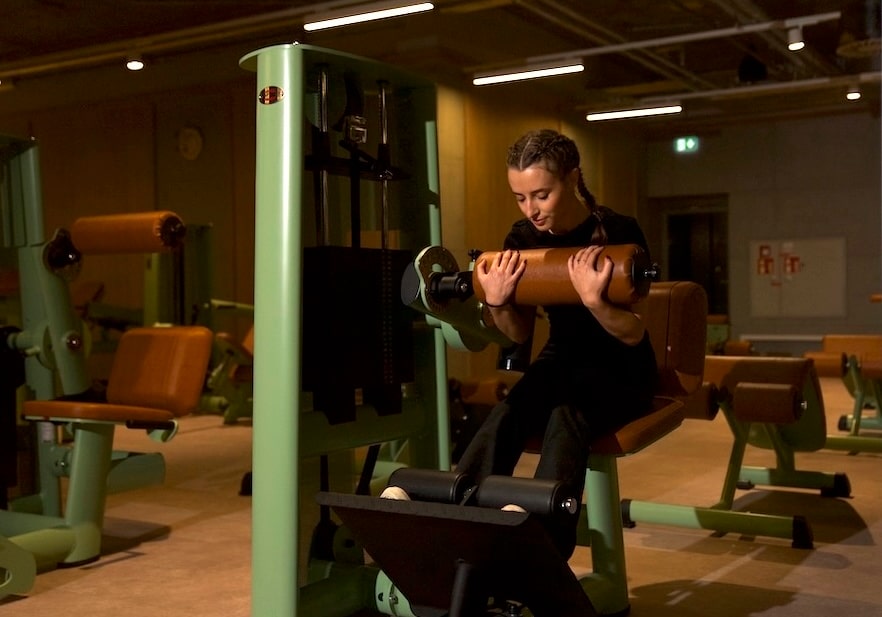
The crunch machine, which effectively trains the abs, comes to mind as an example. Instead of performing the crunch exercise on the floor, you do it on the machine with additional weight that can be adjusted as needed. The machine provides a type of bench or a slightly inclined seat. This is usually adjustable, allowing you to perform the exercise either more lying down or more sitting up. Once seated in the machine, you lean your chest against a designated pad, which you press down toward your legs during the crunch movement. The more weight you want to press, the more abdominal or core muscle strength is required.
Only Feasible with Chest Pain
Maybe not all women experience this, and perhaps some men know the problem too. The chest area is, after all, differently sensitive from person to person. But I believe it’s more likely women who struggle with this: The chest hurts from the pressure the pad exerts on it. It’s undeniable that women generally have more “in the way” in this body area, which can be squeezed by the pad, compared to men. This might sound odd, but I’ve looked at the pad and wondered: Why isn’t there an indentation inside so that people—regardless of chest size—are spared this uncomfortable to painful feeling? But joking aside: It must be possible to design a shape or use a material that is more comfortable.
Too Small for the Crunch on the Machine?
The machine, as a colleague explained to me, has another pitfall: It can’t be optimally adjusted for small people. When she uses the crunch machine, she can’t effectively press the pad down with her upper body. To achieve this, she has to compromise on proper execution technique, which increases the risk of injury and reduces the effectiveness of the exercise.
Back Machine—Again Painful Chest Pad
Another example of the incompatibility of the female chest and gym machines? A back machine. At this device, which was quite new in the specific gym where I trained that day, I observed something interesting. A woman wanted to try the new machine and sought advice from a trainer. Together, they tried to identify the optimal settings, weights, and execution for her. The machine is designed so that you lean your entire body at an angle against a pad while standing. The outstretched arms grab the levers and pull them, and thus the set weight, up to the body. It doesn’t sound complicated, but before the woman completed her training sets, I heard her say, “This hurts my chest.”
When I tried the machine myself, I concluded that the pain wasn’t due to setting too much weight. It wasn’t about chest muscle pain. The pain was again due to the pressure of the pad on the chest. I found this particularly uncomfortable when I leaned my entire body weight into the machine.
The trainer told me that he often hears from female clients that they avoid certain machines because they press uncomfortably on the chest area or can’t be optimally adjusted to their body size. He then likes to show them alternative exercises with free weights, but regrets that gym machines aren’t inclusive in that sense.

I have mixed feelings about women’s sections in the gym.
The 5 Most Important Strength Exercises for Men Over 50
It’s a Shame Not to Use Machines for Anatomical Reasons
Of course, there are worse things than not being able to use three out of maybe 20 machines due to chest pain. Although if I were a small woman, there would certainly be more machines I would be too small for. And, if we think further: You probably can’t be too tall for most machines either. Having “too much” body mass would certainly cause problems as well. And that applies equally to women and men.
Rethinking Standards
Surely: For mass production of products, you need a standard to follow. But shouldn’t this standard occasionally be checked for majority suitability? If, for example, in 2000, 90 percent of gym machine users were men, a “average man” might have been a suitable benchmark (apologies to all “too small,” “too tall,” and “heavier” men). But if the ratio is now possibly 60 percent men and 40 percent women, shouldn’t the standard be adjusted? Perhaps such an adjustment would quickly ensure that the gender ratio in the gym would soon be 50-50.
And another thought: Shouldn’t everything become more individualized? Individual training plans, individual prevention strategies, personalized nutrition, etc., aim to offer optimization possibilities for the individual. Moving away from “one size fits all.” How do gym machines that not everyone can use equally fit into this thinking? Perhaps the “gym of the future” should encompass more than individual advice from trainers—namely, machines that offer everyone the same training effect and enjoyment. I’m honestly curious to see what these might look like.