


July 26, 2025, 3:59 pm | Read time: 6 minutes
Reformer Pilates at home? I tried it out–with a towel, foam roller, and TRX.
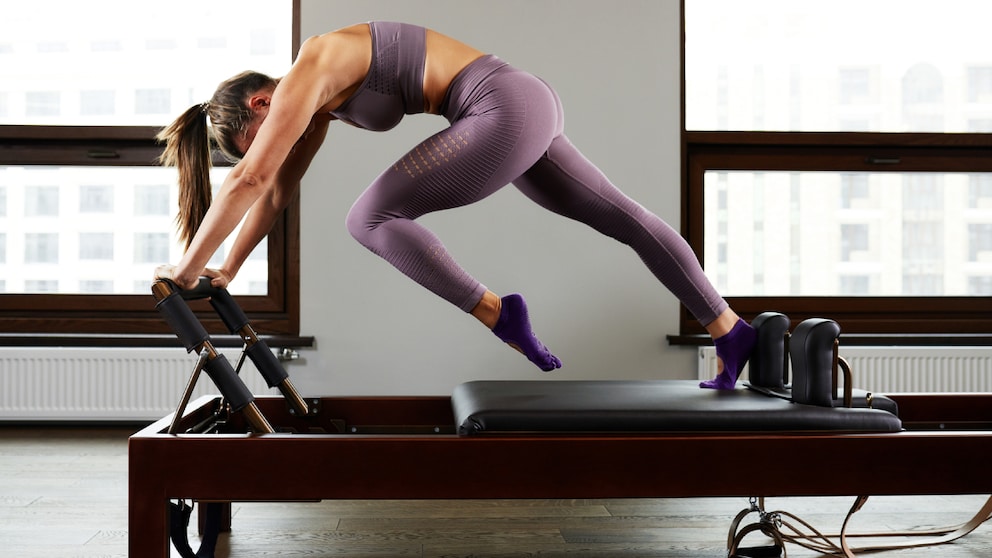
Reformer Pilates is booming. It’s no wonder, as few workouts are as gentle and stylish while simultaneously challenging the body to its core. It’s powerful, fluid, and somehow feels elegant–like dancing in slow motion, but with a lot of muscle work. Add to that the community and the beautiful atmosphere in the studios. Personally, I love it. One thing that bothers me despite all my affection is the whole effort involved: first driving to the studio, then back, all for just under an hour of training, which at around 35 euros isn’t exactly cheap. As good as the workout is, Reformer Pilates doesn’t lure me in regularly.
But maybe you don’t need to go to a studio for Reformer Pilates. Can’t you somehow train Reformer Pilates at home–without the expensive equipment? According to YouTube, it’s possible. If you search for “Reformer Pilates at home,” you’ll find a whole world of towels, resistance bands, foam rollers, and even TRX bands as answers. I took a closer look at four workouts for FITBOOK and dared to try them myself.
10-Minute Reformer Inspiration–with Towels
My first video is a Pilates quickie: The Reformer Pilates workout by Fitness Queen Lilly Sabri for home lasts just ten minutes, where you replace the reformer carriage with two towels. These are placed under your feet, and off you go. The workout consists of exercises like side lunges, planks, and controlled lunges, where the towels on the floor serve as resistance. At first glance, it looks a bit silly, but it’s much more challenging than expected. The slow, controlled movement demands a lot from my muscles–especially in the thighs and core. I have to keep reminding myself not to slump in my posture. Ten minutes later, I’m done and feel nicely refreshed. This training quickie can’t compete with an hour on the reformer, but as a quick, active start to the day, a short break from the desk, or a brisk add-on after running, the workout is great.
30-Minute Power Pilates with the Foam Roller
After my first positive Reformer home workout experience, I dared to try Fitness Influencer Marie Steffen’s workout. Her workout is longer at 30 minutes. A foam roller is used as a tool, serving as the base. The exercises range from classic side planks to glute bridges and controlled lunges. The foam roller is placed under the back, feet, or hands, depending on the exercise, making the workout literally on shaky ground. This challenges the deep muscles and makes the workout significantly more intense. I catch myself wobbling several times–especially with the one-legged variations. The slow pace requires constant tension throughout the body and is more strenuous than I thought. Although the movements seem familiar, they gain a new dimension through the unstable element. The workout feels structured, challenging, and surprisingly “reformer-like”–at least in terms of muscle activation.
TRX Meets Pilates–Controlled Burn for Advanced Users
I’ve owned a TRX suspension trainer for a while. When I first tried Reformer training, I immediately noticed that the straps could be used similarly to the bands on the reformer. Apparently, I’m not the only one who noticed this; on YouTube, several fitness influencers had already come up with the idea of doing a “Reformer Pilates” workout on the TRX. I chose a workout that at first glance doesn’t seem like a big highlight: no fancy background, no music, no timer. Just the suspension trainer and an athlete who doesn’t introduce herself by name or try to be the center of attention. She doesn’t need to, because the workout speaks for itself. The training begins with one-legged lunges, moves into planks with hovering feet, and ends with controlled holding exercises where I feel like I have to activate every muscle fiber. The suspension trainer is used in such a way that the muscles are both stretched and strengthened. During the hovering exercises, the core is constantly challenged–without tension, you immediately sink. I notice how my abs have to work and my shoulders want to tip forward. I stay strong and feel every single muscle fiber at the end of the 45-minute workout. The TRX workout is the most technically demanding of the four tested video workouts. It requires a lot of body control and is probably not ideal for beginners. But: The movement patterns really strongly resemble the reformer or a Pilates Cadillac.
What TRX Pilates Is and How Effective It Is

How I Prepared for My Crossing of the Alps
Reformer Pilates on the Mat
Last but not least, I try a 35-minute video from “PilatesBodyRaven.” The title promises “Reformer on the Mat”, without a reformer. Instead, the main roles are played by a Pilates ball and a small dumbbell. The workout is calm, thoughtful, and follows a clear structure. Squats, lunges, one-legged exercises, and controlled movements where the tools deliberately contribute to instability. The exercises aren’t particularly complex, but the slowness and focus on technique make it increasingly strenuous. I feel like I’m in a real Pilates class–though the breathing is too neglected for my taste.
How Effective Are the Reformer Alternatives Really?
And that brings us to the crux: In all the videos, I notice that the breathing, control, and core of Pilates, the “powerhouse,” are often only mentioned in passing or not at all. Yet breathing is a central component of Pilates–especially on the reformer. The combination of inhaling into the side ribs and exhaling during power phases not only supports movement but also the deep muscles. Without this element, the training often feels more like a classic bodyweight workout, which certainly has its place, but isn’t Pilates.