


April 30, 2026, 11:55 am | Read time: 5 minutes
Today, nothing reminds us that Pilates was once developed as a rehabilitation program for soldiers. The trendy sport is considered an elegant, almost luxurious workout—somewhere between yoga, strength training, and Instagram aesthetics. I tried Reformer Pilates for the first time at 30 and now share my experience. Amid scrunch leggings and grip socks, one question quickly arose: Is this really a sport, or more of a pastime?
Before the Workout: Don’t Forget Your Socks!
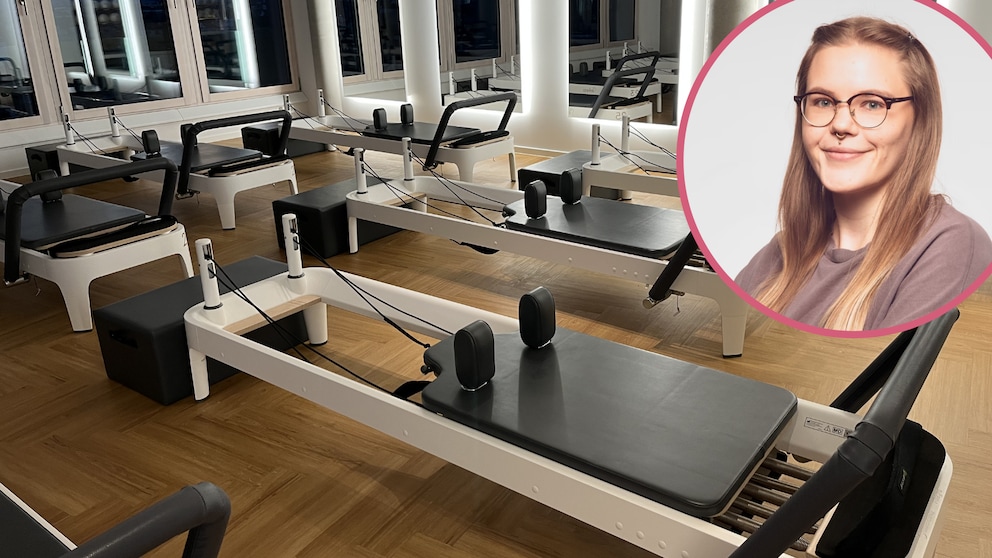
I tried Reformer Pilates for the first time at 30—in Berlin, on the eighth floor of a studio overlooking the city. The setting alone makes it clear: This is not a classic sports class, but a complete package of fitness and modern aesthetics. At the end of the session, there’s a sunset instead of neon lights.
What’s important to know at the start: You can only use the Reformer—a training device with a movable platform (carriage), loops for hands and feet, a footbar, and various springs to adjust resistance—with non-slip socks. You can buy a pair of Pilates socks for a steep 15 euros at the studio—luckily, a friend lent me hers. I wanted to test first if this sport was for me.
Although I booked a beginner’s course, there was still a slight uncertainty. How complicated is this device, really? Is the workout challenging enough? Will I get bored, or will I overestimate myself and embarrass myself among the stylish participants in their cherry-patterned socks and scrunch leggings, who looked like they weren’t lying here for the first time?
My First Thought on the Reformer: Big Toy
Right at the start, I had my first problem: The footbar should be adjusted to your height. Of course, it got stuck for me. At least I quickly got help, and no one looked overly annoyed. Suddenly, this new, monstrous device wasn’t so intimidating anymore.
Overall, my first thought about the Reformer wasn’t: fitness machine from hell. Rather: big toy—in the best sense. You can do an incredible number of exercises with it, constantly changing, pushing, pulling, adjusting, and hooking. For me, it was like gymnastics for adults—just stylish. You quickly realize how many possibilities the Reformer offers once you get familiar with it.
Footwork, Frog Position, and Burpees: It Doesn’t Get Boring on the Reformer
We started with footwork. It sounds harmless at first, but felt very unfamiliar: Lying on our backs, we placed our feet in different positions on the footbar, including the “Pilates V” or legs in a kind of frog position. It quickly became clear why Pilates constantly talks about the powerhouse. The abdominal muscles are actually working all the time. Especially because you lie on your back so often, the core is permanently active, even if it looks more relaxed than it is.
A nice side effect: Lying on your back looking at the ceiling, you can’t catch yourself watching other participants or feel watched—instead, you’re one hundred percent focused on the correct execution and breathing.
Later, much more dynamic exercises were added. We had loops on our feet and made large circles with our legs in the air, went into stretches, and even burpees were part of the session, with a box on the carriage to prevent feet from slipping. Although the beginner-friendly resistance settings were very manageable, pulsating or unilateral movements made it quite intense.
Breathing Was More Present Than I Thought
Breathing was more present than I thought. At the beginning of the session, we practiced “Pilates breathing.” Inhale deeply and exhale as if blowing out a candle—honestly, I couldn’t see a difference from yoga breathing. At first, you should even feel your own ribs to see how the breath spreads.
Does Reformer Pilates Work at Home Without Expensive Equipment? I Tried It
Pilates for Beginners: 5 Exercises You Can Do Correctly Today
The Most Surprising: How Safe and Challenging the Workout Felt
What I found particularly interesting: Despite the device’s complexity, I felt surprisingly safe during the session. You’re stable thanks to the shoulder pads, receive precise instructions on breathing, and even on how to sit or stand correctly when you need to adjust something.
Perhaps that’s part of the appeal. Reformer Pilates is challenging but not hectic. It’s strenuous, but not so much that you just want to get through it. There are always brief moments to catch your breath, which I personally used to comfortably rest my feet on the footbar.
Is the Hype Justified? For Me, Yes
Admittedly, I didn’t think I’d report so positively. After a brief test at FIBO, I had filed Reformer Pilates under “quite nice”—but not really challenging. Yet Reformer Pilates is demanding, but not frustrating. And above all: not boring at all. I didn’t expect that! I will definitely go again. Also, because I feel there’s much more potential: Once you know the device better, master the settings more confidently, and work more precisely with the springs, the workout can certainly be more demanding. For me, it doesn’t replace strength training at the gym, but it’s a welcome change or supplement when I’m in the mood for a calm, controlled workout.
Moreover, I really had doubts beforehand about whether I would feel comfortable in this setting, whether Reformer Pilates would give me enough, and whether the hype might be bigger than the effect. For me, all of that dissolved during the session. And honestly, I’d go a step further: I think more people should try Reformer Pilates—even those who don’t see themselves in the typical Pilates target group. In my class, there were at least two men for the quota—and there could be more. The more people who aren’t put off by the Instagram aesthetic, the better. Because behind the fancy facade lies a surprisingly versatile training that is fun.