

September 25, 2019, 3:03 pm | Read time: 3 minutes
Extreme and intense–that’s how head coach Erik Jäger describes the effect of leg raises on the rectus abdominis. However, a common mistake not only negates this effect but also strains the intervertebral discs. Here’s how the strength exercise works.
You’ve probably tried leg raises while lying on your back. Understandably so, as it’s one of the most effective exercises for the rectus abdominis without being particularly complicated. But simplicity can be deceiving. Under no circumstances should you rush through leg raises–for the sake of your intervertebral discs!
In this video, head coach Erik Jäger shows what to focus on when performing this popular bodyweight exercise. He also explains which variations particularly target the rectus abdominis, which is divided by three to four tendinous intersections.
These Exercises Are Shown in the Video
Pre-exercise: Lie down with your legs bent, inhale deeply into your abdomen. As you exhale, tense your abdomen.
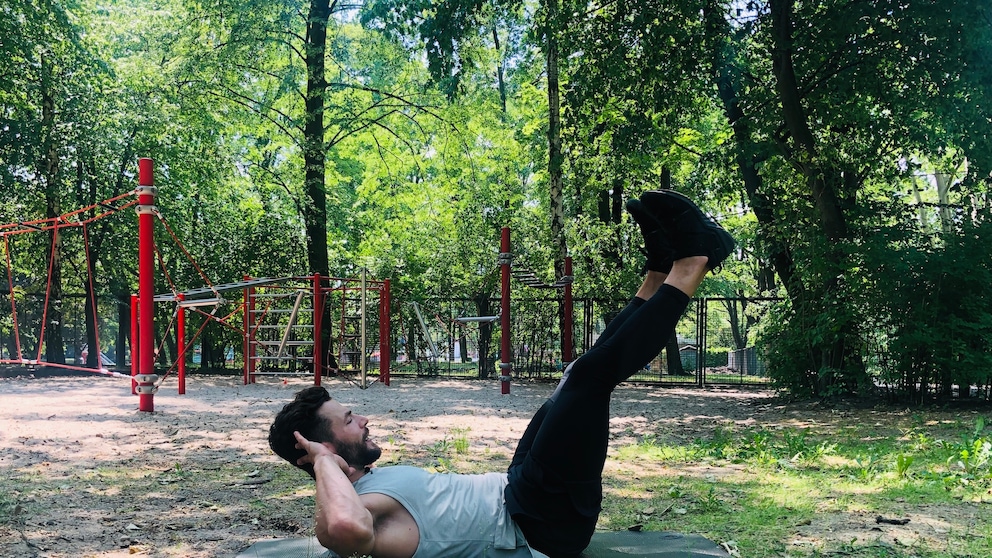
Level 1: The lower back should be completely on the floor. Now stretch both legs upward–as far as possible without pulling on the lower back. The arms rest loosely beside the body. Raise the upper body so that the shoulder blades no longer touch the floor. Now slowly push one leg forward while keeping it straight and then pull it back. The other leg remains up.
Also interesting: FITBOOK explains the best way to a six-pack
Level 2: If you’re confident at the previous level, place your hands behind your head. Be sure to keep the shoulder blades lifted and not touching the floor. The lower back, however, should be pressed firmly onto the mat.
Level 3: In this extremely intense variation, the legs are slowly lowered simultaneously (take 5 to 6 seconds). Caution: This variation is only executed correctly if the lower back remains in contact with the floor the entire time. This requires a high degree of core stability–which some may lack.
Only practice Level 3 if your back stays on the floor–any form of arching strains the intervertebral discs, but not what you actually want to train with the exercise: your abdominal muscles.
Alternative Exercise Series for Low Core Stability
Level 1: Keep your legs bent, draw in your abdomen, and press your hands against your thighs. Hold for several seconds multiple times.
Level 2: From the previous position, open one side of your body. Extend your right arm and right leg simultaneously backward and forward, then close them again, while keeping your left hand firmly pressed on your left thigh.
Also interesting: These two exercises train the core muscles

Are Sit-ups and Crunches Really Ineffective Ab Exercises? Here’s What the Expert Says

Effective Bodyweight Exercises for a Slim Waist
How Many Repetitions Does the Expert Recommend?
According to Erik Jäger, you should do at least 10 repetitions per side, ideally extending to 3 to 5 sets. For static exercises, try to hold the position for at least 20 to 30 seconds.
Also interesting: The best strength exercises at a glance
In Between: Stabilization Exercises
Leg raises, as well as other targeted abdominal exercises, make stabilization exercises necessary from the expert’s perspective. These strengthen the lower back and prevent the formation of an arch. Head coach Erik Jäger advises holding the following position for 20 to 30 seconds: lift your knees a few centimeters from the quadruped position (crawl position). Tilt the pelvis forward so that the back arches slightly upward.