


September 13, 2026, 1:00 pm | Read time: 5 minutes
The days of classic sit-ups and crunches are over: Functional ab training challenges the abdominal muscles in a varied way while also making the whole body sweat. Personal trainer and FITBOOK fitness expert Alina Bock demonstrates five functional abdominal exercises that effectively train the core.
Functional ab training not only strengthens the abdominal muscles but also engages multiple muscle groups simultaneously. This can improve core stability, coordination, and balance. Instead of isolated, uniform movements, dynamic and functional exercises are the focus, challenging the entire core.
5 Functional Ab Exercises at a Glance
1. TRX Pike
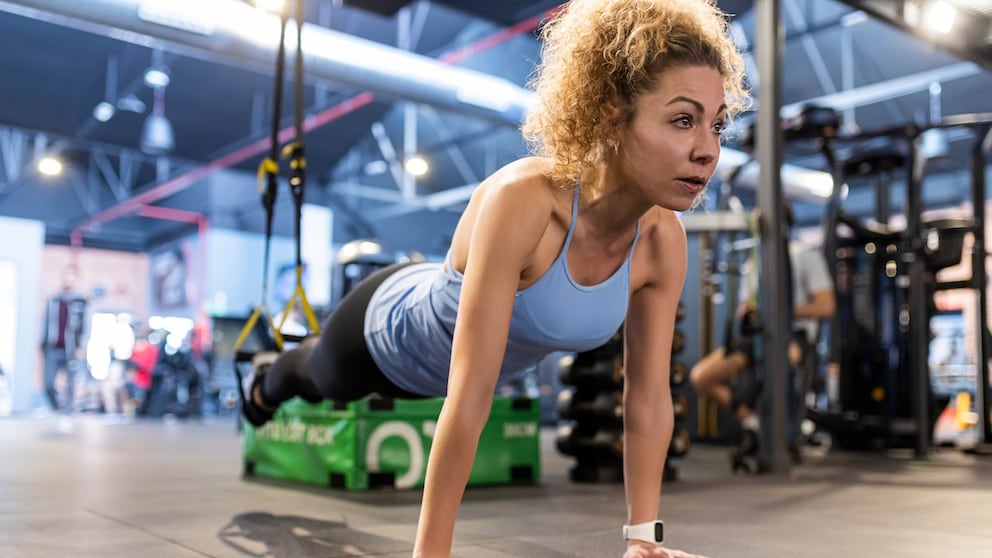
Let’s start with the TRX Pike. This exercise requires a sling trainer, also known as TRX. Begin in the plank position, with hands directly under the shoulders. Then, place your feet in the loops of the sling trainer and tighten your abdominal muscles.
From this position, pull your feet toward your chest while simultaneously pushing your hips upward, forming an inverted V with your body. Hold the end position briefly, then slowly and controlled return to the starting position. The slower and more controlled the movement, the more intensely the abdominal muscles work.

2. Mountain Climber on TRX
The sling trainer is particularly well-suited as training equipment because the unstable loops constantly force the body to stabilize the position. This especially engages the deeper core muscles. For the Mountain Climber on the TRX trainer, start in the plank position, just like with the TRX Pike. Place your feet in the loops and tighten your abdominal muscles.
Then, alternately pull your knees diagonally toward your chest. To increase intensity, you can briefly hold the end position before returning the leg in a controlled manner. The key is not speed: It’s more important to maintain body tension and control throughout the movement. Therefore, perform the exercise slowly and deliberately.
3. Core Rotation Slam
This exercise requires a sturdy wall and a weight or medicine ball. Start about a meter away from the wall, facing it. Stand with feet shoulder-width apart and knees slightly bent. This position ensures a stable stance throughout the exercise. Hold the weight or medicine ball at chest height with both hands.
Now, slightly rotate your upper body to the right and bring the ball close to your body toward your hip. Your head follows the movement of your upper body. Then, explosively throw the ball against the wall from the rotation. At the end of the throw, your upper body should face forward again. Exhale during the throw.
Catch the ball as it bounces back from the wall and rotate your upper body again. Then immediately follow with the next throw. After 12 to 15 repetitions, switch sides.
Throughout the exercise, actively engage your core muscles and maintain a stable posture. The movement should be controlled from the core. If body tension decreases or the movement can no longer be performed cleanly, reduce the weight or stop the exercise.
4. Hanging Leg Raises with Resistance Band
For the next exercise, head to the pull-up bar. Start by hanging. A resistance band, in this case, a loop band, is placed around both feet. Slightly flex your toes to prevent the band from slipping during the exercise.
Now, pull your right knee toward your upper body in a controlled manner. Keep the left leg straight, maintaining tension in the resistance band. Then slowly extend the right leg again and switch sides: Now bring the left knee to the upper body while keeping the right leg straight. Alternate the movement until each knee has been brought to the upper body 12 to 15 times.
5. Standing Oblique Crunch on Step
The following exercise not only challenges the abdominal muscles but also gets the cardiovascular system going through its dynamic execution. The oblique crunch begins standing in front of the step. The height of the step can be adjusted depending on the desired intensity. Bend your right arm and place your right hand behind your ear.
Now step onto the step with your right foot and lean your upper body slightly forward. Then dynamically pull your left knee toward your right elbow. Place your left foot back on the ground without touching the step, and immediately bring the knee up again.
To keep the pace and intensity high, only let the left toes briefly touch the ground between repetitions. After at least 15 repetitions, switch sides.
What Studies Show
That exercises on the sling trainer challenge the abdominal muscles is also measurable. An Italian study in the “Journal of Human Kinetics” had 17 physically active men perform four typical sling exercises—including the pike—and recorded the activity of the rectus abdominis, oblique muscles, and back extensors using electromyography.1 All four variations significantly activated the abdominal muscles. However, the highest values for the rectus abdominis and external oblique muscles were not achieved by the pike but by the roll-out. So, if you want to increase intensity, the sling trainer offers room for improvement. A limitation: The study included only a few, exclusively male participants and measured muscle activity at the moment of execution—not the long-term training success.
The idea that it’s beneficial to challenge the core in a varied way is also suggested by a systematic review in the “International Journal of Environmental Research and Public Health.”2 The authors evaluated studies on the electrical activity of six core muscles during various fitness exercises. Their conclusion: No exercise category is superior to all others. The rectus abdominis, external oblique muscles, and back extensors worked most during free weight exercises; the internal oblique muscles during core stability exercises; and the deep-lying multifidus during classic exercises. So, a mix is worthwhile for a stable core.