

September 7, 2026, 1:37 am | Read time: 8 minutes
It is the most important muscle-tendon cuff in the body and one of the most sensitive: the rotator cuff. According to orthopedic chief physician Thomas Kälicke, it determines whether you can still lift weights and carry groceries at 70. He warns: Those who do the wrong exercises in the gym at 30, 40, or 50 risk the tendon not recovering over time. Which exercises these are—and what he includes in training instead—he explains on FITBOOK.
Rotator Cuff = Most Important Muscle-Tendon Cuff
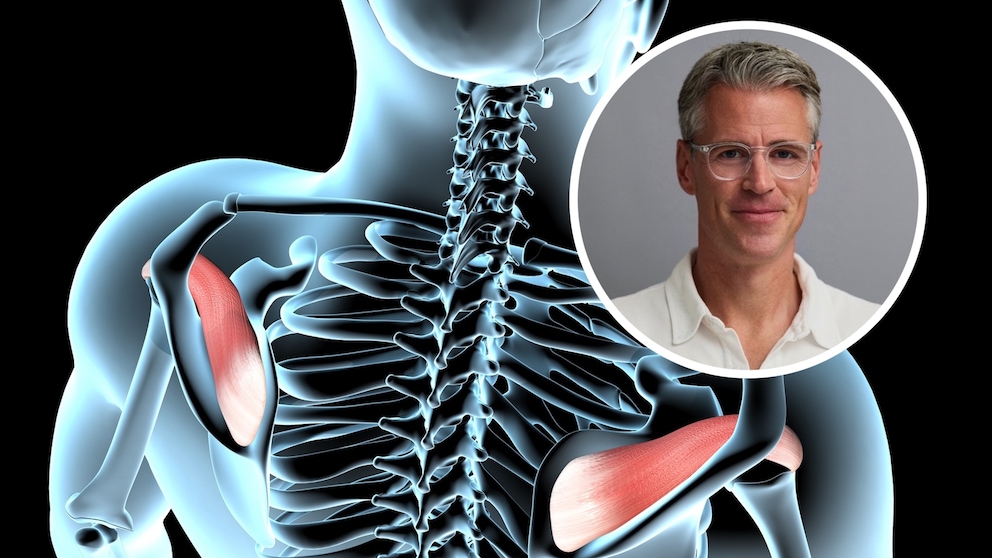
The rotator cuff is a muscle-tendon cuff that wraps around the head of the upper arm like a hand around a ball. The associated muscles originate at the shoulder blade and extend from there to the upper arm. This cuff has more than one job: It rotates the arm inward and outward. It also initiates the lateral abduction of the arm before the powerful deltoid muscle takes over and moves the arm further upward. What is often underestimated: The cuff centers the head of the upper arm in the joint socket. The shoulder joint is the most mobile joint in the body and is hardly guided by bones. What holds it together is soft tissue. If the cuff fails, the shoulder loses its anchor.
The rotator cuff consists of three tendons: supraspinatus, infraspinatus, and subscapularis. Teres minor and teres major are also significant. Additionally, the latissimus, deltoid muscle, and biceps play a role. They help determine how the head of the upper arm is positioned in the socket.
The supraspinatus tendon is particularly at risk. It runs over the upper edge of the head of the upper arm, and directly above it is the acromion, the shoulder roof, as a bony boundary. The gap between them is called the subacromial space—the space under the shoulder roof. How wide this space is varies individually. It is usually over seven millimeters, often around one centimeter. Sounds comfortable. But it is not when you consider that a tendon, a bursa, and the long biceps tendon run through this gap—with every single arm movement.
Why the Shoulder Roof Becomes a Problem Over the Years
Bone is built up and broken down throughout life. And the shoulder roof changes its shape in the process. In young years, it is usually straight; with advancing age, it often becomes arched and forms a kind of spur at the front. The result: The space becomes narrower, and shoulder impingement syndrome can develop. When moving, a part of the tissue—often the supraspinatus tendon—is pinched between the head of the upper arm and the lower edge of the acromion.
For a long time, this does nothing, but over time it leads to damage to the tendon, up to a tear in the rotator cuff. Like a climber hanging on a rope that constantly rubs over a rock edge. First, fibers come loose, and eventually, the rope breaks. The consequences of a rotator cuff tear can be severe—but they don’t have to be. In autopsies of 80-year-olds and older, many such tears have been found without ever having become symptomatic. This is partly because the deltoid muscle can sometimes compensate for the torn tendon.
Tear of the Rotator Cuff–I Am Particularly Alarmed in Young Patients
However, if such a tear occurs at a young age, cuff arthropathy—premature wear of the shoulder joint itself—threatens. The rotator cuff can no longer keep the head of the upper arm in position relative to the joint socket. Osteoarthritis develops. If the process progresses long enough, the problem may only be resolved prosthetically. That’s why, as an orthopedist, I am much more alarmed by rotator cuff damage in young patients than in 80-year-olds.
The good news: If you train sensibly, you can avoid or even prevent the development of impingement syndrome and a subsequent tear.
The Underestimated Factor: Over the course of life, many people become more hunched from prolonged sitting in a bent posture. This further narrows the subacromial space and promotes impingement—in healthy individuals as well as those with rotator cuff problems. The office chair is thus indirectly a risk factor for the shoulder.
These 3 Exercises Are Rotator Cuff Killers–I Avoid Them in the Gym
The head of the upper arm is not completely round. The supraspinatus tendon ends at a bony prominence, the greater tubercle. If I rotate my arm inward and then lift it sideways, the tubercle comes forward—and the subacromial space becomes maximally narrow. The attachment of my supraspinatus tendon then experiences a “squeeze” with each repetition. That’s not good in the long run. And that’s exactly how you can recognize the typical rotator cuff killers!
1. Face Pull
Cable pull at head height, pull to the face—as seen in almost every gym, namely with internally rotated arms. This lands you exactly in the position that narrows the subacromial space the most: arm raised, upper arm rotated inward. For me, the face pull in this execution is a no-go. If you love the exercise, you should at least know: The variant where the upper arm is actively rotated outward at the end of the movement (forearms move upward, “W-position”) puts significantly less strain on the bottleneck. I still leave it out—there are better ways to target the rear shoulder.
2. Lateral Raise with Internally Rotated Arms
The classic execution is “as if you wanted to empty a bottle”; it’s not called Empty Can for nothing. This is where the squeeze effect at the greater tubercle fully kicks in. This is well-researched: In direct comparison with the Full-Can variant (thumb pointing up, arm slightly externally rotated), the Empty-Can position provokes more pain and unfavorable movement patterns at the shoulder blade. My advice: Lateral raise yes—but preferably not with an internally rotated arm. Thumb up or neutral, and not significantly above shoulder height.
3. Incline Bench Press
In the incline bench press, the upper arm is brought into a position where the subacromial space becomes narrow and the front shoulder capsule is put under tension. I am very cautious with it. If you can’t do without the incline bench press, you should perform it with free weights and clean technique. In my experience, you tend to rotate outward, and the space becomes less narrow than on guided machines.
Patients with Impingement Syndrome Should Avoid These Exercises
For patients who already have impingement syndrome, I advise initially avoiding these two exercises because they tend to pull the head of the upper arm upward and thus narrow the subacromial space:
- Bicep curls: The long biceps tendon runs through the shoulder joint and ends above the joint socket. It is directly involved in the process.
- Deltoid muscle training: The shoulder cap muscle also pulls the head upward.
How I Train the Shoulder Depressors
The antagonists that pull the head of the upper arm downward and thus create space are often forgotten because they are hardly visible. No one gets compliments for a well-trained subscapularis. The shoulder doesn’t care.
This is how I train them:
External and internal rotation of the arm bent at the elbow at 90 degrees against resistance. I tell my patients: Take a resistance band and hook it into a door handle.
- External rotation: Stand with one side of the body to the door, upper arm close to the body, rotate the forearm outward against the band pull.
- Internal rotation: Turn around, other side to the door, rotate the forearm inward toward the stomach.
The elbow remains at the body—it’s best to clamp a rolled-up towel in between. Light resistance, clean execution, calmly—two to three sets of 12 to 15 repetitions, several times a week.
Overhead Press: Sculpt Your Shoulders with Dumbbells

8 Effective Cable Exercises for a Strong Upper Body
Very Important: the Reverse Butterfly
Also crucial is the reverse butterfly and training the upper rear back muscles. These muscles straighten us up and counteract the forward-oriented everyday life. This can help us to set the acromion back to a horizontal position in the neutral position—or to permanently prevent us from becoming hunched. Which in turn means: more space under the shoulder roof. Rowing, face-pull alternatives like the reverse fly on the cable, and exercises for the scapular stabilizers should be part of every reasonable upper body program.
My Conclusion
Caring for the rotator cuff is important—more important than most people in the gym believe. It helps determine whether you can still lift weights and carry groceries at 70.
The short version:
- Train smart! Technique before weight, always!
- Consistently include the shoulder depressors in your training. External and internal rotation with the band, even if you can’t see them in the mirror.
- Biceps and deltoid training are usually possible without problems
- Face pulls in the internally rotated standard execution are a no-go in my view
- Lateral raise yes—but preferably not with an internally rotated arm
- Be very cautious with incline bench press, and if you do it, use free weights
- Reverse butterfly and upper back should be in every program
Those who follow these points do more for their shoulders than any ointment—and maintain the prerequisite for doing strength training that keeps them vital in the long term.