

April 25, 2026, 4:10 pm | Read time: 4 minutes
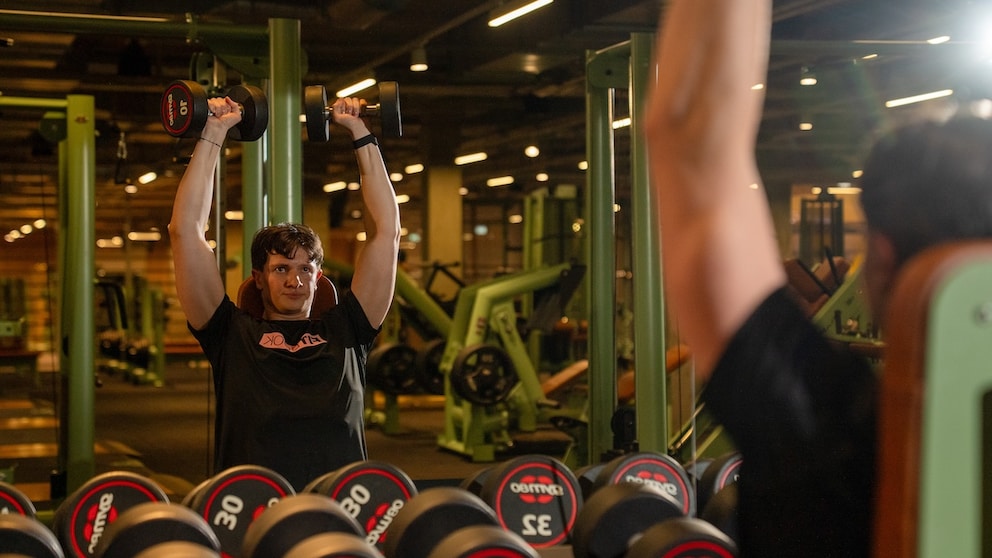
Shoulders are the main carriers of an impressive physique. A pronounced shoulder-to-hip ratio is considered an ideal for attractiveness worldwide, but trained shoulders also provide a foundation that helps you better navigate daily life. In this context, FITBOOK editor Michel Winges introduces you to the dumbbell shoulder press exercise.
Follow the FITBOOK channel on WhatsApp now!
Why Everyone Should Train Their Shoulders
Aesthetics and Body Proportions
The so-called shoulder-to-hip ratio is a global ideal for attractiveness, and this is not just “gym talk” but also scientifically observed. For example, a study measured the brain activity of participants while they assessed different body proportions and came to a clear conclusion.1 Both men and women found bodies with a larger shoulder-to-hip ratio more attractive, regardless of the gender of the person being assessed.2
Another study, published in the Journal of Social and Personal Relationships, specifically examined which body proportions people prefer when choosing a romantic partner.3 And here, the same result as before–men with the same trait were significantly more desirable to a potential partner.
The reason for this can likely be explained by evolution. Broad shoulders signal strength, health, and dominance–traits that the human mind has associated with a good partner for millennia. These preferences are mostly unconscious but are deeply rooted in the human brain.
Improving Daily Life–Functionality & Injury Prevention
But it’s not just about appearance and attractiveness. Of course, trained shoulders also provide functionality in everyday life and contribute to injury prevention.
Injury Prevention
The shoulder joint is a so-called ball-and-socket joint. However, the unfortunate characteristic of ball-and-socket joints is that they are naturally unstable due to their enormous mobility. The surrounding shoulder muscles act as active stabilizers, keeping the head of the upper arm securely in the socket. Strong shoulders and a well-trained rotator cuff form a protective muscle shield that can protect the joint from injuries such as dislocation.
Functionality
In everyday life, you constantly need to lift, carry, or store things overhead–and this works so well thanks to the shoulder muscles. The overhead press primarily trains the deltoid muscle, triceps, and trapezius–or simply the trapezius. To keep you stable, the rotator cuff and serratus anterior muscle assist. The great thing about this exercise is that it not only builds muscles but also improves your posture and increases functional strength throughout the upper body.
8 Effective Cable Exercises for a Strong Upper Body
Headline: Chief Physician: “As an Orthopedist, I Consistently Avoid These 3 Exercises at the Gym”
The Correct Execution
Assume Position
- Sit upright on a weight bench with the backrest set vertically. Grab two dumbbells and first place them on your thighs. Use momentum from your legs to bring the weights up one at a time to the starting position at shoulder height.
- Keep your back in contact with the backrest throughout the exercise, maintaining a slight, natural arch in the lower back. Pull the shoulder blades slightly back and down to stabilize the joint.
Movement Sequence
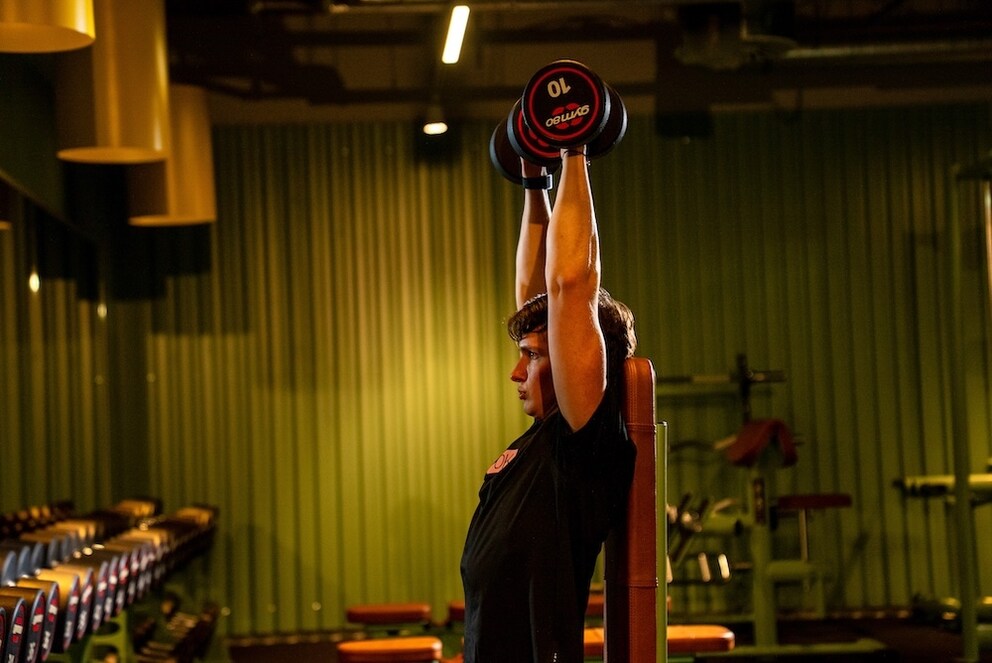
- Press the dumbbells from the starting position upward in a controlled and powerful manner. The movement follows a slight arc until the arms are almost fully extended, without locking the elbows at the top. Make sure the dumbbells don’t collide at the top.
- Briefly stabilize the weight at the highest point, then slowly and deliberately lower it again. Lower the dumbbells until they are back at shoulder height or almost touching the shoulders. Keep the forearms perpendicular to the ground throughout the phase.
- Maintain firm body tension throughout the execution and avoid excessive arching of the lower back.
Exhale when pressing the weights up and perform a controlled inhalation when lowering them.
Also interesting: What to focus on when doing incline bench presses with dumbbells
Is Choosing Dumbbells Better?
Probably yes, because dumbbells allow for more targeted activation of the shoulder muscles and a significantly greater range of motion. While the barbell is often limited by contact with the body, the dumbbell allows for deeper stretching in the lower phase and a converging path at the top. This bringing together of the weights allows for maximum “squeeze” of the muscle, which can stimulate hypertrophy more strongly. Additionally, dumbbells promote a more natural execution in the so-called scapular plane (elbows about 30 to 45 degrees forward), which protects the wrists and minimizes the risk of injury. Another crucial advantage is that each arm moves an independent weight. This corrects strength asymmetries and challenges the stabilizing muscles and core much more than the rigid barbell.