


August 15, 2025, 6:04 pm | Read time: 5 minutes
Boost your Booty! A well-shaped butt is high on the list of fitness goals for both men and women. Not just for aesthetic reasons, but also because the gluteal muscle is one of the largest in our body. But which exercise is best for the butt? A study now provides a surprising answer.
Follow the FITBOOK channel on WhatsApp now!
Squats – One of the Most Effective Full-Body Exercises
Much like a six-pack, a well-shaped butt is not only nice to look at but also exudes vitality. After all, it is, alongside the large back muscle (latissimus dorsi), the largest muscle in our body. The gluteus maximus is crucial for stabilizing the hip joint (as the strongest extensor) and is also responsible for the external rotation of the thighs. It is involved in almost every walking movement, running, and cycling, but especially in climbing stairs and walking uphill. However, pure endurance sports and many steps won’t enlarge the gluteal muscle. Specific strength exercises are needed for that. But which exercise is best for the butt? Researchers have investigated this in a study, comparing the squat with the hip thrust.
Squats are classic strength exercises—and rightly so. As a compound exercise, squats train several large muscle groups of the body simultaneously:
- Quadriceps
- Hamstrings
- Gluteus maximus
- Calves
- Lower back
Particularly for strengthening the leg and gluteal muscles, squats with a barbell on the shoulder blade are ideal. Because squats train these large muscle groups, they boost metabolism. This not only results in strong legs and a firm butt but also burns a significant amount of calories, aiding in fat loss. That’s why squats are rightly considered one of the most effective full-body exercises.
Also interesting: What do you think is the most common cause of injuries in the gym?
Hip Thrust – The Hip Thrust as a Trend Exercise
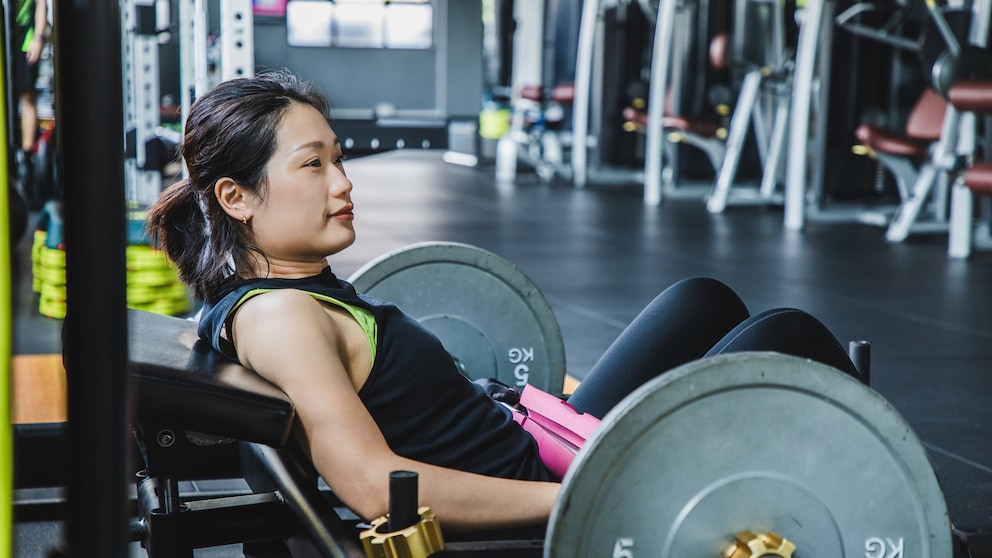
In addition to the classic squat, the hip thrust has become a true trend in the gym in recent years. Lying on your back, you push a barbell from the ground upward with your hips. Although it engages slightly fewer muscles, the hip thrust is also ideal for training the gluteal muscle and the entire pelvic musculature. The following muscles are particularly stimulated:
- Gluteal muscles
- Thighs (especially the back)
- Hamstrings
Which Exercise Is Best for the Butt? Study Investigates
American researchers from Auburn University in Alabama have now explored which exercise leads to more gluteal hypertrophy with the same training volume (and is thus the best for the butt)—the squat or the hip thrust? They also examined strength performance in the squat, hip thrust, deadlift, and isometric wall push.1
For the study, 34 young but untrained students were selected. Initially, their baseline muscle size (via MRI) and strength performance (in three repetitions) for squats, hip thrusts, and wall push were measured. Then, 18 participants completed a training program with squats and the other 16 with hip thrusts. The nine-week training included two sessions per week with 3-6 sets of 8-12 repetitions each.
Both at the beginning of the study and after the training period, muscle activity of the gluteal and leg muscles was measured via EMG (electromyography)—specifically:
- Gluteal muscles (gluteus maximus, medius, and minimus)
- Hamstrings (back of the thighs)
- Quadriceps (front of the thighs)
- Adductors (inner thighs)
At the end of the study period, muscle size and strength were determined again.

Squats or Deadlifts: Which Strength Exercise Is Better for You

The Incredibly Effective Ab Exercise Men Should Also Do
Squats and Hip Thrusts Have a Similar Effect on the Gluteal Muscle
Although the exercises are very different in execution, researchers found that both squats and hip thrusts resulted in similarly strong growth (hypertrophy) of the gluteus maximus (upper and lower parts). However, there were differences: Participants who trained with squats showed significantly greater muscle growth in the front of the thighs and adductors. The hip thrust group had little thigh growth. No significant growth was observed in the hamstrings for either group.
The study also showed that the hip thrust is ideal if you want to specifically target the gluteal muscle—all parts of the gluteal muscles were more active in the hip thrust than in the squat. This is also confirmed by our expert Jörn Giersberg in a previous FITBOOK article. He does not see the hip thrust as a main exercise. However, he believes it is ideal for complementing, varying, and rounding off a training program. Especially for trained strength athletes, it is important to regularly vary training to avoid stagnation in muscle growth.
Regarding strength performance, researchers found that the hip thrust group improved their hip thrust performance more, while the squat group improved their squat performance more. There was no difference between the groups in deadlift and wall push performance.
Conclusion
According to the study results, the gluteal muscles seem to experience similar growth from hip thrusts and squats. Regarding hypertrophy, there is no clearly superior exercise for the butt. The hip thrust leads to greater acute muscle activity in the gluteal muscles, but this does not necessarily predict muscle growth. It should also be noted that strength development was specific to the groups—those who trained with squats improved in that exercise and vice versa. Further studies with trained participants are needed to confirm the results of this analysis.