


February 5, 2024, 9:23 am | Read time: 5 minutes
A few sit-ups for the core and abdominal muscles can almost always be incorporated into daily life. FITBOOK asked an expert: How many should you be able to do to be considered “in good shape”? And when do men and women reach a really good level with sit-ups? Here is the answer.
Among the most popular exercises for the abs are sit-ups. Sit-ups can be done at any time and anywhere, making them seemingly easy to implement at first glance. However, sports scientist Jörn Giersberg observes the opposite in many people: They can’t get up from a lying position at all. Find out here what fitness level he assigns to your personal sit-up performance.
Overview
- Classic Sit-ups – Technique and Execution
- How Many Sit-ups Can the General Population Do? Observation by the Sports Scientist
- With This Many Repetitions, You’re “Relatively in Good Shape”
- “Good Level” According to Expert for 6 or More Sit-ups Without a Break
- Those Who Can Do This Many Sit-ups Are “Very in Good Shape”
- Men vs. Women
- Can’t Do “Real” Sit-ups Yet? Try This Easier Version
- Sit-ups Not Only Train the Core, They Also Aid Digestion
- Muscle Building: Expert Tips for a Flat Stomach
Classic Sit-ups – Technique and Execution
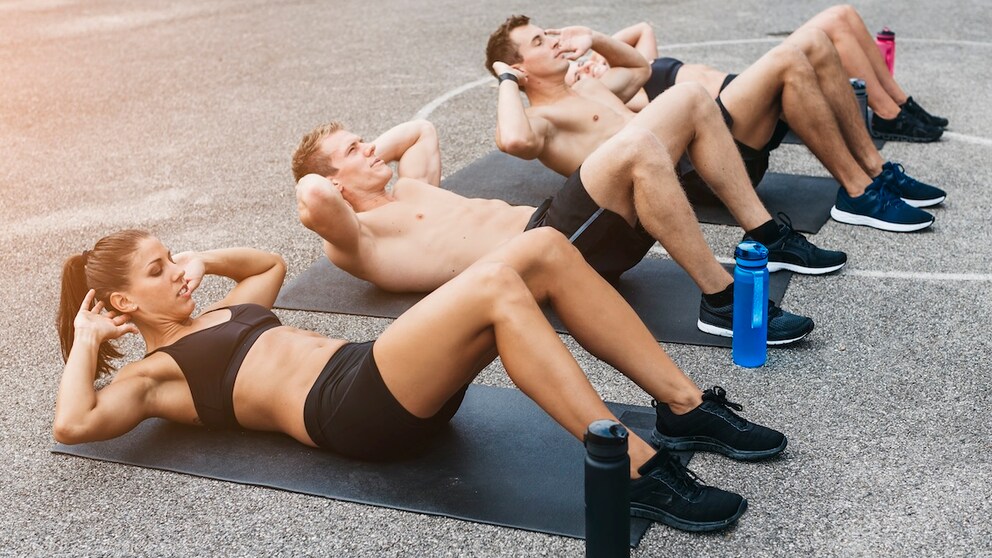
For sit-ups, all you need is a stable surface and a little space to lie down. The classic starting position is clear: With bent legs, you lie on your back, hands behind your head. Then you pull yourself up into a sitting position (exhale). The body returns to the starting position (inhale) and the process repeats. Sounds easy, right? In reality, even a single proper execution can be really difficult for many people–at least that’s what sports scientist Jörn Giersberg observes in his daily work.
How Many Sit-ups Can the General Population Do? Observation by the Sports Scientist
According to the expert, there are “significant differences” in the population regarding the ability to perform sit-ups–both among men and women. He categorizes them into three levels. Giersberg tells FITBOOK: “At level zero, people can’t do anything. They can’t get up from a lying position at all, even if their hands were at their sides.”
With This Many Repetitions, You’re “Relatively in Good Shape”
The sports scientist, who has also worked as a personal trainer for a long time, places both men and women who can do “about one to five repetitions in a row” (with hands behind the head) at level one. “That’s actually already a relatively good form,” Giersberg attests. “The majority of the population can’t do that,” he says bluntly.
Also interesting: Common Mistakes Many Make with Sit-ups
“Good Level” According to Expert for 6 or More Sit-ups Without a Break
With six or more consecutive repetitions, a person belongs to level two, according to the sports scientist. “That’s really already a good level,” the personal trainer tells FITBOOK.
Those Who Can Do This Many Sit-ups Are “Very in Good Shape”
And what about those who can top that? “Those who can do ten or more sit-ups have a very good form.” This generally includes trained athletes, based on experience.
Men vs. Women
Sports scientist Giersberg actually doesn’t observe significant differences in performance between men and women. “Men might be a bit stronger. But there are also plenty of men who can’t manage level zero or one. And vice versa.” However, leverage can play a role. “For people with a longer torso and shorter legs, sit-ups are usually harder because the weight of the legs can’t push them down at that point,” Giersberg explains.
Also interesting: How Many Push-ups Men and Women Should Be Able to Do
Can’t Do “Real” Sit-ups Yet? Try This Easier Version
If you have trouble with the classic execution described above, you can reduce the difficulty. It becomes easier, for example, if the hands are placed at the sides of the body or if the angle of the legs is opened or nearly straightened.

Sit-ups to Combat Belly Fat? Expert Explains if It Works

Children should only start strength training at this age
Sit-ups Not Only Train the Core, They Also Aid Digestion
In general, sit-ups not only train the abdominal muscles. They also improve posture and strengthen the muscles needed for functional movements in daily life. This makes it generally easier to move, and the risk of injury decreases. Moreover, this seemingly targeted exercise for the abs strengthens the stability of the entire upper body and core. Sit-ups also support digestion, as the intestinal tract beneath the abdominal muscles is moved.
Muscle Building: Expert Tips for a Flat Stomach
For most people striving for a flat stomach, sit-ups are part of the routine. However, an excessive regimen and sole focus on them is not recommended. “People need to understand that they won’t get a flat stomach just by training their abs,” warns the fitness expert.
Also interesting: Sit-ups Against Belly Fat? Expert Explains if That Works
Instead, a full-body workout is crucial, where as many large muscle groups as possible are trained. Giersberg recommends: “You should primarily train with dumbbells. Weight is more important than a thousand repetitions.” A practical side effect: Many of these exercises, such as squats or deadlifts, also engage the abdominal muscles. Just like pull-ups, for example. “The abdominal muscles are always indirectly developed,” Giersberg notes. All without sit-ups!