


August 14, 2026, 3:33 pm | Read time: 6 minutes
Although millions of Germans go to the gym and lift weights, they probably have no idea whether they are above or below average in strength for their age, weight, and height. German researchers have developed a strength self-test based on a study that allows individuals to easily assess their personal performance level. FITBOOK also inquired with the study authors about this.
We humans like to compare ourselves. For example, at the gym. I see a teenager on the bench next to me who can bench press 20 kilograms more than I can. However, I am also more than twice his age. So, am I weak compared to him, or actually strong for my age? And is someone my age who is significantly shorter but presses the same amount as strong as I am or much stronger? German researchers from the IST University of Applied Sciences in Düsseldorf and the German Sport University Cologne have found answers to these and similar questions with their current study.1 They developed a strength performance score that, along with a self-test, shows where you stand performance-wise. This provides an important indication of whether your training is working—or not.
What Did the Study Investigate?
The aim of the study was to examine the influence of age, body weight, and height on maximum strength. The influence of so-called anthropometric characteristics, such as arm and leg length, was also considered.
For this purpose, a total of 393 people (197 women and 196 men) aged 16 to 64 were recruited. The range of performance varied from absolute beginners in strength sports, who had never or only irregularly performed the exercises, to true elite powerlifters. Importantly, all participants were healthy and active. Since a 1-RM test determines the maximum weight for exactly one repetition and requires reaching one’s absolute performance limit, beginners were only allowed to participate after a strict review of their movement technique by experts. Three typical full-body exercises were selected for this test:
- Bench press
- Squat
- Deadlift
Subsequently, the performance data, along with age, height, weight, and arm and leg lengths, were evaluated using statistical analysis methods. Based on this, the researchers calculated so-called individualized Z-scores to standardize the 1-RM performance values relative to the mentioned influencing factors.
Arm and Leg Length Are Not Important Factors
The data analysis revealed that arm and leg length—especially thigh length—do not significantly influence strength performance. The explanation is clear: Taller people usually have longer arms and legs automatically. Therefore, the researchers’ performance formula and the self-test based on it work without considering arm and leg length.
“We were finally able to prove and essentially show that we could represent anthropometry relatively well with just body height,” explains study leader Eduard Isenmann in response to a FITBOOK inquiry.
Decisive factors influencing maximum strength in the three tested full-body exercises are body height, body weight, and age.
Another interesting finding from the researchers is that performance does not increase proportionally with body weight. A 105-kilogram man does not automatically have to lift 50 percent more weight than a 70-kilogram man. The data analysis showed that the relationships are more complicated. Therefore, common formulas that assess strength based on body weight are mostly unreliable.
Additionally, the researchers warned against rigid tables that simply classify athletes into categories like “beginner” or “advanced.” Such systems are extremely inaccurate because they cannot fairly account for age and body height. This leads to extremely different strength performances landing in the same category. Instead, an individual, fluid value like the Z-score is much more meaningful.
How the New Strength Self-Test Works
Based on the study data, the researchers developed the so-called Z-score. This value normalizes performance: If the Z-score is exactly zero, the performance corresponds exactly to the average expected for age, gender, and body stature. A value above zero means the performance level is above average. A value below zero indicates that one is performing below average.
For the strength self-test, you need the following information:
- Gender
- Age
- Height
- Body weight
- Maximum weight for exactly one repetition of bench press, squat, deadlift
You just need to enter this information into the free calculator developed by the researchers, and you’ll know where you stand performance-wise. Here is the performance calculator.
Bench Press in the Age Check: How Much Weight Is Realistic?
“7 Exercises That Really Make My Shoulders Burn”
What to Consider with the Z-Score
The researchers emphasize that the Z-score is a guideline. It indicates whether you are average, below, or above in maximum strength. However, it does not provide an exact indication of whether you are untrained or a powerlifter. Rather, it serves as a good indicator of whether the current training is successful. For example, if you are in the negative range, you can adjust your training and check after a few weeks if the Z-score moves toward zero. If you are in the positive range, you must expect that further performance increases will be more difficult, as you are already in the high-performance range.
“The Z-score calculator can be used for hobby athletes. However, only for people who regularly perform these exercises and are between 16 and 64 years old,” explains study leader Isenmann.
The Correct Execution
To ensure the calculated Z-score is scientifically valid, you must strictly adhere to the study’s uncompromising execution standards in the gym. Any deviation significantly distorts the result:
- The Squat: The hips must go so low that the hip crease is below the top of the knee joint.
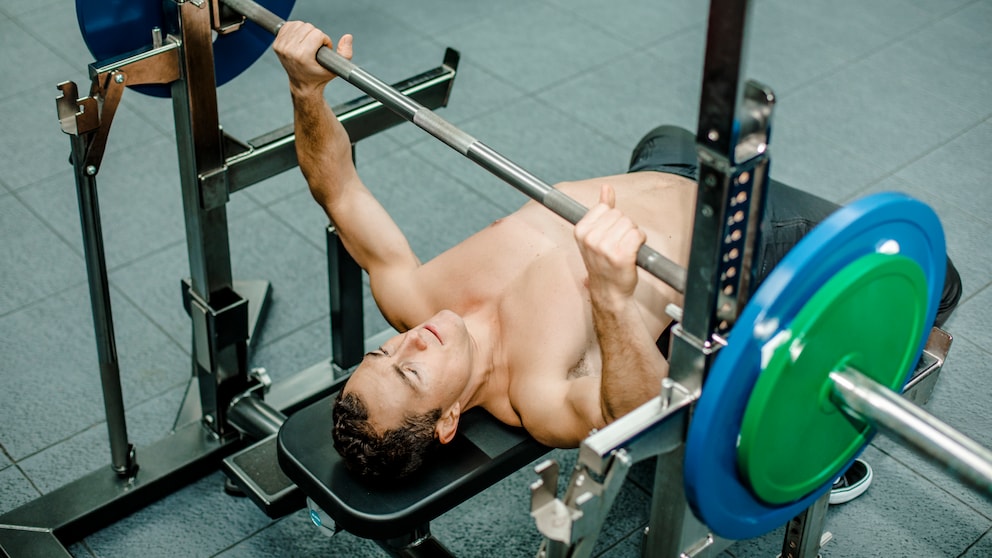
- The Bench Press: You must not bounce the barbell off your chest. It must pause briefly but be controlled on the chest before the upward movement. Additionally, the gluteal muscles must maintain contact with the bench at all times.
- The Deadlift: The exercise is only valid when you stand upright with fully extended knees and hips (lockout). Lifting straps are strictly prohibited—only regular chalk for grip is allowed.
Additionally, the system calculates with completely different mathematical formulas for women and men in the background, as bodies function allometrically differently. Anyone attempting such a maximum effort (1-RM) should never do so alone for safety reasons. It is essential to warm up thoroughly beforehand and have experienced training partners (spotters) to assist if the weight becomes too heavy!