


September 19, 2025, 3:30 am | Read time: 5 minutes
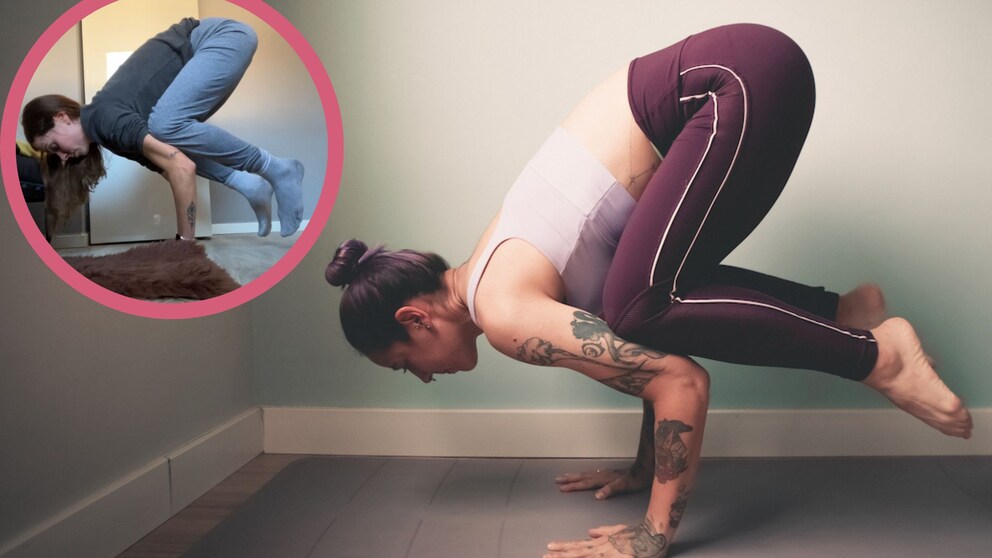
The Crow Pose (Kakasana) is a balance exercise in yoga where the legs and buttocks are lifted into the air by the arms. FITBOOK author Nina Ponath practiced the pose for two weeks—did she master it in the end?
The Crow Pose—How to Do the Yoga Exercise
Yoga is quite diverse. While in the final relaxation—Shavasana—the only thing working is the breath, allowing the rest of the body to fully relax, other asanas (that’s what the poses in yoga are called) can really push you to your limits. Kakasana, also known as “Crow,” is an arm balance that falls into the category of more challenging yoga exercises that test the body and, to be honest, can seem quite intimidating. That’s exactly why I wanted to learn it.
In the Crow, you assume a kind of floating squat: You squat down and tuck your knees under your armpits. From there, you move forward in the squat position, balancing your entire body weight on your hands. The buttocks are the highest point and point upwards, while the head is slightly bent forward.
For the exercise, you need strength and flexibility, as you have to support your entire body weight. Once you’ve assumed the asana, balance is also required. The Crow presents a whole range of challenges for willing yogis. But that’s not the only thing that makes the exercise so difficult. For me personally, it was more of a mental challenge that made the Crow so demanding.
Don’t Be Afraid of Falling
I am a self-confessed coward. Sports that carry an increased risk of injury generally scare me at first. That’s precisely why I enjoy yoga so much—a sport that has always seemed safe to me. Until I decided to tackle the Crow. To get into the position, you have to lean far forward so that the center of gravity is over your hands. That takes quite a bit of courage.
What Gave Me the Most Trouble with the Crow Pose
The first time, I only managed to keep my feet in the air for a few seconds. My butt was still too close to the ground, causing my weight to immediately tip back, and I landed back on my feet. Because I took photos of my attempts, I could clearly see the mistake.
Just because you know what’s going wrong doesn’t make it easy to fix. I realized this during my next attempts, where I theoretically knew exactly where I wanted to go (forward, butt up), but my head still only dared to move a few inches forward protectively. While you certainly can’t break your neck this way, you also can’t quite get into the Crow. For me, it was more of a mental block that made the Crow so challenging.
A Bed Made the Difference in the Yoga Challenge
When fear was mainly the issue preventing me from getting into Kakasana, I decided to think of a way to give myself a greater sense of security. If I was afraid of falling forward, I decided I should at least make sure I fell softly if it happened.
When I visited a friend in Norway, I found an even better tool. The guest bed I slept in offered an even better aid. I pushed myself up from a squat with my hands, and my head was lightly supported on the bed without bearing my body weight. When my buttocks were high enough and I felt like I was carrying the weight entirely with my hands, I got the hang of the individual steps and the body awareness in the pose.

Open Your Hips and Strengthen Your Knees With the Flying Horse Pose

How to Master the Standing Compass Pose in Yoga
How to Learn the Crow More Easily
Aids for the Yoga PosResting your head on a support was a huge help for me, and I can only recommend such support to anyone who is afraid of falling forward on their face. It helps immensely to get a feel for the asana. In sports, trust is often half the battle. When we focus less on our fear and give ourselves over to the movement, it works much better.
Other Tips to Master the CrowApart from this mental support, there are a few other things that can greatly help you master the asana. On Instagram, where I sometimes proudly documented my practice progress, I received a lot of tips. The wider your fingers are spread and the more surface area your hands cover, the more stability you have. Pull your shoulders apart: In the Crow, the knees are placed under the armpits, and the triceps support the shins. Both are easier if you pull your shoulders apart. Move forward, not up: In fact, it’s much easier to move forward. Once you lean far enough forward, your feet will lift off the ground on their own.
Success! This Is What the Crow Feels Like
I gradually learned the yoga pose. The result: I managed the Crow, and I experienced how fantastic it felt. It definitely made me eager to try more because I felt incredibly strong and flexible, as if my body was capable of amazing things. Learning new things helps us see life in a playful way and not take it too seriously. While practicing the Crow, you inevitably fall over like a child playing, and you can’t help but laugh at yourself. Yoga is the playground where we find immense self-confidence as we practice and eventually master a new asana.
I can only recommend the Crow to every yogi. Learning the asana is incredibly fun because you learn a lot about yourself and have to face your fears. I can now hold the Crow securely for a few breaths, and I plan to continue practicing regularly to become even more stable.
By the way, the Crow’s next step is the Crane, or Bakasana, a yoga exercise that works similarly to the Crow, but with arms extended instead of bent.