


October 23, 2025, 6:17 pm | Read time: 5 minutes
During menopause, muscle loss progresses and the risk of porous bones (osteoporosis) increases–but targeted training can counteract this. FITBOOK author Nina Ponath asked a personal trainer how this should ideally look.
When the hormones estrogen and progesterone decrease between the ages of about 45 and 55, it is colloquially referred to as “menopause.” Similar to puberty, the female body undergoes many changes that can be accompanied by various symptoms. They also have long-term effects on health. Estrogen protects bones and muscles. The age-related decline accelerates muscle loss (sarcopenia), reduces bone density, and increases the risk of osteoporosis. Often, fat distribution shifts toward the so-called unhealthy belly fat. Fortunately, the right training can counteract this.
Supporting the Body with Exercise
Sport scientist and personal trainer Andreas Heumann from Berlin knows how important it is to support the body through exercise during this phase of life. The hormonal changes during menopause are one of the main reasons his clients seek him out, the trainer explained to FITBOOK. Unfortunately, the hormone decline also affects weight on the scale: “If you don’t counteract it, you can expect muscle loss and a decrease in lean mass simply due to aging.”
Also interesting: Rebecca Barthel: »This is the training women should focus on during menopause
First a Check-up, Then Training
Before you dive into training with high motivation, personal trainer Andreas Heumann warns against overexertion. If you haven’t trained before, a check-up with a doctor is recommended before starting. “This way, you can rule out illnesses,” the expert explains. If the doctor gives the green light, the sports scientist recommends beginners start training with a professional trainer: “It doesn’t have to be a personal trainer–the training can also simply take place in a group at the gym.”
Also interesting: Is it better to train with free weights or machines for muscle building?
The Expert Recommends Support from Trainers and Equipment for Beginners
A trainer can help avoid form errors that might otherwise hinder progress. Especially when starting to train at the age of menopause, there’s a risk of injury when beginning training. Another tip the trainer has for beginners? Equipment! “Normally, I’m not a big fan of machines, but for the inexperienced, training is safer this way.” In addition to common guided machines, the personal trainer is particularly fond of vibration machines. “They have been proven to help build bone density and muscles.”

At Home Instead of the Gym! Training Tips for Menopause
What women with lipedema should look out for when exercising
Maintaining Basic Functions
A healthy body can lift, pull, push, and jump. Unfortunately, we lose these basic movement patterns over time–sometimes even self-inflicted. As we age, we tend to be more cautious. “At a certain age, we lift less out of fear of injury, and no one jumps anymore,” says Andreas Heumann. Smart training promotes these skills and retrains them.
Also interesting: How women over 50 should train
An Exemplary Training for Menopause
Pressing: Bench Press or Push-ups
This exercise is fundamental for developing strength in the chest, shoulders, and triceps. Lie on a bench and press dumbbells or perform push-ups. The load should be chosen so that you can perform about eight to twelve controlled repetitions per set. This repetition range is ideal for muscle building (hypertrophy).
Hip-Dominant Movement: Deadlifts or Hip Thrusts
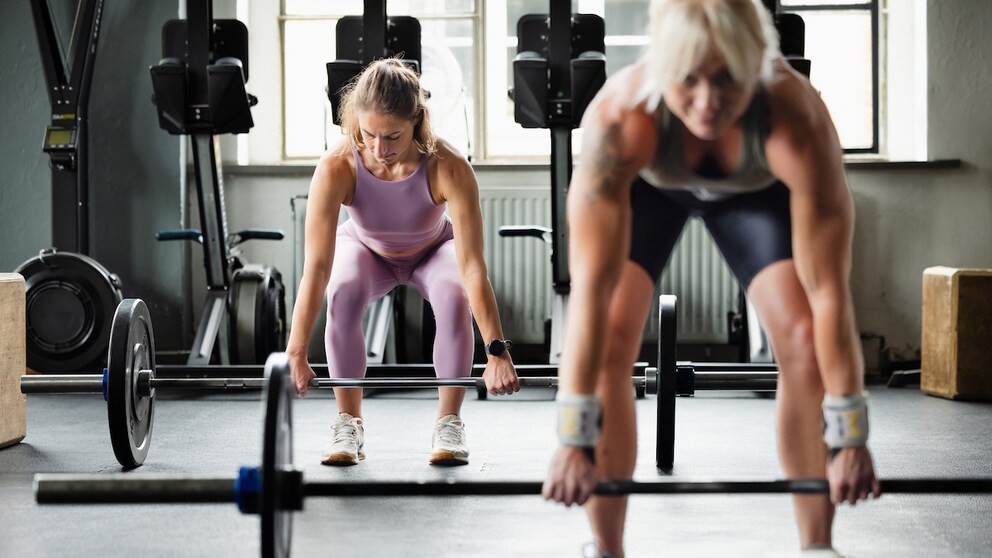
The hip-dominant movement trains the entire backside of the body (lower back, glutes, hamstrings), which is crucial for posture and bone health. In deadlifts (with barbells or dumbbells), you move your hips and glutes back while keeping your back neutral. “As a woman, you should train to lift your own body weight in deadlifts,” says Andreas Heumann.
Pulling: Pull-up
Targeted training of the pulling muscles (back and biceps) is important to balance muscular imbalances and promote an upright posture. Pull-ups are very effective. For beginners, lat pull-down machines or rowing exercises at the gym are suitable. “All my clients must be able to do at least one pull-up by the end of our training,” says Andreas Heumann. The excuse “too old” doesn’t apply here. “I’ve had clients who learned pull-ups even at 60 years old,” says the sports scientist.
Squat Movement: e.g., Back Squat
The squat is the most functional exercise for the lower body. It trains the legs and glutes and improves mobility. Whether with a barbell (back squat) or with your own body weight: Pay attention to clean technique, where the knees point over the feet and the hips come below knee height.
Jumping as a Peak Load
Studies show that high peak loads strengthen bones and muscles.1 Occasionally raising your pulse–such as with jumping rope or jumping jacks–keeps you young and ensures a better metabolism. These short cardio peaks can be ideally incorporated at the end of training to specifically counteract bone loss (osteoporosis). Strong loads during strength training also help bones maintain and stabilize their structure.