


November 2, 2025, 4:51 pm | Read time: 6 minutes
Against muscle loss and weight gain: We asked a personal trainer how you can easily set the most important training impulses for health and hormone balance at home during menopause.
Hot flashes, restless sleep–and then the scale confirms what you’ve already been feeling: Yes, your waistband really does feel tighter than usual. When women between the ages of 45 and 55 experience physical changes, the quick, often resigned response is: “Oh, that’s just how it is during menopause.”
That’s not entirely wrong, because, of course, the hormonal restructuring process, menopause, or the “change of life” during this time has far-reaching consequences. As the hormones estrogen and progesterone decrease, bone density reduces, and muscles break down faster. However, that doesn’t mean you should resign yourself to it.
Why Training Is Essential During This Phase
Even in this phase of life, you can counteract the unwanted effects of hormonal processes with the right training. You should even do it! Training is especially important now because it helps counteract the negative effects of the decline in estrogen and progesterone.
For decades, estrogen was the body’s “bodyguard” for your bones and muscles. As it decreases, bone density reduces, and the risk of osteoporosis increases. At the same time, age-related muscle loss accelerates and becomes noticeable: Less muscle means lower calorie consumption, which automatically leads to easier weight gain and a shift toward visceral belly fat. Additional symptoms such as hot flashes, sleep problems, and stress also reduce the body’s functionality and resilience.
Fortunately, your body responds to the right training stimuli–and you don’t need a monthly gym membership or expensive equipment for that. The most important thing is to challenge your muscles intensively. “Many make the mistake of focusing on cardio. Endurance sports are healthy, but strength training is what really combats muscle loss,” says sports scientist and personal trainer Andreas Heumann from Berlin. The same applies to bone density. “Bones also need a stimulus,” says Andreas Heumann. “Mechanical stimuli, such as light jumps or progressive resistance in strength training, strengthen the bones.”
Home Gym Instead of Fitness Studio: Initiate the Change at Home
What matters is the intensity and type of load, not the training location. The most effective weapons against physical changes during menopause are targeted strength training, stability, and mobility. All of this can be perfectly implemented in your own living room. A few dumbbells (or water bottles), a mat, and your own body weight are often enough to achieve maximum training success. We asked fitness expert Heumann how this targeted training at home should ideally look. Instead of setting up a specific training plan here, the sports scientist advises first conducting an analysis of your body’s movement patterns.
A healthy body, according to the trainer, should be able to perform the following movements: “Bodyweight training has the disadvantage that beginners often can’t do the exercises, while training for advanced users becomes too easy and doesn’t provide enough stimuli,” says Andreas Heumann. Beginners can’t do push-ups yet, and for advanced users, body weight is often too easy. Therefore, it’s important to scale the exercises smartly–making them easier or harder. As for the number of repetitions: The repetitions should lead close to fatigue. “At the end, you should have enough strength for only one to three more repetitions,” says Andreas Heumann. In general, before you start training, you should check with your doctor to see if you can train without restrictions. “With osteopenia, osteoporosis, joint pain, or a longer training break, the training should be increased slowly.” If you experience pain, dizziness, or chest pressure, you should stop the training immediately.
Preventing Bone Loss: The Right Training for Menopause
Pull-Ups with a Band — How to Learn Real Pull-Ups
The Five Basic Bodyweight Functions for the Home Gym
You should incorporate the following exercises into your weekly training. Try to choose the load so that you can manage about 8 to 12 controlled repetitions per set. If you can do more, make the exercise harder (using a resistance band or the exercise variation mentioned below).
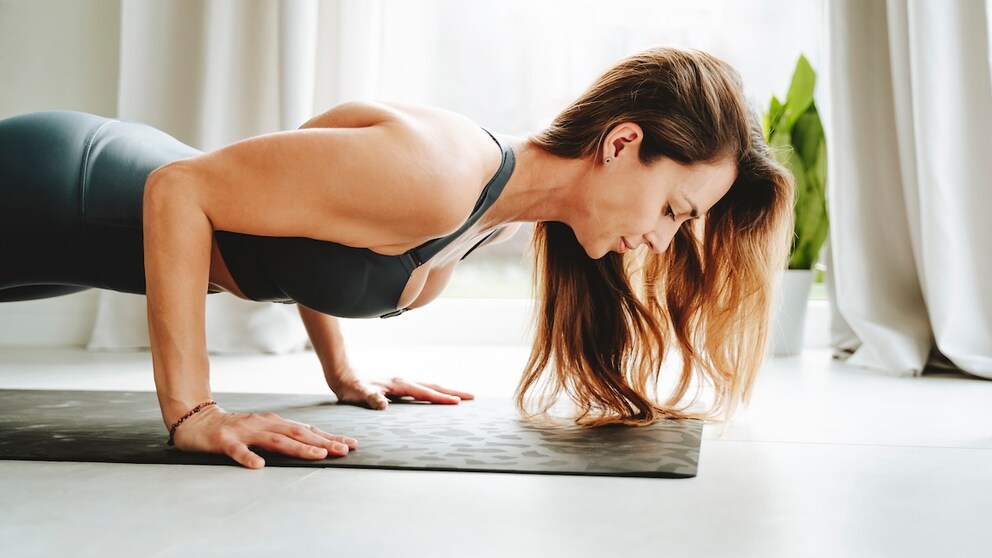
Push: Push-up or Resistance Band Bench Press
This exercise trains the chest, shoulders, and triceps. The push-up is the most effective bodyweight push movement. Beginners can start with wall push-ups or on an elevated surface (such as a couch). Once you’re strong enough, move to your knees and then to your toes.
To mimic the push with a resistance band (as an alternative to studio bench pressing), lie on your back and wrap the band behind your upper back (shoulder blades). Hold the ends of the band firmly and press your arms vertically upward as in bench pressing. This movement strengthens the push muscles and helps prepare for the push-up.
Pull: Rowing with Resistance Band
Targeted training of the pull muscles (back and biceps) is essential for an upright posture and to balance push movements. Sit on the floor with your legs extended and loop the band around your feet. Hold the ends firmly and pull the band toward your navel in a controlled manner. Keep your shoulder blades actively together. Alternatively, you can wrap the band around a doorknob and row while standing or sitting.
Squat Movement: Bodyweight Squat
The squat is fundamental for legs and glutes. Stand shoulder-width apart and squat down as if sitting on a chair. Make sure your knees don’t fall inward and your back stays straight.
To increase the challenge, place a small fitness band (also called a booty band) around your knees (with the band on the outside). This activates the glute muscles more and requires the knee to be actively pushed outward.
Hip-Dominant Movement: Glute Bridges
This exercise primarily strengthens the glute muscles and the back of the thighs and is back-friendly. Lie on your back with your feet hip-width apart on the floor in front of your glutes. Tighten your glutes and lift your hips until your knees, hips, and shoulders form a straight line. Hold the tension briefly and then lower in a controlled manner. For more stimulus, you can place a band around your knees (Banded Glute Bridges).
Gait: Farmers Walk (Farmer’s Carry)
Carrying is an important functional exercise for core stability and grip strength. Take two equally heavy objects (two large water bottles, filled shopping bags, or heavy books) in your hands. Keep your upper body straight, shoulders down and tense. Walk slowly for about 30 to 60 seconds. This exercise prevents posture damage and trains the stabilizers.
You Can Be Strong at Any Age!
Menopause is nothing to fear. What matters is the stimulus you give your muscles and bones. Use this phase of life to become the strongest version of yourself–comfortably in your own living room. Targeted strength training is your best medicine against muscle loss, osteoporosis, and the weight gain many women experience.