

January 25, 2025, 7:23 am | Read time: 6 minutes
The Sphinx Push-up is an advanced exercise that focuses on training the triceps muscles and can help improve strength and stability in the core. But where does this exercise come from, and what points should be considered in the technique? FITBOOK answers these questions and presents the benefits and variations for beginners and advanced practitioners.
When it comes to training the triceps with your own body weight, there aren’t many exercises that don’t require equipment. One of the most effective is the so-called Sphinx Push-up. This exercise combines flowing elements from the classic push-up with the plank position or the Sphinx pose. FITBOOK shows which muscle groups are engaged and clarifies the most common mistakes in the Sphinx Push-up.
Follow the FITBOOK channel on WhatsApp now!
Overview
Origin of the Sphinx Push-up
The exact origin of the Sphinx Push-up cannot be clearly determined, but there is a position in yoga that closely resembles the exercise: Salamba Bhujangasana, also known as the Sphinx pose. This is a variation of the Cobra (Bhujangasana). In Salamba Bhujangasana, you rest on your forearms and keep your hips in contact with the ground. The Sphinx Push-up can be described as a combination of this pose with the classic push-up, and it is also a popular exercise in calisthenics. The name derives from the low position that resembles an Egyptian Sphinx–the mythical creature with the body of a lion and the head of a human.
Also interesting: Why runners should definitely do yoga
Execution and Technique
This guide shows how to perform Sphinx Push-ups correctly:
- Starting Position: Begin in the push-up position with legs closed and fully extended. Compared to the classic push-up, place your hands just as wide but slightly further forward. Keep your gaze downward. Tip: If the tension in the core is already too high and stability is lacking, switch to a beginner’s variation.
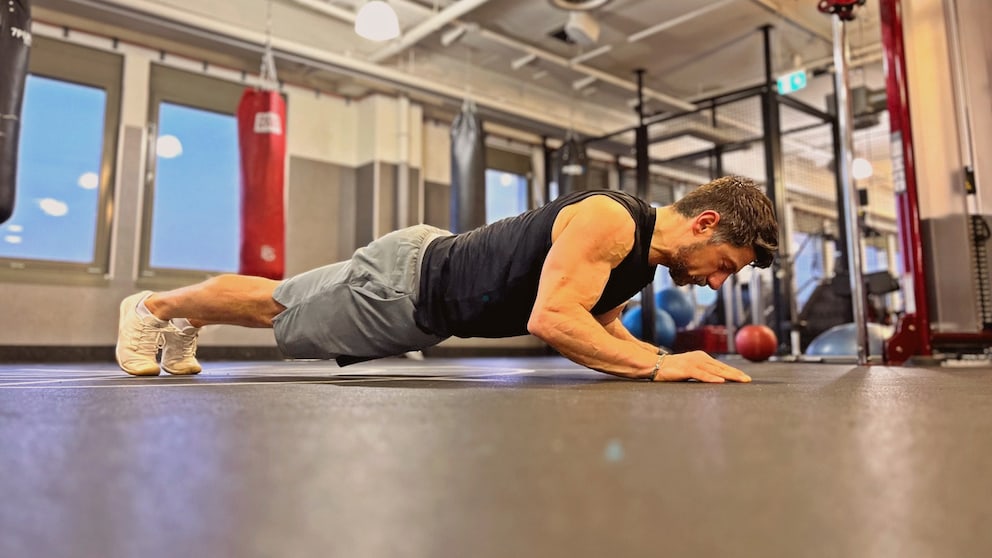
- Downward Movement: Lower your body slowly by bending your arms. The movement ends when your forearms are parallel to the ground and the Sphinx position or plank position is reached. In this position, the elbows are directly under the shoulders. Keep your gaze downward. Your ankles are flexed, creating a slight stretch in the calves.
- Upward Movement: Extend your arms again. Important: Keep your elbows close to your body throughout the movement so that the wrist, elbow, and shoulder are aligned. The end position is reached when the arms are fully extended and the classic push-up position is resumed. In this position, the ankles are extended, and the calf muscles are slightly tense.
Important: Throughout the entire movement, the body should form a straight line, and the buttocks should not be too high or too low.
Muscles Engaged in the Sphinx Push-up
The primary muscles engaged include:
- Triceps (arm extensor)
- Chest muscles
- Shoulder muscles
These muscles work together to lift the body off the ground and lower it again.
Secondary muscles engaged are:
- Abdominal muscles
- Lower back
These muscles help keep the core stable during the exercise, protecting the spine from injury.
Benefits of the Exercise
- Strengthens the chest, triceps, and shoulder muscles
- Improves stability and posture
- Strengthens the abdominal muscles
Common Mistakes in the Sphinx Push-up
- Sagging Lower Back: The entire body should form a straight line. To achieve this, the abdominal muscles must be continuously engaged. If the abdominal muscles are too weak, it manifests in the lower back: It sags, which strains the discs and can cause back pain.
- Raising the Buttocks: The knees and hips should remain fully extended throughout the movement, so the body forms a straight line. If the buttocks rise during the movement, the exercise is compromised. This makes it easier, but it can shift the focus from the triceps to the shoulders.
- Elbows Flaring Out: The elbows should be directly under the shoulders in the start and end positions. If the elbows flare out during the movement, it indicates a weak triceps, which can lead to injuries to the elbows and shoulders.
- Weight Shifting: If strength is lacking, it may happen that when pushing up, the weight shifts slightly, and the relieved arm extends first. This leads to uneven loading and potential imbalances.
- Lowering the Chest: In the end position, the elbows touch the ground. However, it is often observed that instead of the elbows, the chest touches the ground, as in a classic push-up. In this case, the elbows are bent too much (less than 90 degrees).
Sphinx Push-up Variations
For Beginners
- Kneeling Sphinx Push-ups: If it’s difficult to maintain the push-up position and core tension, you can simplify the exercise by placing your knees on the ground. This reduces resistance and allows you to focus on proper technique.
- Incline Sphinx Push-ups: For this variation, you need an elevation for the starting position to reduce resistance. A plyo box or the end of a staircase works well.
- Triceps Push-downs: If the triceps are too weak for a clean execution of the Sphinx Push-up, you should strengthen the triceps muscles in isolation using a cable machine or resistance band.
For Advanced Practitioners
- Elevated Sphinx Push-ups: To make the exercise more challenging, place your feet on an elevated surface. Particularly challenging: a medicine ball.
- Diamond Push-ups: This is a push-up variation where the hands are placed in a diamond shape under the chest. Like the Sphinx Push-up, this variation focuses on the triceps. The increased difficulty comes from the greater range of motion of the muscles.
- Shuttle Push-ups: This variation combines the Sphinx Push-up with the classic push-up. In the plank position, the weight is shifted to the hands without extending the arms.

Archer Push-up: Proper Technique, Targeted Muscles, and Common Mistakes

How to Keep Ab Workouts Exciting: 5 Plank Variations for Beginners and Pros
Workout with the Sphinx Push-up
This circuit training consisting of bodyweight exercises should go for at least three rounds; the break after each round is 2 minutes.
- Sphinx Push-ups: 6 to 8 repetitions
- Inverted Rows (Horizontal Rowing on the Barbell): 8 to 10 repetitions
- Parallel Bar Dips: 6 to 8 repetitions
- Close-grip Pull-ups: 8 to 10 repetitions
Conclusion on Sphinx Push-ups
By combining elements of the classic push-up and the plank, this exercise offers a great way to make training varied and challenging. Sphinx Push-ups are excellent for strengthening the arm extensors or triceps with your own body weight and without equipment. Regular practice of this exercise can improve the maximum number of repetitions in classic push-ups.