


March 6, 2026, 4:23 pm | Read time: 7 minutes
Squats are undoubtedly one of the most effective bodyweight exercises of all. They are easy to do and train several muscle groups at once, especially the buttocks, thighs, and abdominal muscles. They also improve endurance, fitness, and flexibility. But how many squats should you actually do to be considered fit? And what other effects do they have on the body? FITBOOK author Tony Poland asked sports scientist, personal trainer, and alternative practitioner Markus Bremen.
This popular and important strength exercise is technically demanding, but all the more effective when performed correctly. Squats are often performed with a barbell, but you can also do them without any equipment at all. In this case, you work exclusively with your own body weight. But what number gives you an idea of your basic fitness level? How many squats should men and women be able to do? A fitness expert explains this below.
Overview
Squats in Everyday Life
Usually, without realizing it, we already integrate the movement of squats into our everyday lives several times. “They are one of the most functional basic movements and are considered a fundamental human movement pattern,” explains Markus Bremen. There are many examples of this! Squats simulate sitting down and standing up, just like sitting in a chair or going to the toilet. “They are simply very close to everyday life and should therefore definitely be well mastered. We should therefore be able to do a healthy amount of bodyweight squats without any problems,” says the fitness expert.
It’s all about the right execution
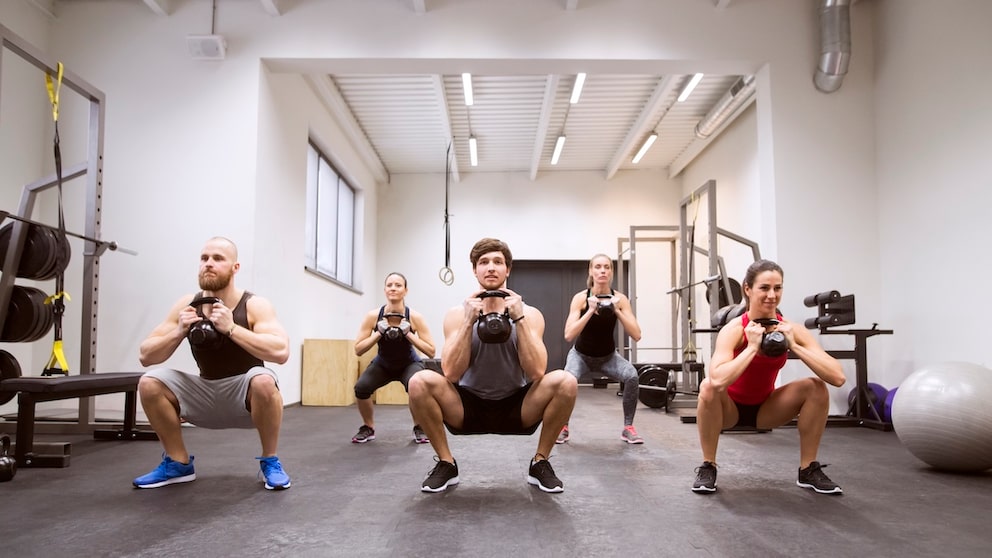
But before you ask yourself how many squats you should be able to do, it is important to master the correct execution. Markus Bremen recommends standing with your shoulders shoulder-width apart and your upper body as upright as possible. Now pull your shoulders or shoulder blades back and downwards while keeping your head in line with your spine. The back is straight without slumping forward. The arms can be stretched forward for balance. Then go down as low as possible in a controlled manner, inhaling as you do so. Exhale again on the way up.
In this context, it is important to maintain the leg axis. In other words, the knees must not collapse or bend inwards, but should be kept in a straight line in line with the axis. Incidentally, the tips of your knees can go beyond the tips of your feet!
The squats themselves should ideally be performed at a lower than 90-degree angle. “That’s the minimum. 90 degrees is the position where there is the most pressure on the kneecap. This is referred to as retropatellar pressure, i.e., behind the kneecap. That’s why you can go below 90 degrees,” explains the fitness coach.
This Number of Repetitions is Realistic for Men and Women
Regardless of the individual’s different training goals in terms of maximum strength, basic endurance, or strength endurance, for example, Markus Bremen has a certain guideline in mind for how many squats you should be able to do. Both genders can use this figure as a guide to assess their own basic fitness. “Men and women who are at their peak age should be able to do at least 30 repetitions,” says the expert. “If you are also pursuing sporting goals, you should do around 50 in a row.”
It is important to keep the right pace. To avoid going too fast or too slow, movement cadences can help – i.e., guidelines for how quickly you lower the weight and raise it again. Markus Bremen: “I don’t recommend a rushed CrossFit pace. Rather, you should go down for one second, hold the lowest point for one second, and then go up for two seconds. And do the whole thing in a controlled manner without falling down!” You can also change the cadences to add a little variation and variety to the sequence. In this case, you could aim for around two seconds for the downward movement and one second for the upward movement.
Can You Increase Your Basic Fitness With Squats?
The good answer first: yes, it is possible. And Markus Bremen explains why. “You simply have an extremely large number of muscle groups that work synergistically. The focus is on your glutes and legs. Additionally, secondary muscle groups are involved, including the core and shoulders, as well as the erector spinae muscles of the back,” he explains. For this reason, squats are the form of exercise that burns the most energy in terms of muscle work alongside deadlifts.
Squats Under Heart Rate Control – Yes or No?
Unlike endurance sports such as jogging or cycling, the pulse rate plays a rather subordinate role in squats. But: “I wouldn’t let anyone exceed 80 percent of their maximum heart rate,” says Markus Bremen. “Because these are always areas where a lot of lactate builds up or where you become unclean. So I recommend exercising between 70 and 80 percent of your maximum heart rate.” It also makes sense to work with a controlled heart rate for people with known pre-existing conditions.
One way or another, it is clear that the pulse rate goes up during exercise. And this, in turn, means that you burn a lot of energy and improve your cardiovascular fitness. “In the beginning, the increases in heart rate are higher, but this adapts. The better you get, and the more often you do squats, the calmer your pulse rate becomes.” Keyword training effect.
Fitness Hype: What Quadrobics Really Has to Do With Training

Why Jump Squats Are So Effective and What to Watch Out For
Tips and Tricks for Getting Started With Squats
Box squats are an option for those who want to approach the exercise slowly. Ideally, you will need a chair or bench so that you can lower yourself onto these devices in a controlled manner. You can consciously make sure that your bottom is brought down towards your heels and that your knees are not pushed directly forward initially. Therefore, this simplified form of squats is an excellent way to practice the basic movement.
If the problem is that the knees collapse too easily, a Theraband can help. Simply tie it around your knees. If, on the other hand, breathing is more difficult, the total number of repetitions can be divided into individual sets. This makes it easier to concentrate on individual breathing phases.
Wall squats can also make it easier to get started—but with this variation, the direction of gaze is towards the wall! This exercise is advisable if your upper body is tilted very far forward. This exercise compels you to descend in an upright position. At least if you don’t want to bump your nose against the wall …
Other Benefits and Effects on the Body
“The muscle involvement in squats is very high. The basic human movement pattern also means they can be adapted very well to different levels of ability,” says Markus Bremen. In addition, mobility of the hips and ankles is promoted, as is core stability. “Squats are highly transferable to everyday fitness and exercise. Leg strength and movement patterns are often included. Indeed, it is a movement that should be maintainable well into one’s senior years,” concludes the lecturer from the IST University of Applied Sciences Düsseldorf. For this reason, you should always ask yourself how many squats you can do—and work on it if necessary.