


January 30, 2026, 4:24 pm | Read time: 5 minutes
As an extremely popular and important bodyweight exercise, the squat is indispensable. But this all-rounder can do much more than just increase fitness and mobility. Squats also burn unwanted calories at the same time! But how many exactly? And what do you need to bear in mind? Qualified sports scientist, personal trainer, and alternative practitioner Markus Bremen spoke to FITBOOK author Tony Poland about this.
Squats are already firmly integrated into our everyday lives, for example, when we sit or stand up, thanks to a variety of basic functional movements. And the more often we move, the better. This is because each of these small and mostly unconscious movements stimulates calorie consumption. Of course, this alone is not enough to reduce excess fat and lose weight. Fitness expert Markus Bremen explains what it takes.
Overview
Why Squats Help to Burn Fat
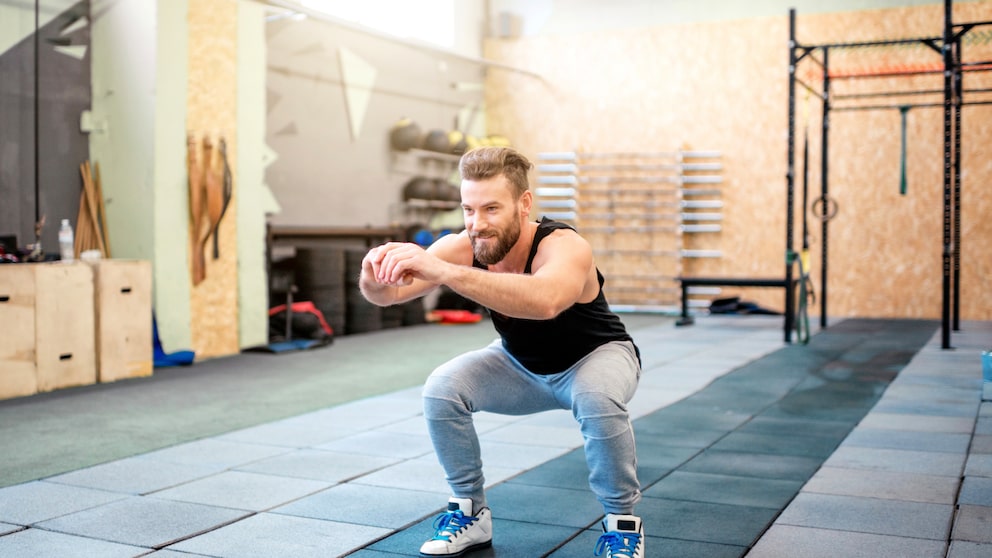
As a full-body exercise, deep squats primarily train the buttocks, legs, and abdomen. The back thigh and buttocks bend the knees and stretch the hips, while the front thigh stretches the knee and bends the hips. The back extensors, abdominal muscles, and hip abductors are used for stabilization. This means that almost the entire body is used with every single squat. In the long term, this builds muscle mass, and more muscle means more fat is burned!
Fitness Expert on Calorie Consumption
How many calories does the body burn when so many muscles are involved? “Of course, how many calories you actually burn depends on a number of factors,” says Markus Bremen. “Age and gender are general characteristics. The older you get, the slower your metabolism is. You have less energy available, which means you are exhausted more quickly,” explains the fitness expert. In terms of gender, men usually burn more calories than women, as they usually have a higher muscle percentage. Weight also plays a role. The heavier a person is, the more calories they burn, as they have to expend more energy for the same exercise.
“Lifestyle is also always a factor. What is my sleep frequency and stress level? What is my daily activity level? How do I eat?” says Markus Bremen. And he adds: “Protein intake is crucial for building muscle and therefore for calorie consumption.”
Example: How Many Calories Men and Women Burn
Calorie calculators quickly show you how many calories you really burn per squat or per minute. As a rough estimate: a single squat burns 0.3 to 0.5 kilocalories, ten squats therefore 3 to 5 calories, and 100 squats 30 to 50 calories.
Calories Burned in One Minute (Man)
For example, a 35-year-old man with a height of 1.80 meters and a weight of 80 kilograms would burn around six to eight calories if he performed squats at a moderate pace for one minute. For ten minutes at a constant speed, this would be around 60 to 80 calories.
Calories Burned in One Minute (Woman)
Similarly, a woman of the same age (1.66 meters, 70 kilograms) would burn approximately five to seven calories in the same amount of time at a moderate pace, which equates to 50 to 70 calories in ten minutes.
Calorie Consumption for Classification
Extrapolated to 60 minutes of squats, a male person would therefore burn just over 400 calories, a female person over 300 calories. That would be less than an hour of running, rowing, or swimming, for example. Basically, it can be said that the more muscle areas of the body are used, the more calories are burned!
But according to Markus Bremen, the calorie consumption of squats adapts quickly. For good reason: “This is because you quickly become more economical and the squat is one of the classic basic movement patterns. That’s why they are very quickly memorized in the body and motor memory,” explains the fitness expert.

How Many Calories do Push-Ups Burn?

What Are the Benefits of Sled Pushing Compared to Traditional Leg Workouts?
How to Increase Calorie Consumption
There are several ways to make squats even more effective. Shorter breaks between squats mean higher energy consumption, while longer breaks mean more economical consumption. You can also play around with the surface, the intensity, and, of course, the number of repetitions. “It takes some training time to fully exploit these techniques,” says Markus Bremen.
A combination with other exercises, such as push-ups, is also highly recommended. If you integrate jumps, add weights (e.g., in the form of a barbell or a weight vest) or incorporate squats into a challenging HIIT workout, your calorie consumption will significantly increase.
Squats vs. Push-Ups
Although neither exercise is primarily aimed at burning calories, they still have their place. Markus Bremen recommends squats over push-ups. “Squats are much easier to learn than push-ups because they are closer to everyday life. Alongside pull-ups, they are clearly the ‘go-to’ exercise for the upper body. However, when considering calorie consumption, I would recommend squats,” says the expert.
The muscles involved are higher, and so is the effect. As squats activate the largest muscles in the body, especially the legs, buttocks, and torso, they also increase calorie consumption in the long term by building muscle. Moreover, individuals typically can perform squats for a longer duration than push-ups.