


August 19, 2025, 7:00 pm | Read time: 5 minutes
If you’re not seeing progress in your body despite regular squats, you’re likely training incorrectly. Perhaps the routine isn’t effective, or you’re training too narrowly. The glutes and thighs should become noticeably more defined over time, ideally within three months. FITBOOK author Tony Poland spoke with personal trainer Markus Bremen about how many squats you should do daily and what else to consider.
Follow the FITBOOK channel on WhatsApp now!
Why Squats Are So Effective
Squats using your own body weight, without a barbell, are among the most effective exercises. The reason: They train multiple muscle groups simultaneously, such as the legs and glutes. They also strengthen the core. Because many muscle groups are involved, the calorie burn is higher than with isolation exercises that target only one muscle or separate muscle group. Additionally, the squat movement resembles many natural daily activities, especially sitting down and standing up. To build muscle, you should plan ahead and consider some important factors. This applies to both beginners and pros. Fitness expert Markus Bremen explains to FITBOOK what really matters.
Clean Technique Is Crucial Because…
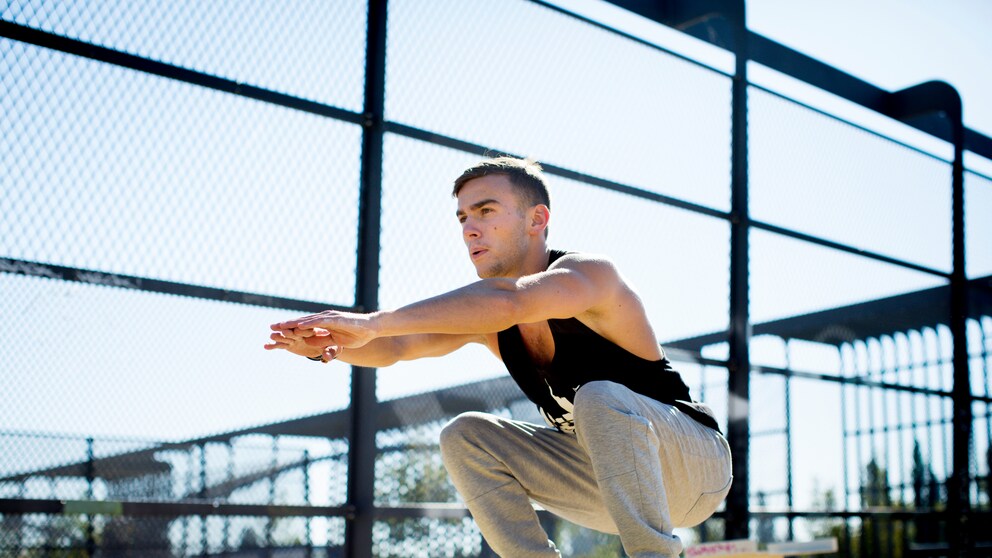
Fact is: As with muscle building through pull-ups or push-ups, four factors are essential for visible muscles in squats: nutrition, regular stimulus, sufficient recovery, and flawless technique. Markus Bremen emphasizes the fourth point: “Clean technique is important to stabilize the leg axis and keep the upper body upright. This allows for a certain depth. Squats are really effective when you go all the way down with your glutes.” So “Ass to the grass,” the expert underscores. Additionally, this optimizes hormone release, which would stimulate and support muscle growth.
Training Plan by Level – Number of Squats and Sets
Some are more experienced with squat training, while others are just starting out. And some have mastered squats almost perfectly. Accordingly, the training routine varies in terms of repetitions and intensity for each group.
However, the number of weekly training days is the same for all three levels. “I would divide it into three to four training days, focusing solely on this area. In between, take a day off,” recommends Markus Bremen. He also advises three to four sets per training day, with a corresponding number of repetitions.
Beginners
Beginners should start with 15 to 20 repetitions per set, aiming for 80 to a maximum of 100 repetitions per session. As a rule of thumb for beginners: 50 to 100 clean squats per training day.
Intermediate
Markus Bremen advises intermediates to do a total of 75 to 125 squats per day. However, they should quickly switch to heavier variations and integrate them into their training, even faster than with pull-ups, for example.
Advanced
The expert also has a number for squat pros, which doesn’t necessarily differ from the previous group. “I would aim for a maximum of 25 repetitions per set. Stick to your three to four sets, but intensify them by adjusting variations. The execution speed is also a stimulus to consider,” explains Markus Bremen. So: The faster the pace, the more intense the exercise!
By the way: Doing 200 squats a day or more wouldn’t contribute much to muscle building, as you’d be in the endurance range. The training goal would be different.
Join our FITBOOK survey!
These Squat Variations Are Especially Effective
To increase the difficulty level for intermediates and pros and make workouts more effective, there are various squat variations that can really make them sweat! Options include single-leg squats, known as pistol squats. “But it must be clear that the leg axis is stable enough or you hold on first to perform the exercise cleanly,” emphasizes Markus Bremen. Explosive jumps also push you to the limit. A challenging option is to pause briefly in the deep position and bounce a bit.

How Many Pull-Ups a Day Lead to Visible Muscles?

How Much Weight Fit Men and Women Can Squat
Introducing New Stimuli
Stagnation often means regression, and this applies to squats as well. Markus Bremen explains why this is the case: “You should quickly incorporate variations to keep the stimulus above threshold.” Only then can you achieve muscle adaptation that leads to growth. The leg area has the largest muscle mass and is the most enduring. Thus, the muscles adapt quickly. “If you maintain the same style for about three months, the body will quickly get used to it. Then, in terms of muscle building, nothing happens.”
How Squats Change the Body in Three Months
What are your starting conditions, training status, experience, and diet? These questions, among others, influence how quickly you notice progress from squat training. Three months, or twelve weeks, is the typical timeframe for initial results—divided into microcycle, mesocycle, and macrocycle.
“In the leg area, as mentioned, there’s more muscle, so changes might happen a bit faster. The thigh circumference might adjust, becoming leaner. Or more muscle might become visible, especially from the thigh down to the kneecap. These muscles can develop quickly in terms of definition,” describes Markus Bremen. This could only happen if the strain is evenly distributed. Deadlifts should be part of squats to strengthen and build the posterior muscle chain.
“Especially in the front thigh area, there will definitely be changes. It will widen, and you’ll get that ‘pump,’ making pants tighter.” The glutes will also change, becoming firmer and more stable or even protruding more. “These are the classic stories that are often considered beauty ideals,” concludes Markus Bremen. However, results can vary for each person due to different factors—every body reacts differently. There’s no universal rule.