


September 26, 2025, 1:28 pm | Read time: 6 minutes
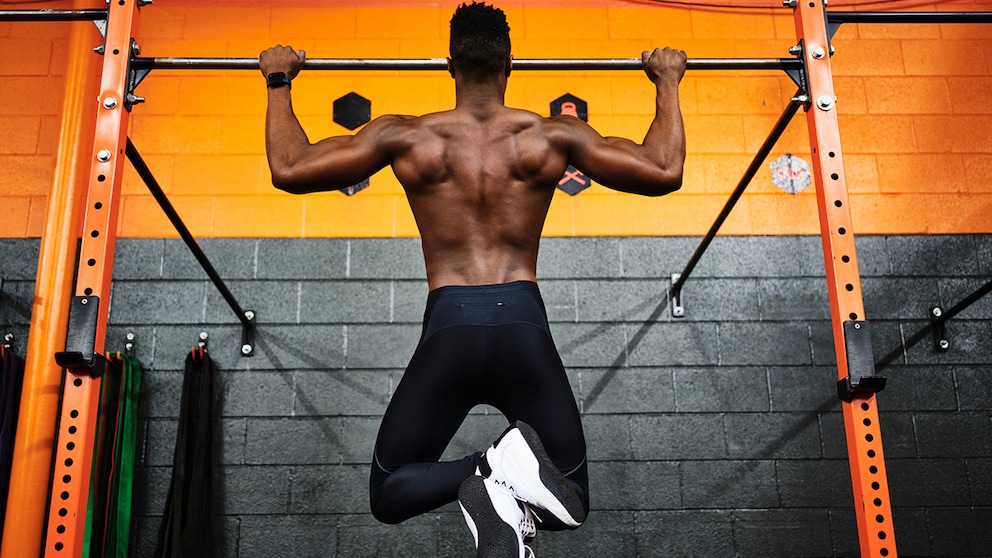
Muscle building, V-shaped back, more upper body power: Those who approach pull-up training with discipline and regularity can see visible effects in three to six months. A fitness coach explains exactly what beginners, intermediates, and pros need to do to achieve this.
Follow the FITBOOK channel on WhatsApp now!
Why Pull-Ups Are Effective
Few exercises target the upper body as effectively as pull-ups. They require a lot of strength and coordination, as well as a stable core, to pull your chin maximally over the bar. This specifically trains the latissimus dorsi, biceps, triceps, shoulder, and core muscles. However, to ensure that the strenuous pull-up workouts are not in vain and that you truly build the desired muscles, it’s important to follow some basics. Beginners should train differently than pros, but both share the number of weekly training days. However, the number of repetitions is just one of four components, as personal trainer Markus Bremen explains in an interview with FITBOOK.
The 4 Training Factors
“Four essential factors are crucial for visible muscles,” explains the fitness coach. “This quartet consists of regular stimulus, proper technique, adjusted nutrition, and sufficient recovery,” Bremen lists.
When it comes to nutrition, you should definitely keep an eye on your calories and burn more than you consume. This creates the desired calorie deficit. The result: you lose body fat, and the muscles underneath become visible. To promote growth, you also need to consume enough protein. Researchers have defined the optimal amount of protein for more muscle strength as 1.5 grams of protein per kilogram of body weight–if you are also doing strength training, FITBOOK reported.
Training Plan by Level – Number of Pull-Ups and Sets
The number one prerequisite is pull-up training: You can’t do without a certain number of daily or weekly pull-ups. For training and its frequency, fitness coach Bremen offers the following tips for beginners, intermediates, and experienced trainees.
Beginners
The expert recommends that beginners practice pull-ups three to four days a week. This amount ensures both regularity and sufficient rest periods. “For those who want to build both their strength levels and upper body accordingly, I recommend three sets of five to eight repetitions on training days. This builds good muscle mass, which becomes visible after three to six months.” Divided into sets, this results in a maximum of 15 to 24 pull-ups per training session.
Also interesting: How many pull-ups men and women should be able to do for their basic fitness
Intermediates
Those with a bit more experience and practice should aim for an increased number of pull-ups in their training. Bremen advises intermediates to complete three to five sets of ten to 15 pull-ups on three or four training days per week (no more!). This amounts to a maximum of 50 to 60 pull-ups per session or training day.
Pros
Even pros should not plan more than four training days per week, according to the expert. However, the total number of pull-ups can, of course, be increased as desired. “I would also start working with additional weight, such as weight vests,” Bremen explains. The number of repetitions would naturally decrease. It’s also possible to do a corresponding number of sets. “That would be an option too. Then I might do ten sets of five repetitions on training days, but with additional weight,” the expert explains. Experienced trainees thus reach 50 to 60 pull-up repetitions.
Too Many Repetitions – When Pull-Ups Become Ineffective
Could you not just increase the number of pull-ups indefinitely? According to fitness coach Markus Bremen, this doesn’t work–at least not if muscle building is truly the priority. “Otherwise, you’d be moving into the endurance range. In terms of hypertrophy, not much happens then,” Bremen notes.
Also interesting: How many push-ups per day lead to visible muscles
All-Out Sets for More Mass
To further stimulate muscle thickness growth, the expert also swears by so-called all-out sets. These sets are performed with maximum intensity until no more repetitions are possible. “In all-out sets, you try to do as many repetitions as possible three to five times to challenge yourself.” Pro Bremen recommends targeting the hypertrophic effect in such sets–that is, the increase in muscle size. “So I take more additional weight again, but have fewer repetitions,” he explains.
How Grip Type Affects Muscle Building in Pull-Ups
Pull-ups also include different grip variations. They emphasize different muscle groups. The seemingly simplest grip is the underhand grip, which heavily engages the biceps. Depending on the training goal, different grip widths can also be used, according to Bremen. “The wider you grip, the more intense it becomes, and the more the V-shaped back or broad back is challenged. The latissimus comes even more into focus with a wide grip,” the coach explains.
Also interesting: From overhand to mixed grip – Expert explains the different grips in pull-ups
The Right Rest Time Between Sets
To be fully recovered and minimize the risk of injury on training days, you should take a short breather between sets. “For beginners, I definitely recommend three to five minutes. Recovery, injury risk, and execution quality weigh more heavily here than for intermediates. For this group, it’s assumed that the understanding is there and the exercise is performed cleanly.” Experienced individuals need less time for recovery. For pros working on strength building, Markus Bremen suggests two to three minutes of rest between sets.
Recommendation for Rest Days
The question remains how to ideally use rest days. These are particularly important for muscle growth. “I recommend active recovery, such as light cardio training like swimming. Mobility exercises are also a nice addition,” says Bremen.

How Many Squats a Day Are Needed to See Visible Results?

How Many Push-Ups Per Day Lead to Visible Muscles
What Pull-Ups Really Change in the Body After 3 to 6 Months
It’s clear: Nothing happens overnight or immediately–you need to be a bit patient. But if you follow all the described points and work intensively on the pull-up bar, visible successes should appear after three to six months, according to the pro: You will be “swollen,” the upper body will have a bit more “pump.” The back should also be broader. Additionally, you’ll feel a different tone and have more tension. “If you look at yourself in the mirror every day, you probably won’t notice it as much,” says Markus Bremen.
It becomes more apparent if, for example, you take a friend along on your pull-up journey. It’s best to ask them to observe you from the start of training over a set period. “After three or six months, it will be more noticeable to them,” says the personal trainer. And if not? “The increase in strength is undeniable in any case,” says the pro. This will be noticeable in everyday life and sports.
Conclusion: Consistency Beats Intensity
As with almost all fitness exercises, building a healthy routine is paramount to continuously improving and ultimately reaching your goal. This means regularity and continuity over a longer period with a focus on clean pull-ups are the royal road and far more important than a certain number of repetitions under maximum effort. Moreover, there’s a risk of performing the exercise incorrectly. “Consistency beats intensity!” says Markus Bremen. Translated: Consistency and uniformity in the sessions always take precedence over intensity.