


April 14, 2026, 9:15 am | Read time: 5 minutes
Burpees don’t have a good reputation. After all, an overwhelming majority of FITBOOK readers once voted for the push-up stretch as their “most hated fitness exercise”. This is probably due to the fact that you really start to pant when performing it. Not everyone loves it. On the other hand, hardly any other full-body exercise works more muscles at the same time—and burns so many calories. A personal trainer shows you how to do it properly.
Imagine falling to the floor and having to get up again quickly—that’s exactly what you train with a burpee. It sounds banal, but it requires a few technical refinements to make the burpee what it can be for us: A great way to get the cardiovascular system pumping fast and hard, burn a lot of calories—and also train many muscle groups at the same time. Former personal trainer Erik Jäger from Berlin, now a trainer at Peloton, shows you how to do burpees correctly, gives beginners an adapted version, and tells you how many repetitions you should start with—assuming you have the right technique.
Overview
Who Do We Actually Have to Thank for the Burpee?
The burpee has nothing to do with the English “to burp”—it is named after its inventor, Royal Huddlestone Burpee. The American physiologist developed the exercise in the 1930s as part of his doctoral thesis at Columbia University. He wanted to develop a quick and simple test to assess physical fitness for the US military. During the Second World War, the US military adopted burpees as a fitness test for recruits. The exercise was designed to help measure the strength, agility, and endurance of prospective recruits. Its original version consisted of four steps:
- Squat down and place your hands on the floor
- Extend your feet backward into a push-up position
- Bring your feet forward again into a squat position
- Stand up again
In the following decades, the exercise became increasingly popular as it provides a highly effective full-body workout without equipment. More recently, the burpee has become more widespread, particularly through CrossFit, HIIT workouts, and bootcamp training. Today, there are many burpee variations, which have been developed by CrossFit in particular. For example: jumping sideways over an obstacle (burpee over bar) or jumping onto a box instead of a normal jump (burpee box jump). Standards in CrossFit competitions are as follows:
- Chest and thighs must touch the ground
- Hands must be above the head
Endurance, Muscle Groups, Calorie Consumption – These Are the Benefits of the Burpee
The exercise is considered one of the most challenging self-weight exercises because it trains both strength and endurance.
Burpees have five impressive features:
- Burpees combine squats, push-ups, and jumps, training many muscle groups simultaneously (legs, core, arms, chest, and shoulders).
- The rapid sequence of movements gets your heart rate up in a short space of time and improves your stamina. This burns a lot of calories.
- Burpees can be done anywhere—at home, in the park, or at the gym.
- The exercise simulates movement patterns that you need in everyday life (going down to the ground, getting up again). This improves functional fitness.
- Another plus: as a combination exercise, burpees improve your reaction and coordination skills as well as your endurance thanks to their complex sequence of movements.
How Many Calories 14 Burpees Burn
A few figures may illustrate the effectiveness quite well: an average of 1.4 calories is burned per burpee—with 14 burpees (and you can do them quite well if you’re reasonably fit), you burn 20 calories, which would require you to climb around four stories. Burpees are therefore very strenuous, but the work pays off. Your training progresses quickly, your fitness improves, and you will experience the afterburning effect on your own body as your breathing rate increases dramatically. Of course, the right burpee technique is a prerequisite.
The Right Technique for Burpees
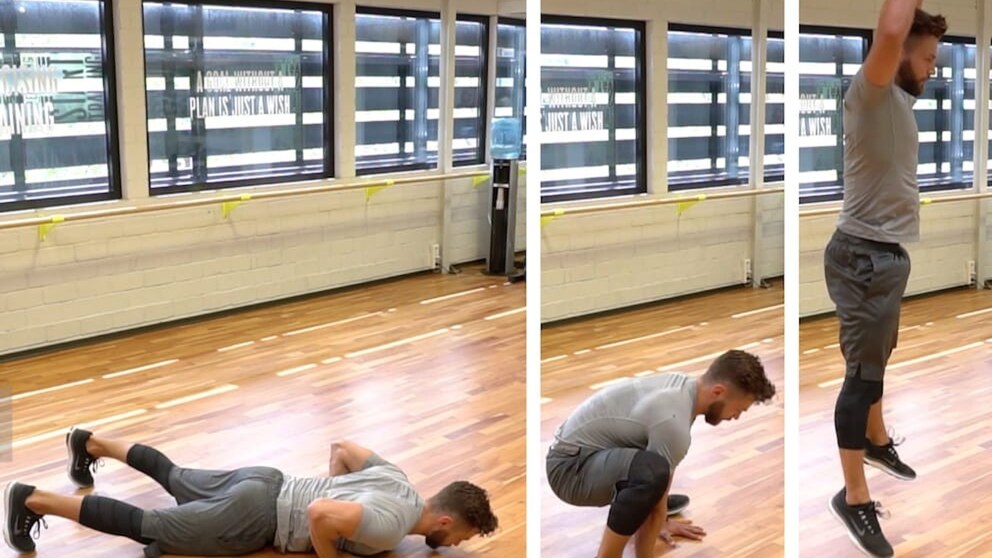
Stand upright, toes pointing slightly outwards. Squat down low and place your hands on the floor between your knees. Now push backward strongly with a jump. From this (planking) position, do a push-up with your upper body touching the floor. Push up again and jump out of the movement with your feet on the outside next to your hands. Finally, jump upwards (stretch jump). The burpee is finished.
Position of the hands
When performing burpees, pay particular attention to the position of your hands: they should remain in a line under your shoulders. To prevent your hips and bottom from sagging when jumping backward, you should counteract this by tensing your stomach and bottom. Finally, when jumping forward, make sure that your feet land on the outside of your hands and not between them.

How to Do Twice as Many Burpees in 30 Days as You Can Now

Step-by-Step Guide to Quickly Mastering Proper Burpees
Variation for Beginners
Burpees are less strenuous with this technique: you do without the push-up jumps and instead place your feet backward and forward one after the other. If you need even more relief to get started, you can put your knees down during the push-ups.
You Should Start With This Many Repetitions
It should be said again in advance: push-up extensions are extremely strenuous, so start with a low number of repetitions and keep increasing them with each workout. Personal trainer Erik Jäger advises you to start with five to ten repetitions at a time and then keep increasing to 15, 20, and so on. Alternatively, you can do the same number for a specific time, e.g., one minute. Regardless of the training level, the expert recommends three to four sets per workout.