


May 14, 2026, 12:17 pm | Read time: 4 minutes
In the fitness world, countless ab exercises now promise to achieve the much-desired six-pack. Among them, there’s one that trainer and FITBOOK expert Alina Bock calls her favorite ab exercise. It not only works the superficial but also the deeper abdominal muscles, as well as balance and coordination. Additionally, it effectively promotes muscle activation. She reveals which exercise is this all-rounder here.
Abdominal training is often included in workouts, if at all, for aesthetic reasons. Many perform exercises such as sit-ups, leg raises, and crunches, which aim to make the superficial and usually straight abdominal muscles visible with a low body fat percentage. However, the abdominal muscles consist not only of the straight abdominal muscles (rectus abdominis) but also the external oblique muscles (obliquus externus abdominis), the internal oblique muscles (internus abdominis), and the transverse abdominal muscles (transversus abdominis).
While the straight abdominal muscles are responsible for pelvic alignment and thus trunk flexion, the external and internal oblique muscles assist in lateral bending and body rotation. The transverse abdominal muscles also play a role here.
The abdominal muscles serve to stabilize and relieve the spine. By tensing the abdominal muscles and increasing pressure in the abdominal cavity, the trunk forms a stable center, thus relieving the spine. Additionally, well-trained core muscles support a healthy and upright posture, preventing postural damage and subsequent disc problems. Proper breathing also relieves and trains the pelvic floor, protecting against incontinence and other pelvic floor issues.
Also interesting: “If I have to choose a glute exercise as an expert, it’s this one”
Commonly Performed Ab Exercises and Their Limitations
Exercises like sit-ups and crunches, which are often included in workout plans to cover ab exercises, can only target the entire abdominal muscles to a limited extent. These exercises primarily train the straight abdominal muscles, covering only a small part of the core muscles.
My Favorite Ab Exercise: Heel Taps with Pilates Ball
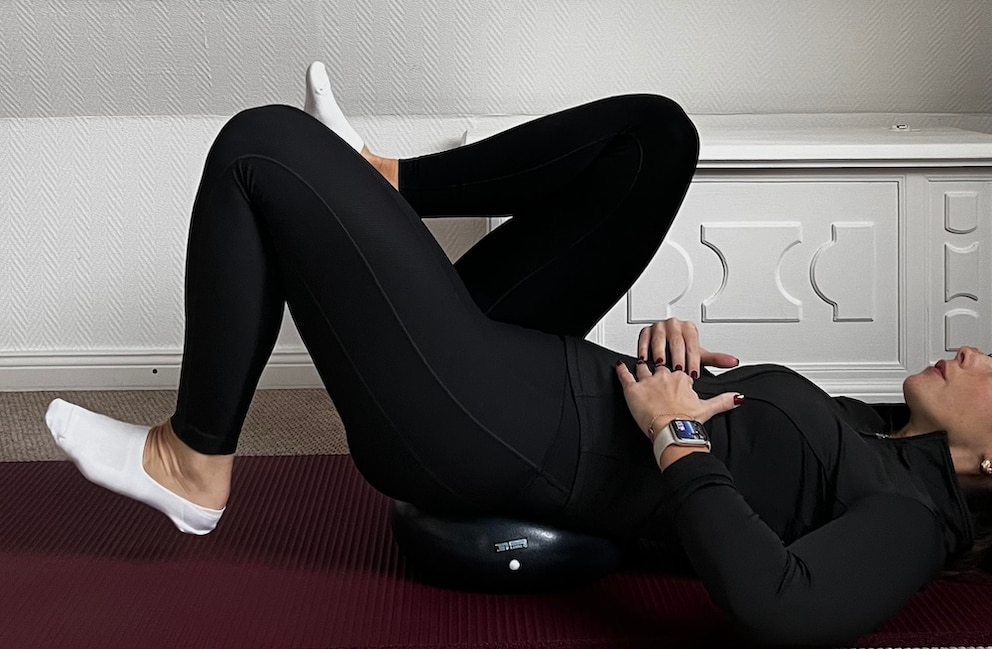
To cover a wide range of abdominal muscles and also train the deep abdominal muscles to benefit from health advantages, proper muscle activation is fundamental. As a trainer, my favorite exercise is heel taps with a Pilates ball. The reason: It targets the muscles specifically, promotes balance and coordination, and engages most of the abdominal muscles.
Proper Execution
You need a Pilates ball for the exercise. The firmer the ball, the more challenging the execution. Initially, it’s recommended to inflate the ball halfway and gradually increase the firmness.
Start in a supine position with bent legs. The Pilates ball can now be placed under the lower back. It should be positioned so that the back is actively pulled into an arch. You can place your hands on your stomach while your elbows touch the floor. Now relax the stomach and take a deep breath. Then, while exhaling, tense the stomach. It’s important to tilt the pelvis toward the ceiling and press the lower back against the ball. The arch should now be completely filled.
Now hold the tension in the stomach and lift the feet off the ground. The legs are bent in the air while the elbows on the floor provide stabilization. Then lower the heels alternately toward the ground. The heels tap the ground alternately.
To further increase intensity and promote coordination and deep abdominal muscles even more, you can lift the elbows off the ground. The deep abdominal muscles must stabilize the body during heel tapping. The abdominal muscles should be noticeably engaged. The better they can be activated and tensed, the easier it is to maintain balance.
Muscles Trained
Heel tapping on the Pilates ball trains the straight and lateral abdominal muscles, the deep abdominal muscles, and the hip flexor. By specifically tensing and incorporating an unstable surface, the deep abdominal muscles can also train the pelvic floor. This exercise is a good choice for promoting muscles, balance, and coordination. It helps alleviate and prevent back and pelvic floor problems.