

August 13, 2026, 6:07 pm | Read time: 6 minutes
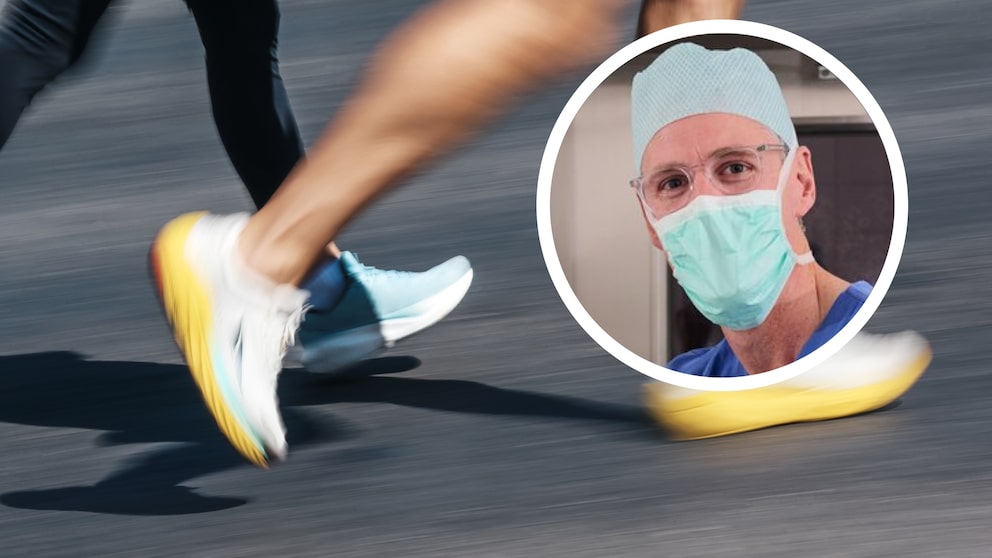
Carbon shoes generally deliver on their promise of allowing you to run a bit faster with less energy. Not only professionals but also hobby runners have long jumped on the bandwagon. The downsides of this development are increasingly observed by orthopedic chief physician Thomas Kälicke in his practice: Patients report similar pain patterns. What the expert advises runners who want to switch to carbon–and who he generally advises against it.
Since carbon plates and highly reactive foams have dominated the midsoles of modern competition shoes, marathon times have literally exploded. Many experts believe that these so-called super shoes can improve running economy by one to four percent. In a marathon, such differences can decide minutes. However, I do not observe the downside of this development with world record holders, but in my orthopedic practice.
This is how carbon running shoes make you faster: Inside is a stiff carbon plate surrounded by highly reactive foam. This system works, simply put, like a spring. When the foot lands, energy is stored. When pushing off, part of this energy is released and transferred forward. At the same time, the carbon plate changes the foot’s rolling motion and improves running economy.
What I observe in my practice
I have been an orthopedic chief physician for many years and treat people with musculoskeletal complaints daily. In recent years, I have gained the impression that chronic Achilles tendon complaints have become significantly more common.
Of course, there is no personal statistic for this. But it is strikingly common for the medical history to begin with a sentence like: “Actually, I haven’t changed anything. I just bought new running shoes.” And often, these are carbon shoes.
When patients with Achilles tendon pain appear at the orthopedist, the diagnosis of overuse is often made. This is usually correct. But the crucial question is: Why did this overuse occur in the first place? This is where a detailed medical history is worthwhile.
- What has changed in recent weeks?
- Has the training volume increased?
- Were additional intervals added?
- Were there weight changes?
- Was the running technique changed?
- Or were simply new shoes bought?
Also interesting: Tested! The Crivit “Carbonlite 1.0” from Lidl in the recreational runner check
For gradually developing pain, this question is worthwhile
For gradually developing pain, it is always worthwhile to take a step back and ask yourself this question: What have I done differently recently? The answer often already provides the key to the diagnosis.
The Achilles tendon is the strongest tendon in our body. It connects the calf muscles to the heel bone and must transmit enormous forces with every running step. At the same time, it is significantly less well supplied with blood than a muscle and adapts much more slowly to new loads.
That is precisely why I repeatedly see the same situation: The muscle already feels capable, but the tendon is not yet. I have already described this principle in a previous FITBOOK article: Muscles respond surprisingly quickly to training stimuli, while tendons often take months for structural adjustments.
This is where the danger arises. The runner feels fit–the tendon thinks otherwise. And at some point, it signals with pain, chronic irritation, or, in the worst case, a tear.
Typical complaints after switching to carbon shoes
Due to the stiff carbon plate and the special sole construction, loads shift within the entire movement chain: Part of the forces is directed more towards the calf and Achilles tendon. Especially runners who have previously only used traditional training shoes and switch to carbon relatively abruptly often feel this change very clearly.
Typical complaints are:
- Pain a few centimeters above the heel bone
- Starting pain in the morning
- Pressure pain along the Achilles tendon
- Tension in the calf
- Complaints after tempo runs
Often, it is not only the tendon itself that is affected. The surrounding tendon glide tissue can also become inflamed and cause pain.
My own experience with carbon shoes
I must admit at this point: I love carbon running shoes. As a former 400-meter runner, I still have a certain affinity for speed. When I put on my first pair, I was immediately thrilled. The shoe feels fast, direct, explosive. You immediately notice that you run differently. Unfortunately awesome. That’s exactly what makes it so tempting.
However, I also felt that the load felt unusual. Maybe I was just a bit sensitized as an orthopedist. In any case, I consciously did not make the mistake of running ten kilometers with them right away. My first sessions were on the treadmill. I warmed up with normal shoes and then switched to carbon shoes for a few minutes. I gradually extended these intervals over several months. This gave my Achilles tendon enough time to structurally adapt. Result: Today, I can easily run ten kilometers in carbon shoes when I want to pick up the pace.
Who I advise against carbon shoes and who I don’t
Ultimately, everyone has to decide for themselves. My personal opinion: For ambitious runners, these shoes can be an interesting training tool. Especially for tempo runs and interval training.
Recreational runners usually have no measurable benefit but carry a higher risk of injury due to unstable soles. I would say: If you can’t run ten kilometers safely under 50 minutes and don’t have performance-oriented goals, you generally don’t need a carbon shoe.
Additionally, the shoes are expensive, costing between 250 and 500 euros depending on the model. At the same time, the foam and carbon construction quickly lose their original properties. Those who train regularly with them must expect to buy new shoes much more frequently than with traditional training shoes.

Can I, as a Beginner Runner, Become as Fast as Ricarda Lang in a Year?

Why People Get Injured Just as They Become Fitter
Achilles tendon problems?
If there is already chronic Achilles tendinopathy–that is, persistent pain and irritation of the Achilles tendon–I generally recommend taking a break from carbon shoes initially. During this phase, other things take priority:
- targeted strength training for the calf muscles
- regular and sufficiently long stretching
- cryotherapy
- gradual load increase
The re-entry should be slow, indeed very slow. This works particularly well on the treadmill! First, warm up with normal shoes, then follow with a few minutes in the carbon shoe. These intervals are increased over weeks and months. The same principle works outdoors–a second pair of shoes in a small running backpack is enough.
My conclusion
Carbon running shoes are fascinating technology. They can make you faster, can be fun, and have undoubtedly contributed to performances today that seemed almost unimaginable a few years ago. But every technological advancement also has a downside. In my practice, I regularly see runners who were thrilled by the speed of the new shoes–but whose Achilles tendon did not have enough time to adapt to the changed load. The biggest mistake many hobby runners make is not the carbon shoe. The biggest mistake is believing that the Achilles tendon adapts as quickly as the enthusiasm for the new shoe.