


March 4, 2026, 11:53 am | Read time: 7 minutes
Do squats train your bottom? Yes, but much more than that. FITBOOK author Nina Ponath reveals here how the supreme discipline of strength training works.
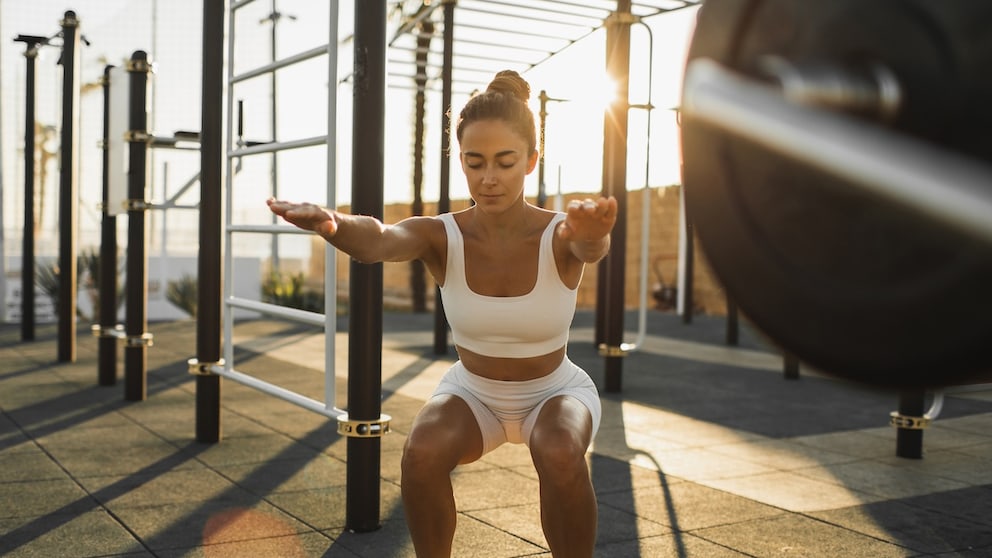
“Squats? They train your legs and bottom, don’t they?” There’s no doubt that squats work your legs. It’s not for nothing that the exercise is considered the supreme discipline of strength training. But a squat can do much more than that. It is one of the most effective and versatile strength exercises. FITBOOK asked a personal trainer and sports scientist which muscles are really used during squats. He reveals exactly which muscle groups are involved and why this exercise should not be missing from any training plan.
Overview
Why Are Squats So Effective?
Squats are a so-called multi-joint exercise, which means that they work several muscle groups at the same time. Together with push-ups, pull-ups, deadlifts, and rowing, they are also among the basic strength training exercises. Squats are ideal for building strength and muscle mass without spending too much time. But that’s not all. They not only have a positive effect on muscle strength but also improve mobility and posture. They also ensure a strong core, which has a positive effect on many other movements in everyday life and during sport. Squats also promote intermuscular coordination, i.e., the interplay between different muscle groups, which leads to more efficient movement sequences.
Which Muscle Groups Are Used During Squats?
“Squats train almost the whole body,” says personal trainer Andreas Heumann, “you have a mixture of stabilization, i.e., muscles that work statically, such as the core and back muscles, and muscles that work dynamically, such as the quadriceps and adductors.”
Quadriceps (anterior thigh muscle)
The quadriceps femoris consists of four muscle heads and is located on the front of the thigh. It is the main player in the squat as it is responsible for knee extension.
Gluteal Muscles (gluteus maximus, medius, minimus)
The gluteal muscles play a crucial role in stabilizing the hips and help to push yourself back up from a deep squat. The gluteus maximus in particular is used intensively.
Leg Flexors (ischiocrural muscles)
The muscles on the back of the thigh, consisting of the biceps femoris, semitendinosus, and semimembranosus, support the squat by stabilizing the knee and controlling the movement.
Calf Muscles (gastrocnemius and soleus)
The calf muscles help to maintain balance and stabilize the ankle joint during the entire movement.
Adductors and Abductors
During the squat, the adductors (inner thigh muscles) and abductors (outer hip muscles) are also activated, which makes the exercise a comprehensive workout for the entire lower half of the body.
Core Muscles
The abdominal and back muscles play a crucial role in keeping the upper body stable. The straight abdominal muscle (rectus abdominis) and the deep core muscles (transversus abdominis, multifidus) are particularly heavily involved.
Measurable Strain on the Muscles
“There are evaluations using EMG,” says Andreas Heumann, “which show exactly which muscles are used to what extent and how.” The sports scientist refers here to a scientifically based analysis of muscle activation that shows the strain on the different muscle groups to varying degrees.1
The sequence is based on EMG studies (electromyography), biomechanics, and physiological stress and is as follows:2,3,4
Primary Agonists (main muscle groups, highest activation)
These muscles are mainly responsible for the movement during the squat:
Quadriceps femoris (front thigh)
- Especially the Vastus Lateralis, Vastus Medialis, Vastus Intermedius, and Rectus Femoris
- Extension of the knee (knee extension)
- EMG values: approx. 60 to 80 percent of maximum activation
Gluteus maximus (large gluteal muscle)
- Strongest hip extension (extension)
- Especially during deep squats or squats with high loads
- EMG values: approx. 40 to 70 percent of maximum activation
- Deep squats activate the gluteus more than parallel squats
Secondary Agonists (high activation, but not primarily responsible for the movement)
These muscles support the movement considerably:
Adductor Group (inner thigh)
- The adductor magnus is particularly active as it supports hip extension
- The wider the stance, the greater the activation
- EMG values: approx. 30 to 50 percent of maximum activation
Hamstrings (posterior thigh muscles)
- Biceps femoris, semimembranosus, semitendinosus
- Support hip extension, but less than the gluteus maximus
- Low activation with classic squats because they do not cause knee extension (high activity only in combination with hinge movement)
- EMG values: approx. 20 to 40 percent of maximum activation
Stabilizers (lower activation, but essential for controlling the movement)
These muscles stabilize the movement without providing the main force:
Erector spinae (back extensors)
- Isometric holding work of the spine
- The heavier the load, the higher the activation
- EMG values: approx. 20 to 40 percent of maximum activation
Core Muscles (trunk)
- Rectus abdominis, obliquus externus/internus, transversus abdominis
- Stabilize the pelvis and prevent it from tilting forward
- Particularly heavily used during front squats and overhead squats
- EMG values: approx. 15 to 35 percent of maximum activation
Calf Muscles (gastrocnemius and soleus)
- Stabilize the ankle joint
- Higher activation with deeper squats or squats with heel raises
- EMG values: approx. 10 to 30 percent of maximum activation
Summary of Muscle Activation by Order of Stress
- Quadriceps femoris (60-80%)
- Gluteus maximus (40-70 %)
- Adductors (30-50 %)
- Hamstrings (20-40 %)
- Erector spinae (20-40 %)
- Core muscles (15-35 %)
- Calf muscles (10-30 %)
Important Factors for Activation
Which muscles are used to what extent depends on the movement and the position of the barbell, says personal trainer Andreas Heumann: “The EMG evaluation relates to ‘high bar squats,’ where the bar is placed on the trapezius and the shoulder muscles. There are also low bar squats, but very few people can do them well.
Note: Contrary to the belief that the buttocks should not sink lower than the knees, deep squats are absolutely permitted and even desirable if you want to train the buttocks. “The deeper you go, the more the gluteal muscles are used,” says Andreas Heumann.”
The activation is as follows, depending on the type of squat and posture:
- Deeper squats: more gluteus and adductors
- Wider foot position: greater activation of the adductors
- Higher weight: more quadriceps and core
- Front squat: greater core activation than back squat
- High bar vs. low bar: low bar activates more hip extensors, high bar activates more thigh muscles
Why Are These Muscles Important?
The muscle groups trained by squats are essential in everyday life and sport. They support us when walking, running, jumping, and lifting weights. Strong leg and gluteal muscles also prevent injuries and improve posture. Well-trained muscles contribute to an increased basal metabolic rate, which means that the body burns more calories even at rest. This can help with weight loss and weight maintenance.
Squats or Deadlifts: Which Strength Exercise Is Better for You
Hip Thrust or Squat: Which Is Better for a Toned Butt?
Conditioning and Coordination Also Benefit From Squats
Squats are not only strength training, but also excellent fitness training. By using large muscle groups, the cardiovascular system is challenged, which improves endurance. The correct execution of squats also requires a high level of coordination. The interaction of muscles, joints, and the nervous system is trained, which optimizes movement sequences in everyday life and during sport. If squats are performed with additional weights or at a faster pace, the physical challenge increases further.
Conclusion
Squats are one of the best full-body exercises in strength training. The exercise saves time as it trains many muscle groups simultaneously. Squats are therefore ideal for muscle building, body stability, and general fitness. Regardless of whether you are a beginner or advanced, squats should not be missing from any training program. By integrating squats into your training plan, you can not only build strength and muscle mass but also improve your stamina, coordination, and flexibility. This versatile exercise, therefore, contributes to a comprehensive increase in physical performance and supports an active and healthy lifestyle.