

January 19, 2026, 7:11 pm | Read time: 4 minutes
Is dumbbell bench pressing equivalent to the classic barbell bench press–or does it offer different training stimuli? And what truly matters for correct execution? Find answers and a step-by-step explanation here.
Follow the FITBOOK channel on WhatsApp now!
The Correct Execution
Assume Position
- First, stand with your back to the flat bench and grip the dumbbells with a neutral grip. Then, sit down on the bench in a controlled manner and place a dumbbell on each thigh.
- Your feet should be firmly and fully on the ground, about shoulder-width apart. The knees are slightly opened outward to create a stable base. Keep your back straight, with shoulder blades slightly pulled back.
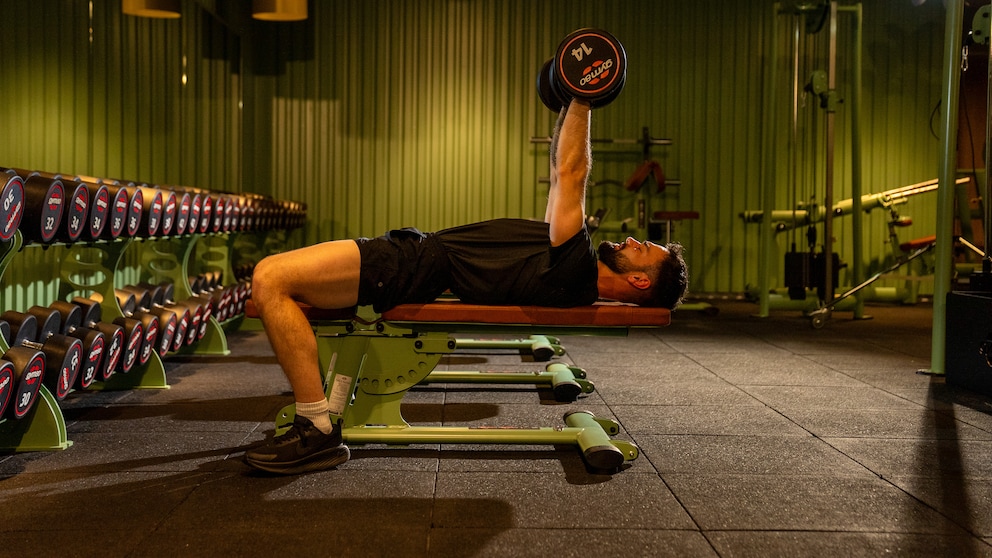
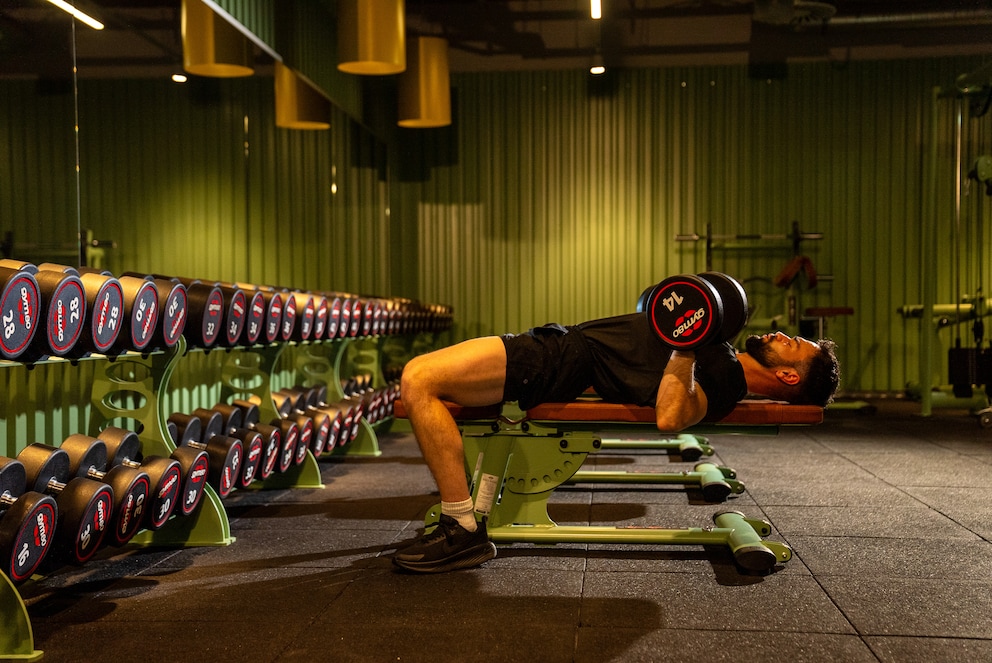
- Now lie down on the flat bench with a straight back. Support the movement by using your thighs to guide the dumbbells up to your chest. In the starting position, the weights are beside your chest at the level of the lower chest area.
- Hold the dumbbells with an overhand grip, so the thumbs point toward each other. The elbows are bent and point diagonally outward, at an angle of about 45 to 60 degrees to the torso. The head rests relaxed on the bench, with your gaze directed upward.
- Keep your buttocks and upper back in contact with the bench. Actively press your feet into the ground to ensure stable body tension throughout the exercise.
Movement Sequence
- From the starting position, press the dumbbells upward in a controlled manner. The arms extend almost fully without locking the elbows. The weights move in a slightly inward path over the chest.
- In the top position, briefly stabilize the dumbbells. Then slowly and controlled lower them again until they are at chest height on the sides. The elbows point diagonally outward and remain at an angle of about 45 to 60 degrees to the torso.
- Throughout the movement, keep your buttocks and upper back in contact with the bench, and actively press your feet into the ground. Exhale when pressing up, inhale when lowering.
Bench press – better on the machine, with free weights, or with a barbell?
Bench Pressing: Targeted Muscles, Technique, and Common Mistakes
Are Dumbbells Better for the Exercise Than Barbells?
Better? Not necessarily–but different!
Range of Motion
Dumbbells allow for freer arm movement, as wrists and elbows are not constrained by a fixed bar. This often enables a slightly greater downward movement, allowing the muscle to work over a longer path. A greater range of motion can increase the load on the chest muscles and contribute to greater muscle growth.1
Movement Control
Since the dumbbells are moved independently, both arms stabilize and guide the weight on their own. This activates not only the chest muscles but also numerous additional muscles in the shoulder girdle, which are less engaged during barbell training. Especially the stabilizing muscle groups work more intensively and also strengthen the core.
Balancing Strength Differences
Dumbbells make it possible to reveal strength differences between the left and right sides. Since both arms work independently, muscular imbalances cannot be compensated for but become apparent in the movement sequence. This can be particularly important for achieving a balanced strength level and clean technique.
These Muscles Are Engaged
In classic dumbbell bench pressing on the flat training bench, the focus is primarily on the large chest muscle (pectoralis major). To specifically target certain areas of the chest muscles–such as the upper or lower part–alternatives like incline bench pressing or decline bench pressing with dumbbells are recommended.2
In addition to the chest muscles, several supporting muscle groups are also engaged. These include particularly the triceps (triceps brachii), the front part of the shoulder muscles (deltoid, clavicular part), and the serratus anterior. These muscles stabilize the movement and actively contribute to the execution of the exercise.