

August 29, 2025, 8:54 am | Read time: 4 minutes
Lumps under the skin can be a huge shock for those affected. If they are lipomas, there’s no need to worry: These slow-growing, benign tumors originate from fat cells and are harmless in most cases. Learn why lipomas occur, how to recognize them, and in which rare cases they should be removed here.
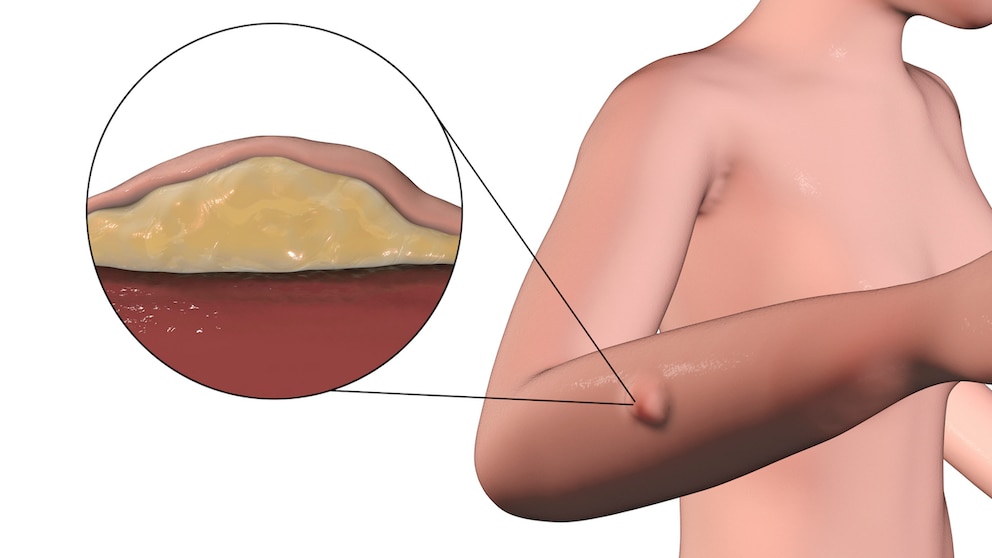
A lipoma is a benign, non-cancerous lump of fatty tissue that slowly develops between the skin and the underlying muscle layer. These fatty nodules are mostly harmless. They only need to be treated or removed if they are bothersome, painful, or growing. Those affected often find lipomas aesthetically displeasing.
How to Recognize a Lipoma
In addition to the noticeable, knot-like bulge on the skin, a lipoma can be identified by several characteristics. A lipoma …
- … is located directly under the skin
- … is colorless, round, and oval-shaped
- … feels soft
- … does not hurt
- … can be moved with light pressure
- … typically has a diameter of less than five and no more than ten centimeters
- … does not spread to the surrounding tissue
- … may grow slowly
Lipomas are very common and primarily appear on the arms, legs, shoulders, neck, and abdomen. Multiple nodules can develop simultaneously (lipomatosis), but this is very rare.1
Also interesting: Wild Flesh on Piercings – What Is It and What Can Be Done About It?
Different Types of Lipomas
While all lipomas consist of fat, some may also contain other tissue or blood vessels. Different types are distinguished:2
- “Conventional” lipoma: consists of white fat cells
- Angiolipoma: lipoma that also contains blood vessels
- Fibrolipoma: consists of fat and fibrous tissue
- Hibernoma: consists of brown fat
- Myelolipoma: contains fat and blood cell-producing (hematopoietic) tissue
- Pleomorphic lipoma: consists of fat cells of varying shapes and sizes
- Spindle cell lipoma: a mix of spindle cells and fat cells
The type of fatty lump present can only be determined by a doctor through ultrasound and/or microscopic examination.
Possible Causes
The exact causes of lipomas are not yet understood. Possible triggers include genetic predisposition, metabolic disorders such as diabetes mellitus, and high blood fat levels (hyperlipidemia). Additionally, there are some rare conditions, including Dercum’s disease, Gardner syndrome, hereditary multiple lipomatosis, and Madelung’s disease, that can cause lipomas.
When and Who Gets Lipomas?
The lumps usually appear after age 40 and are slightly more common in men than women. Additionally, years of excessive alcohol consumption can increase the risk of developing Madelung’s disease. This is a fat distribution disorder that triggers lipomatosis, the formation of multiple lipomas, and primarily occurs in men between 30 and 60 years old.
Diagnosis
In general, any sudden lump on the skin should be examined by a doctor. This is the only way to rule out a malignant tumor or cancer. Typically, the doctor will first inspect the lipoma by touching it and asking about sensations. A biopsy may be necessary, where a small sample of the lipoma is taken and sent to a lab for examination.
Additionally, imaging tests such as ultrasound, computed tomography (CT), or magnetic resonance imaging (MRI) can clarify whether it is indeed a lipoma and, if so, how deep and where it is located. These tests can also reveal whether the fatty lump contains blood vessels and if it is pressing on nerves or other tissue.3

Itchy Armpits Can Indicate These Cancers
How Aggressive Is White Skin Cancer?
Treatment Options
As long as the lipoma does not hurt, is not uncomfortable, does not interfere with movement, or continue to grow, it does not need to be removed for medical reasons. However, those affected often find the lump aesthetically displeasing. The surgical procedure for removal is usually performed under local anesthesia. The doctor cuts the tumor out of the surrounding tissue and then stitches the wound. Alternatively, a lipoma can be removed via liposuction, although this carries a higher risk that the fatty lump may not be completely removed.4,5
Can Lipomas Be Prevented?
Since it is unclear why lipomas develop, there are currently no measures to reduce the likelihood of their occurrence. The only risk that can be mitigated is developing Madelung’s disease (also known as Madelung’s fat neck) by limiting alcohol consumption. This is a form of multiple lipomatosis—a rare and benign fatty lump characterized by abnormal, symmetrical fat distribution in the head, neck, trunk, and proximal parts of the upper extremities.