

June 15, 2026, 8:02 am | Read time: 4 minutes
As a patient, when having your blood pressure measured in a medical facility, you usually don’t need to do much more than roll up your sleeve. The rest is typically handled by medical staff, or more precisely, by the often-used automatic blood pressure monitors. However, this doesn’t necessarily mean that everything is done correctly during the measurement. Not least, when measuring at home, it’s important to know that arm position during the measurement is crucial. FITBOOK examines the scientific perspective on this topic and has also spoken with doctors.
Study on the Impact of Arm Position During Blood Pressure Measurement
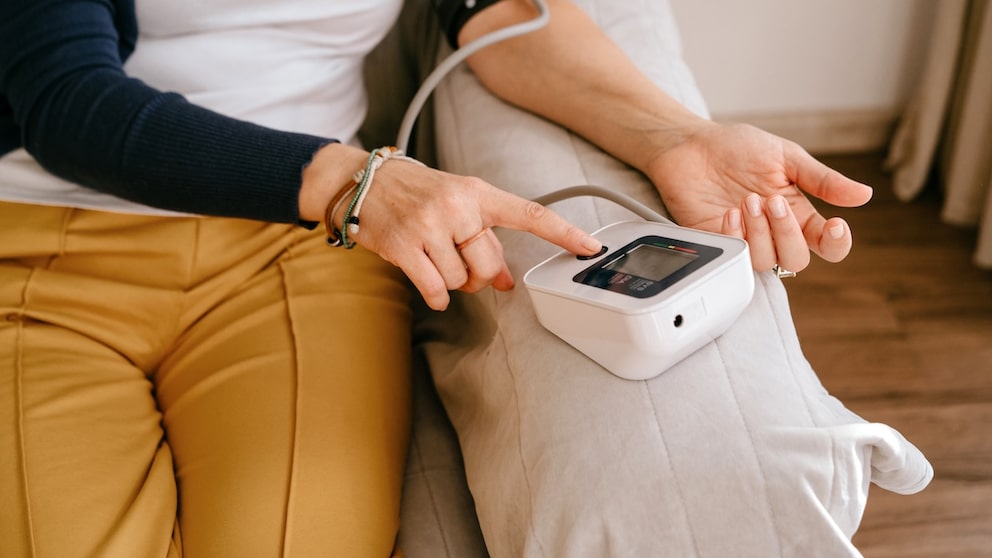
How do you sit when measuring your blood pressure? Probably quite comfortably—you likely rest your arm relaxed on your lap. But this can distort the results. This is a “common clinical experience,” as internist Dr. Matthias Riedl confirms in a conversation with FITBOOK.
The most methodologically robust and clinically prominent modern study on this topic comes from researchers at Johns Hopkins University in 2024.1 The study found that incorrect arm positioning during blood pressure measurement can lead to significantly elevated readings. Particularly “incorrect” would be an arm resting on the lap or an unsupported, hanging arm.
Details of the Study
The study involved 133 adults aged 18 to 80. Researchers compared different arm positions during blood pressure measurement with automatic devices. Each person was measured multiple times—once with the arm correctly supported at heart level and in incorrect positions, such as with the arm on the lap or hanging to the side. Between measurements, participants walked briefly and then took a rest period.
The result: When the arm was on the lap, the systolic blood pressure was, on average, nearly 4 mmHg (millimeters of mercury) too high. An arm hanging to the side increased it by about 6.5 mmHg. Diastolic values also rose measurably.
Significance of the Findings
The researchers emphasize that their results could particularly apply to automatic blood pressure monitors. Nevertheless, they conclude from their study that even small errors in arm positioning can significantly distort blood pressure readings. As a result, people could be mistakenly classified as having high blood pressure–in extreme cases, even with values corresponding to stage 2 hypertension. This could lead to unnecessary medication treatments.
The Correct Arm Position–and What Else Matters
The study shows that the upper arm should be supported at heart level during blood pressure measurement. This recommendation is also found in the guidelines of the American Heart Association and the European Society of Hypertension, which call for a stable, resting arm position.2,3
This standard has now also been established in medical practice, as general practitioner Michael Feld confirms upon FITBOOK’s inquiry. He recommends placing the patient’s arm on a cushion, for example. If the upper arm is below heart level, the readings tend to be too high. Conversely, if it is above, blood pressure readings can be falsely low.

Incorrect Arm Position During Blood Pressure Measurement Can Skew Results
Hypertension Expert: “Patients with High Blood Pressure Are Three Times More Likely to Suffer from Depression”
Influence of the Cuff and the Measured Arm
But that’s not all. The choice of cuff is also important: It should neither be too large nor too small. Measuring a broad arm with a too-thin cuff will again skew the readings upward. A wide cuff on a thin arm could lead to readings that are too low.
Differences can also occur between the right and left arms when measuring blood pressure. As Dr. Feld explains, deviations of several mmHg are quite normal. Therefore, it is often initially measured on both arms to determine which side has higher values. For subsequent control measurements, the same arm should be used whenever possible.
Beware of the “White Coat Syndrome”
And one more thing: Dr. Feld points out that sufficient time should be allocated for blood pressure measurement. He refers to the so-called white coat syndrome (white coat hypertension)—a phenomenon where readings are higher in the doctor’s office than at home. According to the expert, the cause is usually excitement or tension in the medical environment, and a bit of calm might help alleviate this.