

November 7, 2025, 7:28 pm | Read time: 6 minutes
Skiing, playing soccer, or heavy lifting from a squat—many everyday and sports movements share a bitter commonality: They are among the most frequent triggers for a meniscus tear. FITBOOK, with expert support from orthopedic surgeon and trauma specialist Caroline Skuhr, shows which risk factors are particularly significant and how knee injuries can be prevented.
Overview
Why the Meniscus Is So Important
Strictly speaking, there isn’t just one meniscus, but two: the medial and lateral meniscus. Both are located on the outer side of the knee and together perform a central function: They act as shock absorbers between the tibial plateau and the femoral condyle. Without this buffer, the knee joint would be subjected to up to six times more stress under load.1 The unique composition of one-third collagen and two-thirds water gives the menisci their elasticity and enables their function as natural shock absorbers. Especially during running and jumping, when enormous forces act on the knee, the indispensability of the menisci becomes evident.
The Meniscus Tear
What Are the Different Types of Meniscus Tears?
- Longitudinal Tear: Runs along the length of the meniscus. Depending on the extent, it can significantly impair the shock-absorbing function.
- Horizontal Tear: Divides the meniscus into an upper and lower half. This injury significantly weakens the joint’s support and load-bearing capacity.
- Radial Tear: Runs from the inside out and disrupts the entire structure. Particularly consequential, as it massively affects the stability of the meniscus.
- Buckethandle Tear: A longitudinal tear where a piece of the meniscus shifts into the joint. This often leads to a painful blockage.
- Flap and Parrot-Beak Tears: Special forms that can also cause acute pain and often result from a combination of wear and injury.
Causes
Statistically, meniscus tears occur slightly more often in men than in women. In a larger group, this means: While about 100 cases are expected among 100,000 men, the number for women is around 40.2
Each year, one in a thousand people sustains a meniscus injury. The reason is that a meniscus tear can essentially happen anywhere. Acute start-stop movements and severe twisting motions are the triggers for the tear. Certain activities or physical conditions can further promote the occurrence of the tear, including:
Sports
Many meniscus tears occur during sports: abrupt twisting movements and heavy loads directly impact the knee. High-impact sports such as tennis, squash, or jogging are particularly risky, says orthopedic surgeon Caroline Skuhr. Whether damage actually occurs, however, strongly depends on factors such as leg alignment, fitness, and training preparation.
Work
Work life can also heavily strain the menisci. Especially activities that require prolonged kneeling or squatting exert enormous pressure on the joint. Combined with lifting heavy loads, this can increase the risk of a meniscus tear. Professions such as caregivers or tilers see meniscus tears more frequently.
Overweight
Overweight is one of the most important risk factors. Skuhr explains: “It’s not just purely mechanical stresses: Overweight also promotes inflammatory metabolic processes that can further weaken the meniscus.”
Orthopedic Risk Factors
In addition to external influences, individual conditions also play a role. Overweight is one of the main risk factors, as it permanently overloads the knees. Misalignments such as knock-knees or bowlegs alter the force impact in the joint and promote wear. Previously sustained injuries, like an ACL tear, also increase the risk of a meniscus tear.
Older Patients
As age increases, meniscus tissue loses elasticity and becomes more prone to tears. A degenerative meniscus tear thus occurs more frequently, even with relatively harmless movements. A small stumble or abrupt turn can already be enough.
Physical Limitations
Nearly 18 percent of all German adults suffer or have suffered from osteoarthritis. The disease leads to a weakening of the cartilage structures, thereby increasing the risk of meniscus damage.3 About 60 percent of people with knee osteoarthritis experience meniscus damage or tears—often without a preceding acute accident.4 Additional muscular weaknesses, limited mobility, or existing joint diseases further reduce the load-bearing capacity of the menisci.
Symptoms
- Clicking or snapping sound in the knee
- Swelling
- Knee pain
- Limited mobility
- Feeling of blockage
- Instability
In the case of an acute tear, the pain is immediately noticeable during twisting or bending movements, often accompanied by swelling or blockage. Small tears are carried by sufferers for a long time before they even realize they have a meniscus tear. The time span until noticing can range from hours to days to weeks after the injury occurs. People aged 40 and older, in particular, often no longer feel any pain. For them, a meniscus tear is only discovered during an examination.
Diagnosis
The diagnosis of a meniscus tear usually begins with a thorough medical history and physical examination. Typical complaints such as pain during twisting movements, movement restrictions, or a feeling of blockage in the knee are crucial. The doctor specifically checks mobility, palpates the joint space, and looks for swelling, instability, or a changed gait pattern.
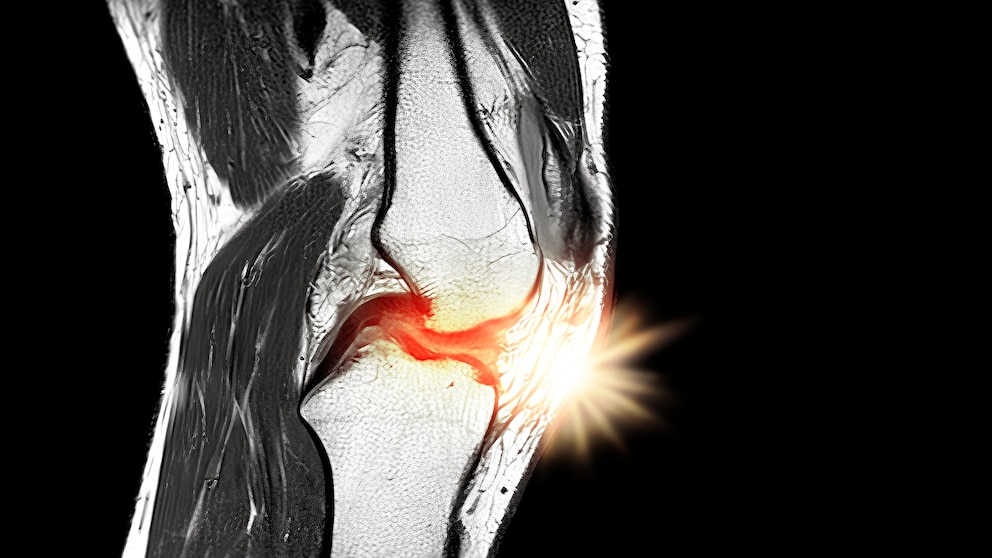
Further clarification may require an X-ray—not so much to visualize the meniscus itself, but to rule out bony injuries or advanced osteoarthritis. An ultrasound examination provides only limited meaningful results, as deeper meniscus parts are hardly captured. For precise assessment, an MRI is often the method of choice.
What Is Worse for the Knees–Knock Knees or Bowlegs?

Arthritis: Signs of the Incurable Disease and How to Prevent It
Treatment
After a meniscus tear, initial acute care is the priority: immobilization, cooling, and pain medication. However, the choice of further therapy, whether conservative or surgical, is crucial.
Physical therapy plays a central role. Depending on the location and severity of the tear, it can not only delay surgeries but also replace them—for example, in degenerative damage or smaller, stable tears. The goal is to relieve the joint, strengthen the muscles, and restore mobility.
If the knee is blocked or the pain persists, an arthroscopic operation is primarily necessary.
The Danger of an Undetected Tear
Without or with inadequate treatment of the meniscus tear, knee health can be impaired in the long term. A small, “silent” meniscus tear is initially less dramatic than an acute, large tear and often causes no or only minor discomfort, says Skuhr. Nevertheless, chronic pain, an increased risk of knee osteoarthritis, and reduced mobility can follow in the long run.
Prevention
Meniscus tears cannot be completely avoided—but the risk can be significantly reduced. The key is load control: Those who frequently perform kneeling activities or engage in intense sports should focus on muscular stability. Well-trained thigh muscles relieve the knee joint and protect the menisci during abrupt movements or strong force impacts. Balance and coordination training, such as on unstable surfaces, can also help improve the fine compensatory movements that keep the knee stable.
The orthopedic surgeon emphasizes that a well-trained knee can remain resilient even with meniscus problems. With stabilizing muscles, appropriate footwear, and targeted preparation, even a marathon is possible.
Another important factor is correcting individual risk factors: Overweight should be consistently reduced, and misalignments like knock-knees or bowlegs should be managed orthopedically. The better the leg’s alignment, the less mechanical stress on the meniscus, and the longer the knee remains resilient.