

November 20, 2026, 9:04 am | Read time: 5 minutes
Pelvic floor exercises are often associated with women after childbirth. However, men can also benefit from a strong pelvic floor–such as in cases of bladder weakness or after prostate surgery.
Most people only pay attention to their pelvic floor when it causes problems. Yet, the muscles perform important functions: They help control the bladder and bowel and play a role in sexual function. Especially after prostate surgery, targeted pelvic floor exercises can be beneficial for men.
What is the function of the pelvic floor in men?
The pelvic floor consists of several layers of muscles and connective tissue that close off the pelvis from below. It supports the pelvic organs and is involved in controlling urine flow.
The basic functions are similar in men and women. Anatomical differences arise, among other things, from the prostate, which is located below the bladder in men and surrounds the urethra.
Why pelvic floor exercises can help after prostate surgery
Pelvic floor exercises can be especially important after the surgical removal of the prostate, such as due to cancer. The procedure can affect structures important for controlling urine flow.
A possible consequence is urinary incontinence: Those affected may involuntarily lose urine, for example, when coughing, sneezing, or during physical exertion. The severity and duration of symptoms depend on factors such as the surgical technique, the function of the sphincter muscle, and individual conditions.
Targeted pelvic floor exercises are often used to improve urinary control after the procedure. However, it is not clear how effective they really are. A 2023 Cochrane review, which evaluated 25 studies with a total of 3,079 men, concluded that the benefits of conservative treatments after prostate surgery remain uncertain.1
Nevertheless, it can be beneficial to learn the exercises under the guidance of a physical therapist. Often, training begins before the surgery.
How men can recognize a weak pelvic floor
A weakened pelvic floor can manifest in various ways. One possible sign is involuntary urine loss, such as when coughing, laughing, or exercising. Difficulty controlling urine flow can also indicate impaired pelvic floor function.
Additionally, the pelvic floor muscles can play a role in erectile problems. However, such issues are not a clear indication of muscle weakness. An overly tense or poorly coordinated pelvic floor can also cause problems.
Whether there is actually a weakness cannot be determined solely by symptoms. Therefore, a urological examination is advisable for persistent issues.
Can pelvic floor exercises improve erections?
The pelvic floor muscles are also involved in erection and ejaculation. Certain muscles help reduce blood outflow from the penis during an erection.
Training can therefore be helpful for some men with erectile problems. This is suggested by a randomized controlled study from 2004 with 55 men. After six months, 40 percent of participants had regained normal erectile function, and about 35 percent had improved.
However, the men did not only perform pelvic floor exercises; they also received biofeedback and lifestyle recommendations. Additionally, the study was relatively small with 55 participants. Therefore, the results cannot be attributed solely to the exercises.2
Pelvic floor exercises are also being investigated as a potential treatment for premature ejaculation. However, whether and how much they help is not yet sufficiently clarified. Those who repeatedly experience problems with erection or ejaculation should have the causes clarified by a urologist.

Training That Can Improve Sex in Older Age

How to Keep Your Prostate Healthy: 8 Effective Tips
How men can locate their pelvic floor muscles
Before men begin training, they need to learn to contract the right muscles. One way is to imagine stopping the urine stream. This activates muscles that help control urine flow. This is also recommended by the Institute for Quality and Efficiency in Health Care (IQWiG) on its information portal. However, the actual urine stream should not be regularly interrupted for training purposes.3
Alternatively, men can try to mentally pull the area between the scrotum and anus inward and upward. The buttocks, abdomen, and thighs should remain as relaxed as possible.
It is important to continue breathing calmly during the exercise and to fully relax the muscles afterward.
Also interesting: Why women and men should do “Kegel Exercises”
Pelvic floor exercises for men: 2 exercises from FITBOOK trainer Alina Bock
Once men can consciously engage their pelvic floor muscles, they can start with targeted exercises. Hardly any equipment is needed for this. FITBOOK trainer Alina Bock demonstrates two exercises that men can try.
Exercise 1: Consciously contract and relax the pelvic floor
Lie on your back and place your feet hip-width apart. First, breathe in calmly. As you exhale, contract the pelvic floor as if you were trying to stop the urine stream and pull the anus inward. Imagine lifting the muscles slightly upward into the body.
Hold the tension for about three to five seconds while continuing to breathe calmly. Then, completely relax. Repeat the exercise five to ten times.
Exercise 2: Pelvic lift with Pilates ball
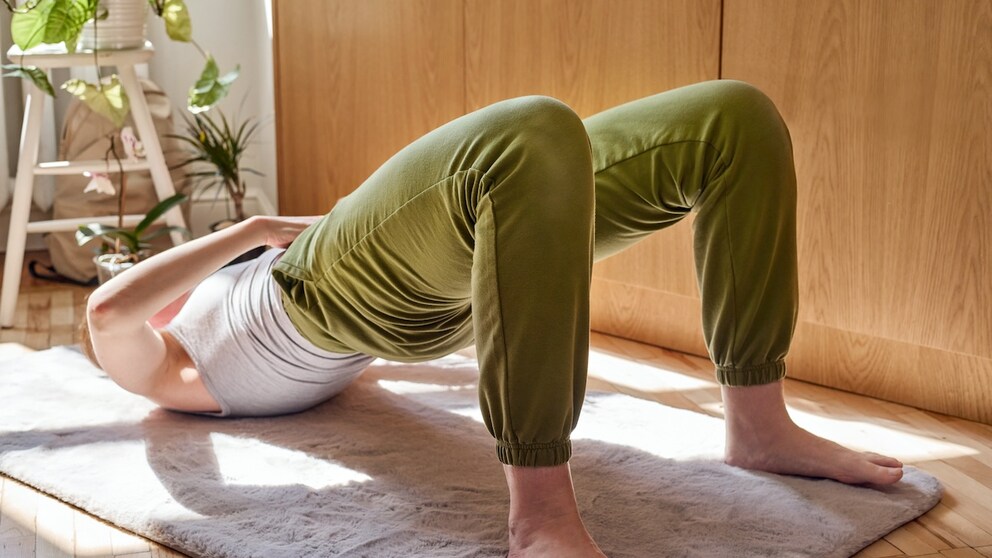
Lie on your back with your legs bent and place a small Pilates ball between your knees. As you exhale, gently squeeze the ball and simultaneously contract the pelvic floor.
Slowly lift your hips until your thighs and upper body form a straight line. Then, lower the pelvis in a controlled manner and release the tension. Repeat the movement eight to twelve times.
The exercise primarily strengthens the gluteal and thigh muscles. By consciously contracting, the pelvic floor muscles can also be engaged.
Important: Not every man benefits from tightening the pelvic floor more. In cases of pain or already overly tense muscles, other exercises may be more appropriate. Those with complaints or who wish to train after prostate surgery should seek individual guidance from a physical therapist.