



March 26, 2026, 7:00 pm | Read time: 5 minutes
Twice a year, we change the clocks. Satchin Panda, a professor at the Salk Institute and one of the world’s leading chronobiologists, has been studying for years how sensitive our internal clock is to time shifts. In an interview, he explains the potential consequences of time changes and which time is biologically better for us. Panda also revealed why evenings are the time for irrational decisions.
FITBOOK: In Europe, the abolition of time changes was partly justified with health benefits. Is this one-hour shift twice a year really that harmful?
Satchin Panda: “Especially in spring, when the clock is set forward by one hour, we observe an increase in accidents, among other things. But the time change has other consequences. People miss flights or trains, and productivity decreases. Even if someone is less productive for just one day, it amounts to a productivity loss of about 0.5 percent over the year. Meanwhile, global productivity has stagnated for about 18 years. So the question is whether we want to accept an additional, avoidable loss with the time change.”
Europe is fundamentally right in abolishing it. However, there is now debate over whether to keep winter or summer time.
“A particular problem is Spain. Looking at the longitude, the country is actually in the time zone of Great Britain. Yet, Central European Time applies there.”
Because the Franco dictatorship aligned its time with Nazi Germany and fascist Italy in 1940.
“And that’s why Spaniards typically eat very late today.”
Also interesting: Why Spain is actually in the wrong time zone
Instead of Time Changes! »We Could Theoretically Return to Local Times
What would be the better solution for Europe from your perspective as a chronobiologist, winter or summer time?
“Winter time is the standard time, and most people prefer it. Ultimately, we orient ourselves by local solar time, meaning sunrise and sunset. The eastern edges of a time zone have clear advantages because they receive the sun earlier. The western edges, however, suffer because they lag behind. This is the challenge when trying to arbitrarily group large land masses into a single time zone. That’s why I’d like to introduce a completely different idea.”
Which one?
“Humanity has existed for about 140,000 to 200,000 years. We’ve only been experimenting with time zones for around 170 years. They were useful for coordinating industrial processes. Before that, local solar time was used everywhere. So there is still room for improvement. With modern computer technology and AI, we could theoretically return to local solar times while machines handle the necessary coordination.”
Regardless of time zones and clocks, one thing remains undisputed: Life on Earth still largely follows the sun. Is there a circadian rhythm for human relationships in this dynamic?
“Definitely. As hunters and gatherers, people worked during the day. In the evening, they returned, made fire, and began baking or grilling. While food was being prepared, light played a central role. Fire was precious and hard to make. It wasn’t private but communal. People sat together, often with extended family, and spent time together. The fire extended our day. This created a completely new way of life. The day was for work, the night for relaxation and social contacts. This is still deeply ingrained in us today.”
Satchin Panda: »Irrational Decisions Happen More Toward the End of the Day
Why does social closeness tend to occur more in the evening than in the morning?
“Social connectedness is often irrational and emotional and doesn’t always have a clear reason. In the morning, we are usually more rational and objective, with a stronger ability for self-control and goal-oriented action. As the day progresses, this shifts. We become more irrational, which is needed for social interaction. It relies on many decisions that aren’t strictly rational: discussing, singing, approaching someone you’re attracted to. Even irrational decisions, like drinking too much, are part of it. All this typically happens more toward the end of the day.”
It gives our everyday life a certain something.
“I would say it’s the spice of life. If couples interacted solely rationally, it would be somewhat robotic.”
Speaking of evening and night: Does the moon influence our circadian rhythm?
“It used to. But studies show that the moon’s influence is significantly less today because we are hardly exposed to moonlight anymore. Artificial light overrides this effect. Before electric lighting, many women had menstrual cycles synchronized with either the full moon or the new moon. Full moon nights and the days before were particularly special. One aspect was the light. On a full moon night, less fire was needed, people could be outside or take a short walk if it was safe. This promoted social activity and made people more emotional and irrational toward the end of the day. Hence the term lunatic.”
About the Person
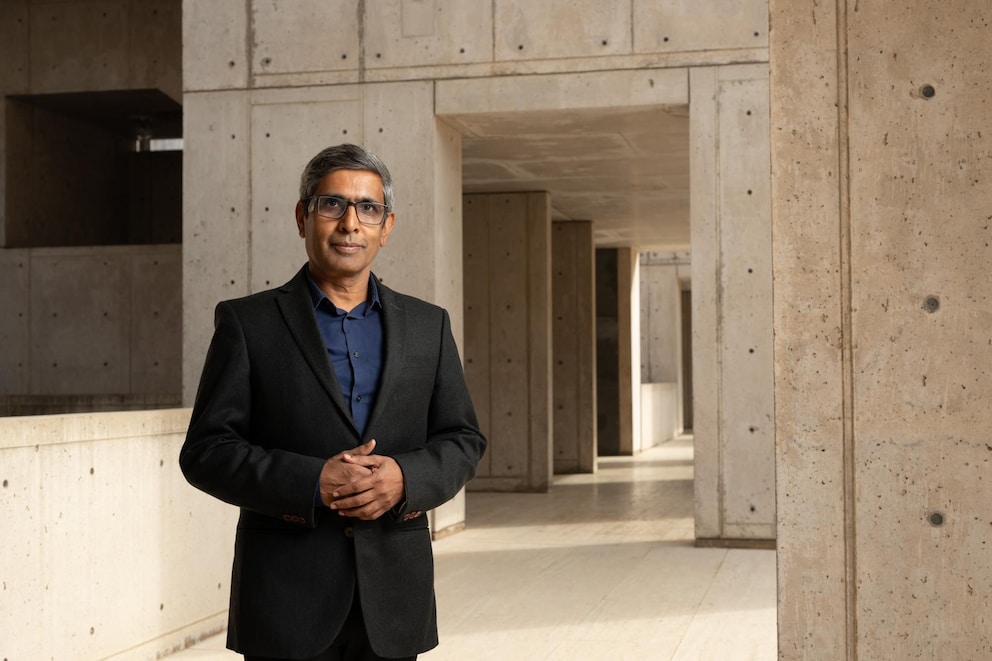
Satchin Panda is a professor at the Salk Institute in California and one of the world’s leading chronobiologists. He researches how the internal clock affects metabolism and sleep and the role of intermittent fasting for the human body. Panda is also the author of several books, including “The Circadian Code – Sleep Well, Lose Weight, Be Healthy.”
What do you pay attention to with lighting?
“We generally have very dim lighting, hardly any bright lights. When I need targeted light, I use table or bedside lamps that illuminate the work surface but not my face. This architectural concept is called light layering. It involves using indirect light from ceilings or walls and supplementing it with so-called task lighting that illuminates only a specific area.”