

July 25, 2025, 2:03 pm | Read time: 8 minutes
Awake, clear, deeply relaxed, and all without sleep? Yoga Nidra, once a secret tip from ancient yoga texts, is now not only conquering yoga studio mats worldwide but is also making waves in the scientific community. FITBOOK editor Michel Winges explains why you should opt for a short Yoga Nidra session instead of a nap.
Overview
What is Yoga Nidra?
Yoga Nidra, also known as “yogic sleep,” has its roots in the ancient yogic traditions of India. It is a guided, meditative, deep relaxation that places the body and mind in a state between sleep and wakefulness. The practice was described in classical texts like the “Upanishads” and has been developed over centuries. In modern times, Yoga Nidra was popularized by Swami Satyananda Saraswati. In the 1960s, he systematized the technique and made it accessible to a broad audience.1 Today, Yoga Nidra is practiced worldwide and is used in both spiritual contexts and healthcare to promote relaxation, regeneration, and inner clarity.
Positive Effects – A Look at the Studies
In recent years, Yoga Nidra has increasingly become the focus of scientific research. Current studies show that this method is far more than mere relaxation: It is being researched in clinical contexts with promising results for positive effects on sleep, stress, and cognitive performance.
Improved Sleep and Memory Performance for Beginners
A randomized study with Yoga Nidra beginners showed, among other things, that after four weeks of regular practice, there was an 18 percent improvement in sleep quality (measured by the Pittsburgh Sleep Quality Index, or PSQI). The PSQI is a self-assessment questionnaire used in clinics and research to evaluate sleep quality over a four-week period.2 Cognitive processing speed increased by 12 percent, while error rates in memory tests decreased by 20 percent.3
Short Sessions Are Enough
A large-scale online study examined the effects of a daily, eleven-minute Yoga Nidra session on stress, well-being, and sleep quality. A total of 771 people participated. They were randomly divided: 341 in the Yoga Nidra group and 340 in the control group. Participants in the Yoga Nidra group conducted a guided meditation daily for 30 days, while the control group did not engage in any meditation or similar exercises during the same period. Both groups completed standardized questionnaires on their stress experience, sleep quality, and general well-being at the beginning, after one month, and six weeks later.
The direct comparison of both groups showed: The Yoga Nidra group experienced a ten percent reduction in stress and negative feelings, a nine percent improvement in sleep quality, and an increase in well-being of up to seven percent, all within just one month. Remarkably, all positive changes remained stable six weeks after the end of the daily practice.4
For Chronic Insomnia
A randomized study from India with adults suffering from chronic insomnia found that Yoga Nidra also had positive effects on this patient group. The 41 participants either practiced Yoga Nidra at home after a brief introduction or received cognitive behavioral therapy for insomnia (CBT-I). CBT-I is a common cognitive behavioral therapy for insomnia.5 The progress was monitored with sleep logs, questionnaires like the PSQI, sleep lab measurements, and saliva tests for stress hormones (cortisol).
After about eight weeks, both groups reported longer and more restful sleep, fewer awakenings during the night, and overall better sleep quality. Particularly among Yoga practitioners, the sleep lab confirmed a significant increase in deep sleep and middle sleep phases, as well as significantly higher sleep efficiency. Additionally, the stress hormone significantly decreased among Yoga Nidra practitioners.6
Non-Sleep Deep Rest (NSDSR)/Non-Sleep Deep Sleep
Why Sleep Often Doesn’t Fully Refresh Us
You go to bed with a head full of thoughts, hoping to “sleep away” the stress and strain. But even after eight hours of sleep, you wake up still tired and unbalanced. This is often the case. You don’t address the problems and stressors, and try to compensate for them with sleep. True relaxation only occurs when these tensions—physical, mental, and emotional—are resolved.7
Yoga Nidra addresses this by specifically promoting relaxation on the levels of body, mind, and emotions. This allows for deeper letting go. Only when these burdens are resolved does sleep—and wakefulness—feel truly restorative.
Andrew Huberman’s NSDR
The term “Non-Sleep Deep Rest” (NSDR) was coined by Andrew Huberman, a neuroscientist and professor at Stanford University School of Medicine. The method describes deliberately induced relaxation states that, while not sleep, provide the body and brain with similarly deep recovery. It consists of a mix of guided meditation, breathing exercises, and Yoga Nidra.
NSDR can be specifically applied in the morning to start the day more awake, focused, and balanced. Especially after restless nights or sleep deficits, a ten- to twenty-minute session can help boost energy, clear the mind, and begin the day with more concentration.8

How to Reduce Stress with Non-Sleep Deep Rest

Open Your Hips and Strengthen Your Knees With the Flying Horse Pose
Why Yoga Nidra Instead of a Nap? – In a Nutshell
- No “sleep inertia” feeling
- Controllable duration and effect
- No impact on nighttime sleep
- Conscious relaxation for body and mind
- Can be done anywhere
Your Guide for Home
1. Starting Position (Shavasana)
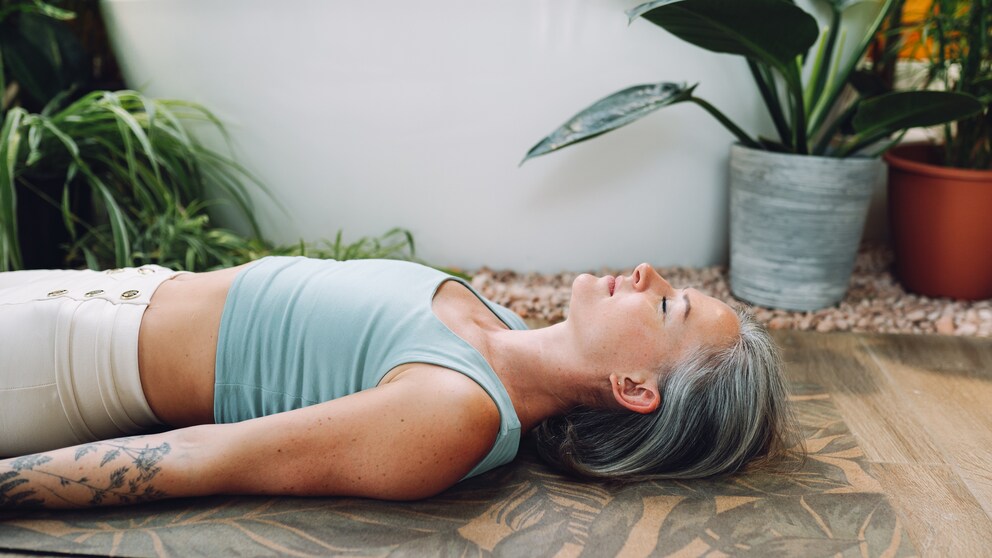
Lie comfortably on your back. Preferably on a carpet or yoga mat. Important: do not lie in bed! The feet are slightly wider than hip-width apart, and the toes fall relaxed outward. The arms rest loosely next to the body, with some distance from the torso and palms facing up. The head rests relaxed in the center.
2. Tensing and Relaxing
Start by consciously tensing and releasing individual body parts:
- Lift the right leg slightly, tense it for five seconds, and then let it relax back onto the floor. Repeat the same with the left leg.
- Lift both arms slightly, clench your hands into fists, hold the tension briefly, and then relax again.
- Lift your pelvis, tense your buttocks and lower back, and then relax again.
- Lift your chest, pull your shoulder blades together, tense your back, and then release.
- Finally, gently turn your head from one side to the other.
3. Body Awareness
Now direct your attention to different areas of your body. Let your awareness travel like an inner journey and perceive several body parts simultaneously.
- Feel the toes of the left foot, then the right, then both feet simultaneously.
- Move on to the feet, the legs, then the hands, arms, and shoulders.
- Try to feel the entire left side of the body from the toes to the fingertips simultaneously.
- Continue and consciously perceive both sides of the body. Then, individual regions like the buttocks or toes. Forehead and crown, also at the same time, if you like.
4. Expansion of Awareness
Focus your attention on the contact points of your body touching the ground. Feel the entire surface with which your body touches the ground as a unit. With each breath, extend your awareness further into the ground, deep into the earth.
Then direct your attention to all the body parts pointing to the left, from the left foot to the left temple. Feel this energy field to the left. With each breath, let your field of awareness grow further to the left. Repeat the same to the right, upward, forward, and backward, so that your energy field expands in all directions. Feel how your field of awareness becomes larger and larger.
5. Rest Phase
Stay in this state of complete calm, expansion, and awareness for a few minutes.
6. Sankalpa (Resolution)
Now mentally repeat a positive affirmation, resolution, or prayer. For example: “I am full of strength and energy. I am well. I look forward to the day.”
7. Return
Take a few deep breaths. Begin to move your feet and hands. Stretch and yawn, bend one knee, and use it to slowly sit up. Feel the new strength and joy flowing through your body and mind.