


March 10, 2026, 8:00 am | Read time: 6 minutes
Black cumin is primarily known from the spice rack. An oil can also be extracted from the seeds, whose healing effects have been revered in the Middle East for several millennia. Discover here the ingredients contained in black cumin oil, its purported health benefits, and what has been substantiated by scientific studies.
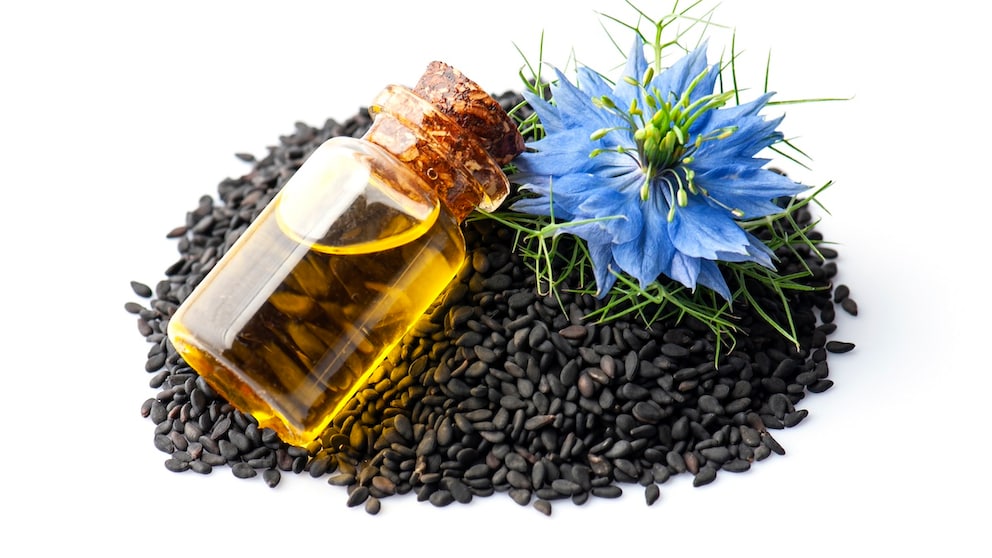
Black cumin oil is extracted from the seeds of the black cumin plant, botanically “Nigella sativa.” Ancient papyrus scrolls prove that even the ancient Egyptians referred to black cumin oil as the “gold of the pharaohs.” A bottle of it was found in the tomb of Pharaoh Tutankhamun..1 However, black cumin was not only part of ancient Egyptian and Greco-Roman medicine, but was also widely used in the Persian-Arabic region. It also has a firm place in all world religions. In the Bible, for example, the small, black seeds are known as “ketzah,” which were usually sprinkled on flatbreads..2 Black cumin is also important in Islam, as the Prophet Mohammed recommended it as a remedy..3 In the Middle Ages, it was mainly the monasteries that introduced black cumin to European medicine, but it was forgotten for a long time afterwards. New research findings explain the renewed hype surrounding black cumin oil. What’s the story? FITBOOK Editorial Director Melanie Hoffmann took a look at what studies have found about the health benefits of black cumin.
Overview
- Production and Ingredients of Black Cumin Seed Oil
- What Is Black Seed Oil Supposed to Help With?
- Is the Health Effect Scientifically Proven?
- Intake, Application, and Dosage
- Possible Side Effects
- Who Should Not Take Black Cumin Oil
- What Does a Good Product Cost and What Should I Look Out for When Buying?
- Black Cumin Oil is No Substitute for Medication
- Sources
Production and Ingredients of Black Cumin Seed Oil
Two different types of oil can be made from black cumin: a normal edible oil and an essential oil. To produce the edible oil, the seeds of the black cumin plant are first dried and then cold-pressed. This is to better preserve the ingredients..4 The essential oil is obtained through a special evaporation process. Up to 60 kilograms of black cumin seeds are needed for one liter.5
Black cumin oil consists of 60 percent polyunsaturated fatty acids, followed by 20 to 25 percent monounsaturated fatty acids. The highest proportion is oleic acid, linoleic acid, and saponins, the latter of which are secondary plant substances. It also contains essential oils and essential amino acids such as L-phenylalanine and L-tyrosine. These, in turn, are the basic building blocks of the neurotransmitters adrenaline, noradrenaline, and dopamine. In addition to the minerals biotin, selenium, and magnesium, black seed oil also contains various vitamins, including provitamin A, B vitamins, vitamin C, and vitamin E.
What Is Black Seed Oil Supposed to Help With?
Black cumin seed oil is said to have countless health benefits in a wide variety of areas. In naturopathy, it is used in particular for the following complaints:6,7,8
- Allergies
- Asthma
- High blood pressure
- High cholesterol
- Diabetes
- Skin diseases such as acne or neurodermatitis
- Relief from the side effects of chemotherapy
- Rheumatoid arthritis
- Digestive problems
- Hashimoto’s thyroiditis
- Vitiligo
Black cumin is also said to strengthen the immune system and have an anti-inflammatory effect.
Is the Health Effect Scientifically Proven?
Black cumin has already been the subject of a large number of studies. In order to classify its diverse findings, it should be noted that these often involved animals or small groups of human test subjects. Cell studies have also been carried out. In addition, sometimes the effect of extracts, sometimes that of oil, sometimes that of seeds or powder, and different types of application—internally and externally—were investigated. It is therefore questionable whether the consumption of black cumin in the diet can also produce the effects. Nevertheless, there is plenty of scientific evidence that black cumin actually offers various health benefits.
An analysis of existing studies from 2017 and a review by the University of Freiburg listed what these are according to the current state of research:9,10
- Anti-inflammatory and antioxidant effect
- Antiproliferative effect on cancer cells
- Protective effect on cells
- Improvement of the metabolism in diabetes
- Blood pressure-lowering effect
- Muscle relaxation
- Antibacterial effects
- Antiviral effects
- Antiparasitic effect
- Anti-inflammatory effect
- Protection of the organs
- Neuroprotective effect
- Protection of the kidneys and lungs
- Can help with asthma
- Antidepressant effect
- Effect on Hashimoto’s thyroiditis
- Relieves symptoms of vitiligo lesions
- Can possibly alleviate symptoms of psoriasis and neurodermatitis
- Effect on acne
- Effects on male infertility
Intake, Application, and Dosage
Based on existing studies, the aforementioned review by the University of Freiburg states that a daily dose of up to 3 grams of black cumin seeds or seed oil is recommended. Another dosage form is capsules. The recommendation here is up to 3 capsules of 500 milligrams each. Black cumin seed oil is also suitable for external use, as research has shown. It is used to treat skin problems such as acne, eczema, neurodermatitis, and psoriasis.
Medical advice should always be sought first, especially in the case of use for illnesses, both with regard to the application in general, as well as the dosage and dosage form.
Possible Side Effects
In principle, side effects rarely appear to occur when using or taking black cumin oil. Studies have occasionally reported itching or nausea. A contact allergy can also occur with external application. In one study, there was a slight drop in blood sugar, and in another, kidney failure.
Who Should Not Take Black Cumin Oil
In general, it is advisable to stop treatment with black cumin oil immediately if there are any signs of side effects. Pregnant women should also refrain from taking it in concentrated form to be on the safe side, as a contraction-inducing effect cannot be ruled out. But don’t worry: the normal caraway seed roll is still safe.

The Versatile Effect of Healing Clay

Can basil help with hereditary hair loss?
What Does a Good Product Cost and What Should I Look Out for When Buying?
When buying black cumin oil, you should pay particular attention to the quality and always choose high-quality, cold-pressed oil from organic cultivation. You can buy both filtered and unfiltered black cumin seed oil. Although the unfiltered version is more natural, the filtered oil has a milder taste and is therefore easier to digest. You can buy the natural product in pharmacies, health food stores, organic food stores, well-stocked drugstores, and online. For 100 milliliters of cold-pressed organic black cumin oil, you can expect to pay around 6 to 13 euros; for a liter, the cost is typically between 24 and 30 euros. The price for capsules varies between 20 and 70 euros, depending on the quantity and manufacturer.
Black Cumin Oil is No Substitute for Medication
Despite all the claimed health effects, we would like to point out that black cumin is only a dietary supplement and not a remedy. Food supplements are legally classed as foodstuffs. They are not intended to prevent, alleviate, or cure diseases. That is the task of medicinal products. This is also due to the fact that food supplements are not tested before they are sold, and the quantities of ingredients they contain are not specified.
However, given that research has demonstrated various benefits and minimal side effects, our conclusion is that if the oil agrees with you, it can be taken in appropriate doses and, ideally, under medical supervision.