

September 15, 2024, 6:13 am | Read time: 6 minutes
Among people who follow a vegan diet, they are likely well-known: We’re talking about nutritional yeast flakes. Their umami note makes them a savory seasoning. Learn here how healthy nutritional yeast flakes are, what happens during production, and what to look for when buying them.
Whether in bread spreads, cheese sauces, or over gratins–nutritional yeast flakes are touted in many recipes for their slightly nutty and cheesy flavor as an umami boost. Veggie fans especially appreciate the flakes for their savory note. But what nutrients are actually in nutritional yeast flakes, and how are they best used?
Follow the FITBOOK channel on WhatsApp now!
Overview
What are nutritional yeast flakes and how are they produced?
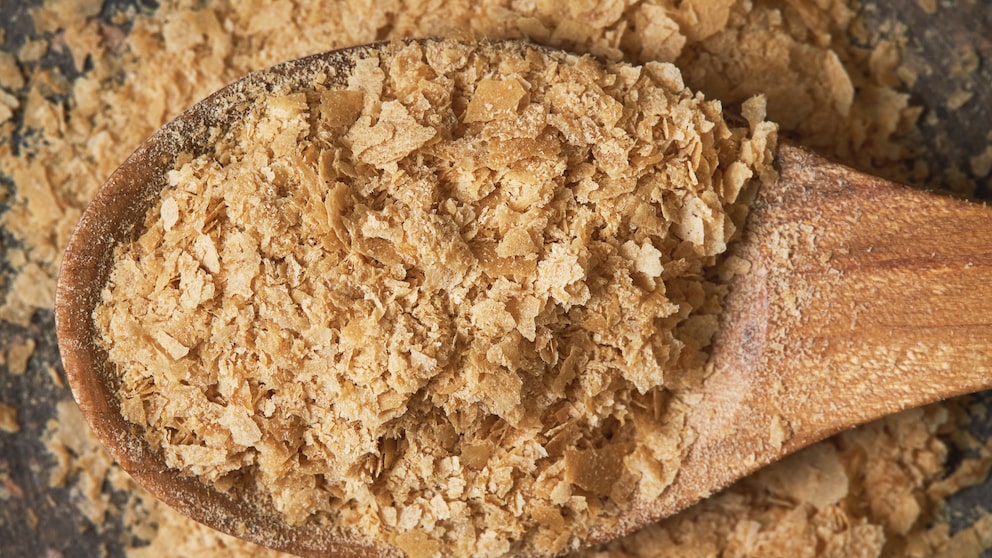
“Nutritional yeast flakes are essentially just dried and rolled yeast,” explains Sabine Hülsmann, a food and nutrition consultant at the Consumer Center Bavaria.
However, in production, one must distinguish between organic and conventional yeast. For conventional yeast, molasses, inorganic nitrogen, and phosphorus are often used as a nutrient solution. Sulfuric acid and caustic soda are used for pH regulation. “When yeast multiplies, it creates foam that inhibits further growth. To prevent this foam, synthetic defoamers are used, which must then be washed out of the final product with a lot of water,” Hülsmann tells FITBOOK. However, this wastewater is biologically difficult to degrade.
In contrast, organic yeast primarily uses grain, and less frequently molasses, as a raw material. “Grain naturally contains nitrogen and phosphorus, so these substances do not need to be artificially added. For pH regulation, sodium carbonate, citric acid, or lactic acid are allowed.” According to many manufacturers, these aids are often not used at all. The foaming in organic yeast is prevented by adding plant-based organic oils, such as sunflower oil. “The production of organic yeast requires significantly less water overall, and the process residues can be used as raw materials for other products,” explains the nutrition expert.
To achieve the desired flake form, the liquid yeast is sprayed onto rollers, dried, and then ground into coarse flakes, clarifies the Consumer Center Bremen. There is no need to worry about the flakes fermenting and swelling at home. The drying process inactivates the yeasts, so they are no longer capable of fermentation.
How healthy are nutritional yeast flakes?
But nutritional yeast flakes are not only rich in flavor but also in valuable nutrients. “Nutritional yeast flakes contain many vitamins, minerals, and trace elements. Especially B vitamins like B1 or B6 are present in significant amounts,” says the nutrition expert.
Nutritional yeast flakes are also relatively high in protein. This is one reason why they are often used in vegan diets, where ensuring adequate protein intake is important.
According to Hülsmann, what is less significant is the energy value of the flakes (341 calories per 100 grams). “Since nutritional yeast flakes are always consumed in relatively small amounts, the amount of carbohydrates or calories has little impact on daily nutrition.”
Also interesting: What you should know about gluten intolerance
Nutritional Table: Nutritional Yeast Flakes
Nutritional yeast flakes are consumable for many intolerances
In general, nutritional yeast flakes are very suitable for a healthy and varied diet. “To preserve the nutrients, however, nutritional yeast flakes should not be heated,” advises the expert.
Nutritional yeast flakes are naturally vegan, low in sodium, gluten-free, and lactose-free, so people with intolerances can consume them without issues. “The flakes are also free of active yeasts due to the drying process, so to our knowledge, there should be no side effects,” the nutrition expert further explains. Only people who generally suffer from a yeast intolerance need to be cautious.
The right use and dosage
Nutritional yeast flakes can be used in a variety of ways. For example:
- for homemade vegetable broth
- for vegan spreads
- as a thickener for sauces and soups
- for patties and burger patties
- for rice and pasta dishes
- for breading
You can also simply sprinkle them as a pure seasoning over dishes, such as yogurt, according to your preference. However, when dosing, keep in mind that the flakes naturally have a very intense flavor. If you prefer a milder taste, use only about one to two teaspoons.
In vegan cuisine, nutritional yeast flakes are also used as a kind of cheese substitute, for example, instead of Parmesan in pasta dishes. However, Hülsmann cautions: “True cheese lovers will not find an adequate substitute in nutritional yeast flakes. The taste is just too different.”
Since nutritional yeast flakes are heat-sensitive, they should not be cooked but added at the end.
Do nutritional yeast flakes contain glutamate?
Anyone who delves into nutritional yeast flakes will likely encounter the claim that they contain glutamate. The flavor enhancer is often criticized for its alleged negative health effects.
Sabine Hülsmann explains from an expert perspective what is behind this claim: “The savory taste of nutritional yeast flakes comes from the protein components. One of these components is indeed natural glutamate, the salt of glutamic acid. Glutamate in this form is found in many foods, such as Parmesan.” But the expert reassures us. This is not the controversial, artificially produced glutamate that must be labeled with an E-number as a flavor enhancer in processed foods. Moreover, its harmful health effects have never been definitively proven. Helena Nareyka, a nutrition expert at the Consumer Center Bremen, still advises: Those who are sensitive to foods containing glutamic acid should avoid using nutritional yeast flakes as a seasoning.
And what about yeast extract?
The term nutritional yeast flakes is reminiscent of yeast extract, which is often used as a flavor enhancer in processed foods because it naturally contains glutamate. Yeast extract is also derived from yeast but is a paste-like extract with a more intense flavor than nutritional yeast flakes.
What to look for when buying nutritional yeast flakes
For those who value sustainable and environmentally friendly production, the nutrition expert recommends opting for organic nutritional yeast flakes. Nutritional yeast flakes are typically found in health food stores, organic shops, drugstores, or online. Since nutritional yeast flakes have a relatively short shelf life, they are usually sold in smaller packages containing 200 to 250 grams. These are priced between four and seven euros.
*with material from dpa