


November 17, 2025, 7:19 pm | Read time: 4 minutes
Deadlifts or squats are optimal for training the glute muscles, but Pilates exercises can also be supportive. Some may already be part of your workout without you knowing they originate from Pilates. If not, here at FITBOOK, you’ll find some inspiration to make your training more varied. The best part: You don’t need any equipment except a fitness mat or a soft surface. You can do the exercises flexibly anytime and anywhere.
Bridge
Many may know the exercise by the name “Glute Bridge” – a fitting name since it trains the glutes, consisting of the three muscles: gluteus maximus, gluteus medius, and gluteus minimus.
The starting position for the bridge is lying on your back on a mat. Arms and hands rest loosely beside the body, palms facing down. Feet are planted, and legs are bent. With a tense core, move the pelvis toward the ceiling as far as possible without arching the back. Hold briefly at the highest point and consciously tense the glute muscles. Then slowly and controlled, lower the pelvis again. After minimal contact with the ground, lift the pelvis again for the next repetition.
To increase the intensity of the Pilates exercise, you can place a weight plate or dumbbell on your lower abdomen to press additional weight during the movement. Another option is to use a resistance band (“Booty Band”). Place it around your thighs for added resistance during the exercise.
Variation: “Bridge Reaches” or “Single Leg Glute Bridge”
The bridge can also be performed single-legged to isolate each side of the glute muscles. For this, lift one leg straight toward the ceiling during the execution of the glute bridge. The challenge is to maintain abdominal tension and target the glute muscles for tension at the highest point of the exercise.
Leg Lifts in Prone Position
Here’s a heads-up: This Pilates exercise looks easier than it is – and it’s ideal for challenging the glute muscles. For this, we lie prone on the mat. Then, we alternately lift one leg off the ground as high as possible without sacrificing abdominal, back, and – most importantly – glute tension.
Kickbacks (“Donkey Kicks”)
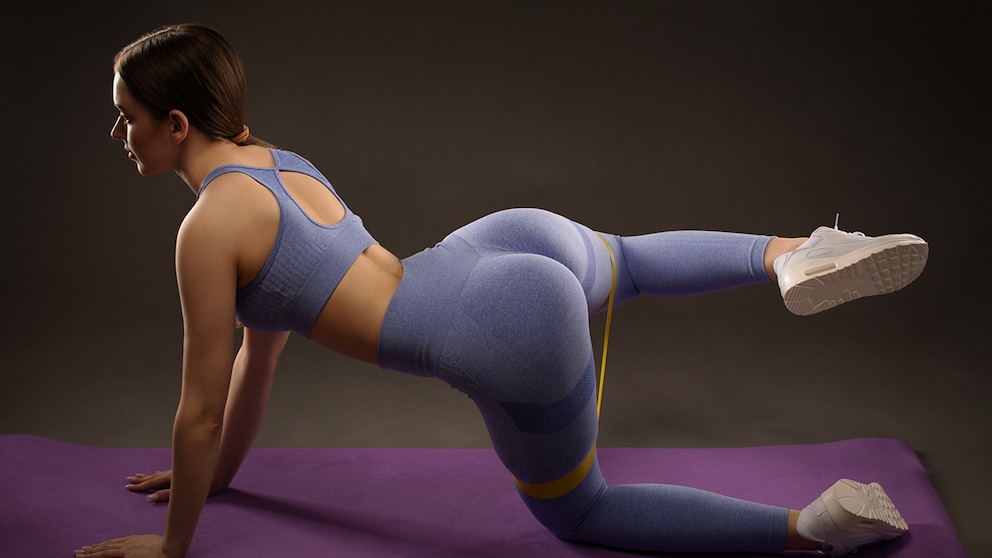
For kickbacks, also known as “Donkey Kicks,” we get into a quadruped position. It’s important that the shoulders are over the hands and the pelvis is over the knees. Core tension is also crucial here. Then, we alternately lift one leg bent toward the ceiling (kicks) slowly and controlled (with tense abs and glutes). To ensure this Pilates exercise effectively targets the glute muscles, make sure your pelvis remains parallel to the ground during the kicks.
Variation: Side Donkey Kicks
A possible variation of the exercise is side donkey kicks. They work essentially the same as kickbacks. The difference is that the leg is lifted sideways (visually, the exercise resembles a dog lifting its leg to pee). By lifting the leg sideways, we also train the lateral instead of the rear glute muscles. For an additional challenge, you can perform side donkey kicks with a Booty Band. Simply place the resistance band around your thighs and perform the side kicks against the resistance.
7 Effective Exercises for the Glute Muscles
5 Ideas for a Creative Booty Workout
Lunge with Pulsation
It’s hard to avoid lunges in lower body training – no wonder, as they are incredibly effective for legs, glutes, and core, and simultaneously train balance. In the Pilates variation for the glute muscles, we perform lunges with pulsation. This means that at the lowest point of the lunge, we don’t immediately return to the full upward movement but make small pulsating movements. This results in the muscle tension being held longer and even intensified at the lowest point of the exercise. After three to five short, pulsating movements, we return to the starting position to perform the next repetition.
Remember the “Powerhouse”
In Pilates, the “Powerhouse” – meaning the body’s core – is absolutely essential. You’ll quickly notice during the exercises that they make the glute muscles burn as desired, but they don’t work or become ineffective if you neglect back and abdominal, or core tension. So always pull the navel inward and keep the pelvis in a neutral position (not too far forward or too far back) – then the Pilates glute training will be successful.