


August 22, 2025, 2:05 am | Read time: 4 minutes
Many know the side plank as an effective exercise for the oblique abdominal muscles. But side planks also work other important muscles like the shoulder, back, and gluteal muscles. By modifying the exercise, you can achieve different levels of difficulty and set targeted new training stimuli that improve stability, balance, and strength equally. FITBOOK expert Alina Bock describes four effective side plank variations.
What Side Planks Are Ideal For
In addition to the positive effects on muscles, side planks help improve hip, knee, and ankle mobility. The side plank is also ideal for correcting muscle imbalances. With the four side plank variations mentioned here, you can ensure that your workout doesn’t become monotonous and that the muscles being worked are continually challenged.
Correct Execution of the Classic Side Plank
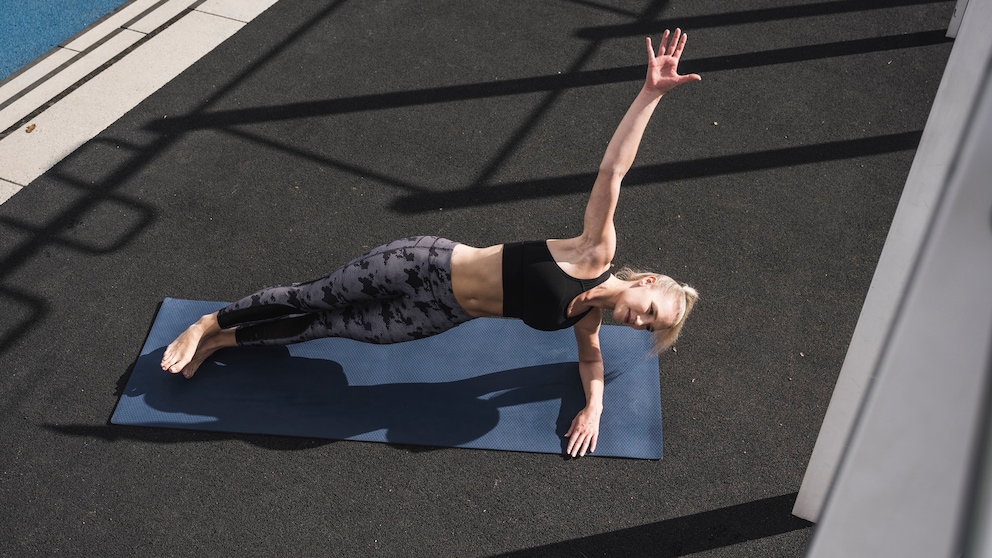
For the classic version of the side plank, lie on your side. It doesn’t matter which side you start with. The important thing is to try to hold each side equally long to avoid imbalances. It’s also ideal to use a soft surface, such as a fitness mat. Place your forearm on the ground, ensuring that your elbow is directly below your shoulder. Your arm should point straight down toward the floor.
Place your feet on top of each other. If this is too difficult at first, you can place the foot of the upper leg in front of the foot of the lower leg. This helps balance your body weight. Make sure the heel of the front foot touches the toes of the foot behind it. Now lift your hips until your body forms a straight line. Beginners who find it difficult to hold the position should start the exercise on their knees.
Tip: I often observe that exercises are performed without a good muscle feel. To effectively engage the muscles—and thus achieve a significant training effect—it’s important to pull your toes toward your chin during the side plank. Press your foot into the ground to create tension. To prevent your hips from sinking, tighten your glutes and slightly tilt your hips forward.
By pulling your elbows toward your feet, you create tension in the abdomen and back. Although it doesn’t move due to contact with the ground, the tension engages the large back muscle (latissimus dorsi), which relieves the shoulder and prevents shoulder problems and pain during the exercise in the long term.
Variation: Side Plank with Leg Lift
Get into the side plank as described above. Now lift the upper leg as high as possible. It’s important that the hips don’t lift during the movement. Lifting the leg also trains the gluteal muscles. For an extra challenge, place a weight plate on the side of your thigh.
Variation: Side Plank with Crunch
For an extra burn in the abdomen, try the side plank with an integrated crunch. Hold the side plank. Bend the upper arm and place your hand on the side of your head. Now bend the upper leg toward the elbow. At the same time, bring the elbow and head toward the knee. Try to bring the elbow and knee as close together as possible by slightly curling sideways. Pause briefly, then return to the starting position. Repeat the movement 12 to 15 times.
High-Intensity Mini-Workout for On-the-Go
Effective Yoga Exercises for a Toned Bottom
Variation: Side Plank with Hip Abduction
This plank variation starts on the knees. The legs are bent, and the feet are stacked. Lift the hips slightly off the ground. Now, spread the upper leg upward without losing contact between the feet. This is the abduction. Meanwhile, lift the hips until they form a straight line with the upper body. Hold the position briefly. Then bring the thighs back together and lower the hips until just above the ground. The additional abduction and extension of the hips further challenge the lateral gluteal muscles, known as the abductors.
Tip: To make this exercise even more challenging, you can use a resistance band placed slightly above the knees around the legs. The resistance adds extra burn to the gluteal muscles.
Variation: Copenhagen Plank
Let’s move on to the most challenging variation in our series: the Copenhagen plank.
You’ll need an elevation, like a bench. Alternatively, a chair will work. Place your elbow directly below your shoulder again. Unlike the classic side plank, place the foot of the upper leg on the bench or chair. Now lift your hips until your body forms a straight line. The lower leg is in the air but is held directly below the bench or chair by the strength of the adductors (inner thighs).