



June 20, 2026, 4:03 pm | Read time: 7 minutes
For a long time, it was assumed that endurance training with as many repetitions as possible positively impacts cyclists’ performance. However, this has been scientifically disproven. The opposite is true: Studies suggest that heavy strength training with few repetitions significantly enhances performance in terms of fatigue, economy, and strength. Trainer and FITBOOK expert Alina Bock reveals which strength exercises cyclists should focus on. Her exemplary four-week training plan takes cycling training to a new level.
Many cyclists avoid heavy strength training out of fear of becoming heavy and inflexible. A mistake, as sports science proves. To maximize pedal efficiency and delay muscle fatigue, heavy strength training is essential.
The Effect of Strength Training on Cycling Performance
Studies show that heavy strength training significantly boosts cyclists’ performance. This occurs primarily through three biological adaptation mechanisms. First, the training increases fatigue resistance by demonstrably delaying the fatigue of type I muscle fibers. Second, the strength stimulus leads to a significantly improved cycling economy (energy efficiency) in the final sprint. This allows cyclists to mobilize more energy even after hours of exertion. Additionally, targeted strength training optimizes power transfer to the pedal. The body consumes less oxygen and energy per pedal stroke, making the entire pedal stroke more economical.1
Strength Exercises Optimal for Cyclists
Since cycling primarily engages the lower body muscles, strength training focuses on this area to achieve performance improvement. The following strength exercises can demonstrably help cyclists enhance their performance.
Squats

During cycling, most power is generated by pushing the pedal down from the highest position. The squat mimics this extension of the hip and knee under load. Additionally, the exercise strengthens the quadriceps and glutes, leading to higher maximum wattage.
The squat is performed in a hip-width stance. With core tension, bend the knees while keeping the heels firmly on the ground. Once the lowest point is reached, extend the knees again. To maintain tension in the lower body muscles, keep the knees slightly bent in the end position.
Ideally, perform the squat freely with a barbell. Alternatives include a Smith machine, kettlebell, and body weight.
Single-Leg Leg Press
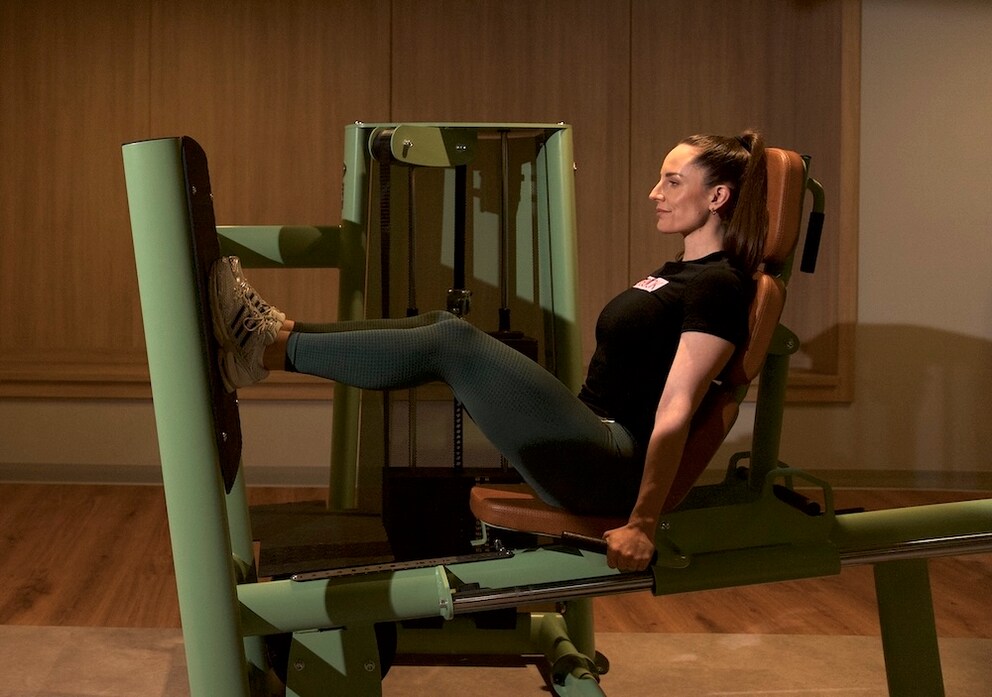
A study from the Journal of Strength and Conditioning Research compared the effects of bilateral (two-legged) and unilateral (single-legged) strength training in cyclists over 10 weeks. While two-legged strength training improved aerobic performance and submaximal cycling economy by a full eight percent, unilateral exercises like the single-leg leg press increased short-term sprint performance by a remarkable 20 percent.2
Romanian Deadlift
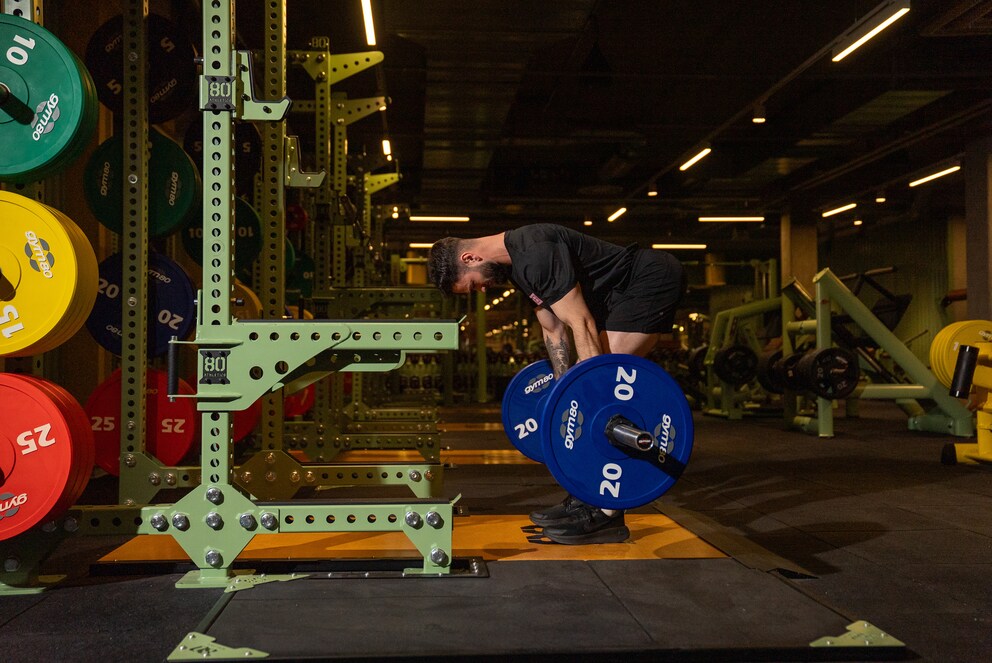
Since most power is generated during the push phase (when pressing the pedal down), the front leg muscles (quadriceps) primarily work during cycling. The posterior chain works only supportively and thus more passively than the front. To stabilize the knee joint and prevent imbalances, cyclists should also isolate the posterior chain. This effectively prevents knee joint injuries.
The Romanian deadlift can be performed with a barbell, dumbbells, or a kettlebell. Start in a hip-width stance. The weight is in your hands in front of your body. Now push your hips back while your upper body leans forward. The knees remain slightly bent throughout the movement. When the training weight is approximately at mid-shin height, slowly straighten your body again. Push up consciously from the heels.
Calf Raises
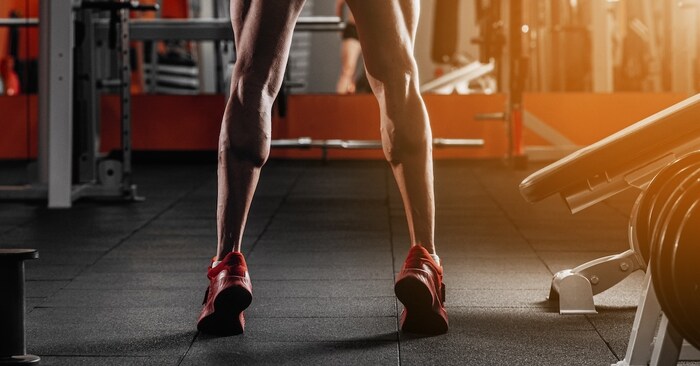
The calf muscles, including the gastrocnemius and soleus, stabilize the ankle joint during cycling. These muscles also ensure power transfer between the thigh muscles and the pedal. The stronger the calf muscles, the lower the risk of overuse injuries, Achilles tendonitis, and calf cramps.
Exercises that effectively train the calves include standing or seated calf raises or single-leg calf raises. Here, the heels are lifted off the ground, and the calf muscles are contracted in a shortened position. Then, the heels are slowly lowered back toward the ground.
Plank

In addition to well-trained lower body muscles, the role of a stable core during cycling should not be underestimated. It ensures optimal power transfer between the upper and lower body, provides stabilization during shocks, and prevents back and neck pain.
An exercise particularly suitable for core training is the plank. The plank requires core tension, effectively training the entire abdominal muscles and deep core muscles. To generate the necessary tension, pull the navel inward, slightly round the lower back, and simultaneously create tension between the forearms and toes. Advanced practitioners can perform the exercise on an unstable surface to train the core muscles even more intensively. Here, the forearms are on an unstable surface, such as a balance pad, Bosu ball, or exercise ball.
Recrunch on a Suspension Trainer
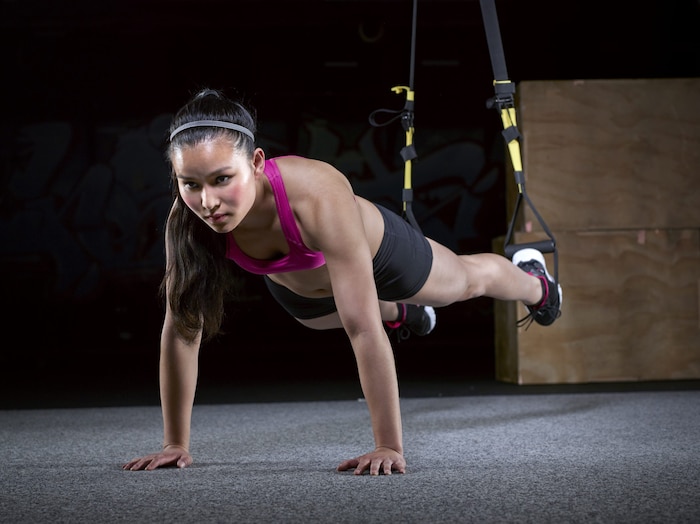
An intense exercise that also engages a large part of the core and deep muscles is the recrunch on a suspension trainer. First, get into the push-up position. Now secure both feet in the loops. Tighten your abs and pull your knees toward your upper body. Then slowly return to the starting position. It is important to perform the movement slowly and controlled to maintain tension in the core for the entire duration.

6 Strength Exercises to Make You a Better Runner

How Long and Far Men and Women Should Be Able to Bike
The Right Training Methodology
To maximize the potential of the training program, a certain intensity is necessary. As mentioned earlier, it is now proven that countless repetitions with correspondingly low weight do not lead to performance improvements in cycling. To benefit from the positive effects of strength training, cyclists should work with an intensity of at least 80 percent of the one-repetition maximum (1 RM). Additionally, heavy maximal strength training with four sets of four to six repetitions provides the best results.3
Implementation in Practice with a 4-Week Training Plan
To ensure cycling and strength training do not interfere with each other and necessary recovery, a well-thought-out training plan is helpful. This covers endurance and strength sessions while allowing room for recovery.
Even though the best results are achieved with a minimum intensity of 80 percent of the one-repetition maximum, the body must initially be slowly accustomed to these loads, and the correct techniques must be learned to avoid injuries and overtraining.
Weeks 1 and 2 Serve to Acclimate the Body to the Load
- Monday: Rest day
- Tuesday: Strength training session (introducing the body to loads and technique); initially 3 sets of 8 to 10 repetitions
- Wednesday: Endurance day (easy base ride – primarily serves recovery through increased blood flow)
- Thursday: Intense cycling day (e.g., intervals; high intensity)
- Friday: Second strength training session (similar to Tuesday)
- Saturday: Long endurance day (with low intensity)
- Sunday: Active recovery (through walks, stretching, foam rolling)
Those who perform only two or fewer cycling sessions per week can plan more rest days between training sessions.
Intensity is Key in Week 3
In week three, strength training sessions can now be more intense, while the volume of cycling remains the same.
- Monday: Rest day
- Tuesday: First strength training session (4 sets per exercise of 4 to 6 repetitions)
- Wednesday: Endurance day (easy base ride – primarily serves recovery through increased blood flow)
- Thursday: Intense cycling day (e.g., intervals; high intensity)
- Friday: Second strength training session (4 sets per exercise of 4 to 6 repetitions)
- Saturday: Long endurance day (with low intensity)
- Sunday: Active recovery (through walks, stretching, foam rolling)
Active Recovery in Week 4
In week four, a deload occurs, serving active recovery and preventing overtraining. While the division of sessions remains the same, the training volume and intensity are reduced.
- Monday: Rest day
- Tuesday: First strength training session (2 sets per exercise of 4 to 6 repetitions)
- Wednesday: Endurance day (easy base ride – primarily serves recovery through increased blood flow)
- Thursday: Endurance day (easy base ride – primarily serves recovery through increased blood flow)
- Friday: Second strength training session (2 sets per exercise of 4 to 6 repetitions)
- Saturday: Endurance day (easy base ride – primarily serves recovery through increased blood flow)
- Sunday: Active recovery (through walks, stretching, foam rolling)