

February 19, 2026, 3:11 am | Read time: 5 minutes
The bent-over barbell row is considered the ultimate “back builder” for maximum depth and a broad V-shape. Why this complex compound exercise significantly improves your core stability according to EMG measurements, why it still poses a challenge for beginners, and how to master the perfect technique–FITBOOK explains it all here.
Follow the FITBOOK channel on WhatsApp now!
The Correct Execution
Assume Position
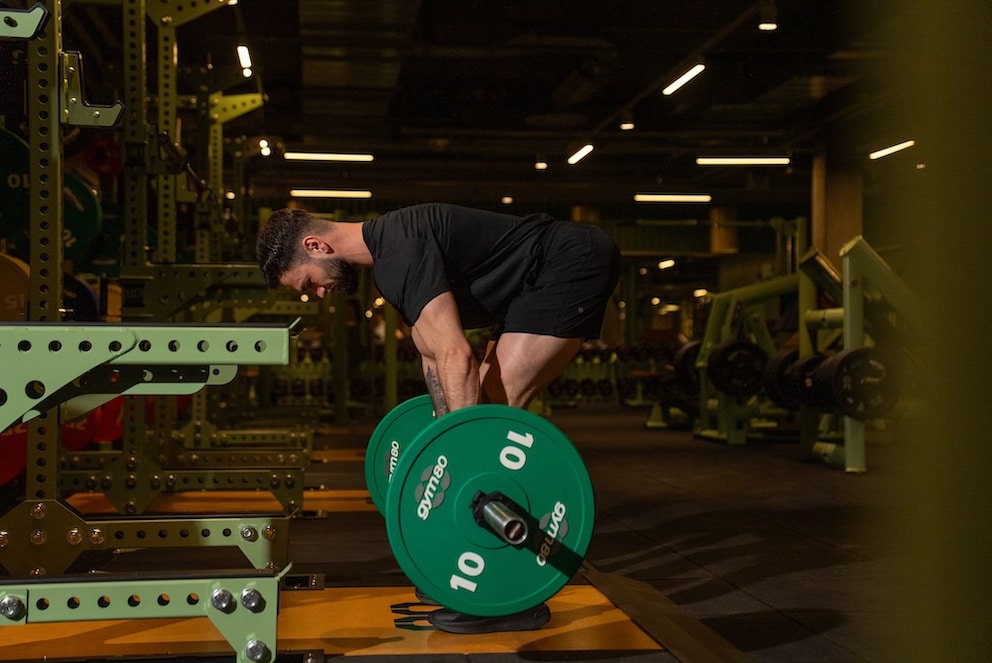
- Stand hip-width apart in front of the barbell. Grip the bar either–as shown here–with an overhand or underhand grip, slightly wider than shoulder-width.
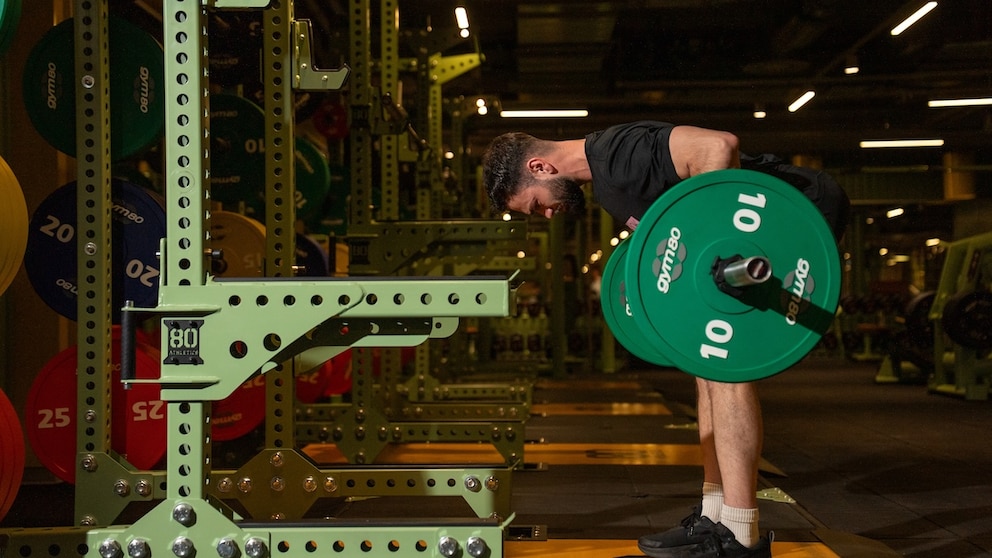
- Slightly bend your knees and lean your upper body forward with a straight back. The optimal angle is between 45 degrees and parallel to the floor. It’s important: Do not round your back; actively engage your abs and lower back.
- The barbell hangs at the start with almost straight arms directly under your shoulders. Ensure your neck is a natural extension of your spine, so your gaze is angled toward the floor in front of you.
Movement Execution
- Pull the barbell in a controlled manner toward your lower abdomen or navel. Execute the movement primarily using the strength of your back: Imagine actively pulling your elbows up and back behind your body. Consciously squeeze your shoulder blades together at the highest point of the movement.
- Hold this maximum tension briefly. Then slowly and deliberately lower the barbell again until your arms are almost fully extended, without losing tension in your back.
- Throughout the entire movement, keep your upper body and legs stable in the bent-over position. Avoid rocking your upper body upward or using momentum from your legs–the power should come solely from your back muscles.
Breathing: Exhale in a controlled manner when pulling the barbell, inhale deeply when slowly lowering it.
Train for the V-Shape: These Muscles Are Engaged
The bent-over barbell row engages a wide range of muscles, making this exercise so valuable. The primary focus is on the back–especially the latissimus, which is responsible for the popular V-shape. The trapezius and rhomboids are also trained, creating depth and thickness between the shoulder blades.
Scientific measurements (EMG) confirm this effectiveness: They show that especially the middle parts of the trapezius experience very high activation, closely followed by the latissimus, which reaches high to maximum load. The rhomboids and rear shoulder are also heavily engaged.
While the arm flexors also assist, you can control the focus: The biceps are more engaged with an underhand grip. If the back should remain the clear focus, an overhand grip is recommended. Meanwhile, various stabilizers ensure the necessary posture: The lower back, glutes, and back of the thighs work together to prevent you from tipping over or bending during the exercise.
Electromyography (EMG) is a method used to measure how strongly a muscle works. The brain controls muscles through small electrical signals. These signals are recorded during an EMG examination. This way, you can find out how intensely a muscle is engaged during rowing–and how strongly it works compared to other exercises.
High Activation of the Back Extensors
As mentioned earlier, the exercise is characterized by high muscle activation. Particularly in the activation of the back extensors, the exercise holds its own against supported rowing variants. The activation is 34 percent, which is remarkable, considering the back extensor is not even the target muscle of the exercise.1, 2

In 6 Steps to Your First Pull-Up

Pull-Ups – How the Grip Variation Affects the Target Muscles
“Spine Stiffness”
During the barbell row, your body must stabilize the upper body without external support. This causes the abdominal muscles and back extensors to contract maximally at the same time–like a muscular “corset” around the spine. This strong stiffening (“spine stiffness”) prevents small wobbles or micro-movements between the vertebrae, which could otherwise irritate the discs.
Although the load is high, the tension acts like an internal brace, as the forces are primarily absorbed by the muscles–provided the technique is clean. This effect is so positive because you learn to keep your back stiff and secure like a pillar even during heavy lifting tasks, which benefits you greatly in everyday life.
Also interesting: 4 exercises for a strong lower back
Beginner-Friendliness–Not So Much
In the gym, the complexity of an exercise can generally be deduced from how many muscle groups are engaged simultaneously. The more muscles involved, the more demanding the execution usually is. This is exactly the case with the barbell row. Beginners often find this exercise difficult because they often lack the necessary muscle tension to maintain a clean and stable posture throughout the entire set.
Without this foundation, the technique suffers. Therefore, it is worthwhile for beginners to start with a low weight or alternatively switch to rowing machines. Additionally, it is advisable to strengthen the lower back in advance with isolated exercises, such as back extensions (hyperextensions).