


December 29, 2025, 3:12 pm | Read time: 5 minutes
The pull-up has a certain magic: You’d love to be able to do it and often try again—only to end up helpless under the bar. Yet this classic “pull” exercise is absolutely achievable! FITBOOK explains how you can systematically achieve your first clean pull-up in six steps.
Muscles Worked During a Pull-Up
The pull-up is one of the most effective upper-body exercises. It targets many muscles in this area and gradually shapes a broad back. For all men, this means the popular V-shape is on the horizon with consistent training. The pull-up engages the broad back muscles, the muscles between the shoulder blades, and the arm muscles.
6 Steps to Your First Pull-Up
Jörn Giersberg is a trained sports scientist and personal trainer. He understands the desire of many clients to finally achieve one (or more) pull-ups. Here are the steps he recommends for pull-up training without any aids.
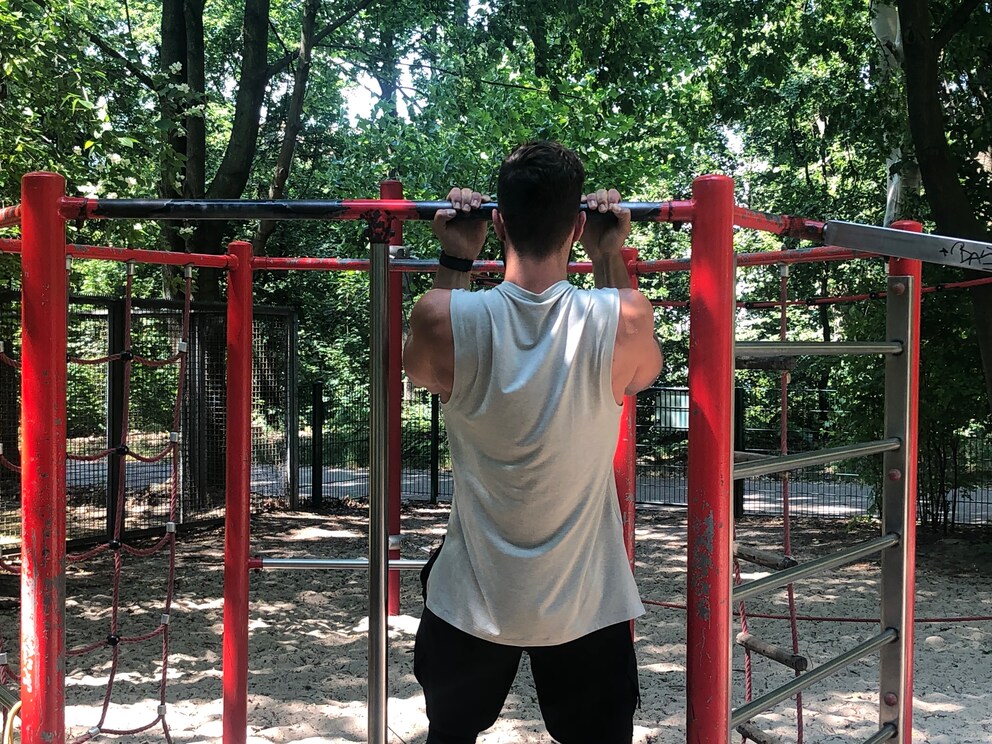
1. Hang Loose
Beginners should start by hanging from the bar. Even this can strengthen the back muscles for those untrained. After a few seconds, take a short break and then repeat the process. Switching from an overhand to an underhand grip and varying the grip width engages different areas of the back. Note: The wider the grip, the more the latissimus is involved.
2. Get Swinging
The next step is swinging. You can either swing your body from a hanging position or jump to the bar. The centrifugal forces create a higher apparent body weight, providing a new growth stimulus for the back muscles. After a few pendulum movements, take a break. Then repeat the process.
3. Climb Along the Bar
Those who make progress with the first two exercises can start climbing along the bar with an overhand grip. Playground equipment can also be used to practice climbing. Simply move forward and backward along the parallel bars.
4. Work with Isometric Tension
For this step, a stool or other aid should be available. In the underhand grip, lower yourself from the top position of the pull-up until your arms form a right angle. Hold this position and after a few seconds, lower yourself again. After a short break, proceed to the next set.
Also interesting: Isometric Training – Workout Without Movement and Equipment
5. Perform Negative Repetitions
Once the back has gradually strengthened, you can perform a half pull-up. Focus first on lowering yourself. Slowly move your body from the top position toward the ground. When your arms are extended, the repetition is complete, and a new round begins.
6. Start with Partial Repetitions
Now you’re close to a full pull-up. The starting position is again with your chin at the bar. Unlike negative repetitions, lower your body slightly and pull back up to the bar. Until a full pull-up is achieved, perform these partial repetitions.
Also interesting: How Many Repetitions Lead to Optimal Muscle Growth?
Simplify Pull-Up Training with a Resistance Band
If desired, you can initially simplify pull-up training with an aid: A medium-resistance Thera-Band ensures that a person weighing 70 kilograms only has to pull up about half of their body weight. The band is looped over the bar. Place one foot in the loop and extend the leg. Now the pull-up training begins.
Tip: If you push the leg hanging in the loop slightly forward, the spine is better activated, and the abdomen is more relaxed.
Technically Clean Execution of a Pull-Up
- Grip: Grip the bar slightly wider than shoulder-width, with palms facing away from the body. Do not place all fingers side by side; instead, wrap your thumb around the bar. This so-called overhand grip activates the back muscles most effectively. The underhand grip requires less back strength and engages the biceps more.
Tip: Try the overhand grip variant first. It’s particularly gentle on the shoulders. You can always switch back to the underhand grip.
- Arms: Before pulling up, fully extend your arms. Make yourself as long as possible! Only then does the pull-up count.
- Position of the Shoulder Blades: In the hanging position, the shoulder blades should first be activated. Try to pull them toward the spine. This trick makes it easier: Imagine pulling yourself up without bending your elbows. Now the shoulders are in the perfect starting position.
- Legs: Push the extended legs slightly forward—this activates the abdominal muscles.
- Properly Pull Up and Lower Down: Pull yourself up under tension, controlled and slowly (exhale), until your chest reaches the bar.
- Do Not use your legs to gain momentum.
- The Head should be neutral over the spine. However, it is also possible to tilt it slightly (!) backward to look up at the target. Lower slowly and controlled (inhale).
Pull-Ups – How the Grip Variation Affects the Target Muscles
Different Grip Variations in Deadlifting and When to Use Them
If You Achieve a Pull-Up
Perform a clean pull-up using the technique described above. Try a second one immediately afterward. Then pause for a minute and repeat the exercise. Again, aim for five to six sets.
If You Achieve 10, 12, or Even 15 Clean Pull-Ups …
First of all: Wow! Congratulations! With this achievement, you probably outshine two-thirds of your gym peers. To continue improving from this level, the following training routine is recommended: Go slightly (about 20 percent) below your maximum without pausing. That means: If you can do 10 pull-ups, do eight. If you can do 15 pull-ups, do eleven or twelve. Then pause for a minute and repeat the process. Can you complete five sets or even a sixth?