

October 3, 2026, 3:33 pm | Read time: 3 minutes
To become a master, you must learn from the master. And even though bench pressing seems to be the iconic foundation of bodybuilding, today’s masters of the sport tell us something different. Across the board, world-class bodybuilders report that they no longer bench press. Why is that, and what can we learn from them?
Follow the FITBOOK channel on WhatsApp now!
Jay Cutler: “You know, everyone tears their pec muscle”
There are now plenty of statements from the most successful bodybuilders that they no longer rely on bench pressing. And it’s not just athletes of the new generation like Urs Kalecinski saying this, but also old-school bodybuilders like Jay Cutler, a four-time Mr. Olympia winner, who also makes it clear in a YouTube video titled “The Worst Exercise?”: “It puts too much strain on the shoulder joint, and you know, everyone tears their pec muscle.”

Bench press – better on the machine, with free weights, or with a barbell?

8 Effective Cable Exercises for a Strong Upper Body
Is the exercise too dangerous?
Almost all professional bodybuilders have built a significant portion of their chest muscles with bench pressing. Many report this. Bench pressing is simply an excellent exercise for muscle building. It achieves particularly high muscle activation and promotes maximum strength. No wonder Cutler also says: “I liked how it felt because I got an incredible pump from it.” However, the problem with heavy bench pressing is the risk of injury. Not necessarily due to technical errors, which are also frequently observed in bench pressing. But also because, as Cutler explains, “what connects the pec muscle to the shoulder is a very short tendon.” Cutler is not entirely wrong. In fact, about 85 percent of all pectoral muscle tears in strength sports occur during bench pressing.1 And the tendon is indeed very short. This means that in the lowest phase of the bench press, it is subjected to a strong stretch under high load, which can lead to partial tears or even complete tendon ruptures, especially with heavy weights. A low number of repetitions combined with very high weight is therefore a particularly risky combination.
The advantage of the chest press
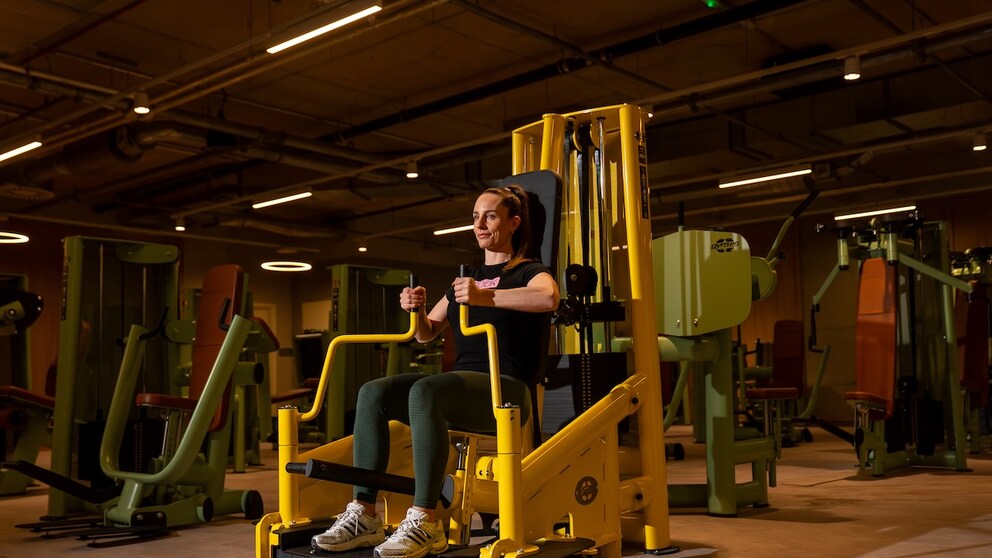
The chest press offers several advantages, making it a sensible exercise for both beginners and advanced athletes. Beginners, in particular, benefit from the guided movement, which is easy to learn. Unlike bench pressing with free weights, neither extensive practice nor advanced technical knowledge is required. Additionally, many find it easier to initially develop a feel for the targeted muscles on a machine.
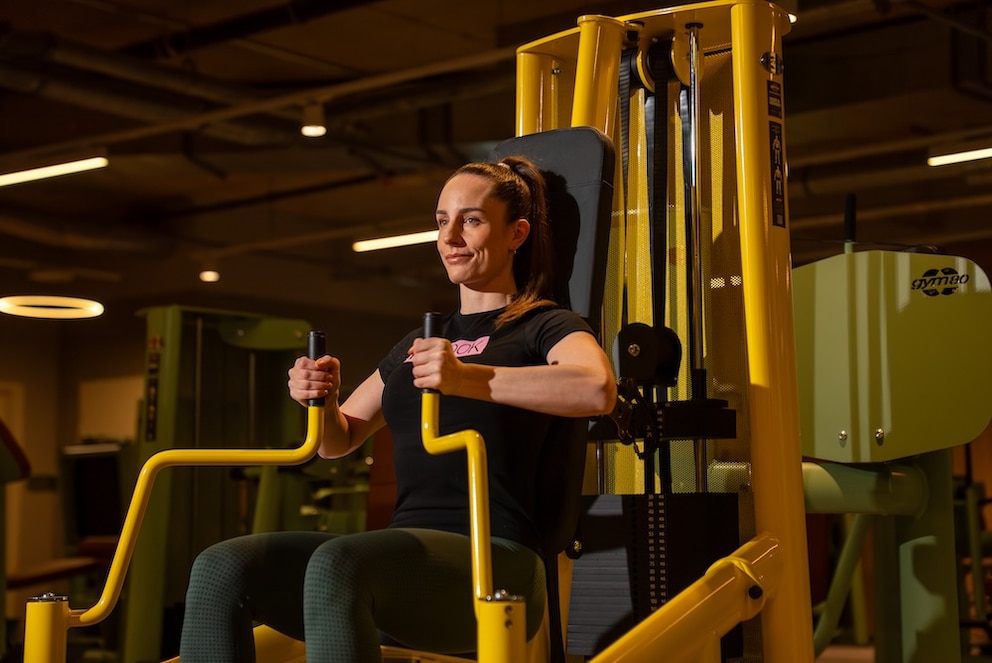
But advanced athletes can also benefit from the chest press. Those who want to move as much weight as possible can often do so more safely here than with traditional bench pressing. A training partner is not necessarily required, and sets to muscle failure can be performed without the risk of getting stuck under a barbell. Additionally, the chest muscles work somewhat more isolated on the machine. In contrast, more stabilizing muscles are involved in bench pressing to control the movement.
For proper adjustment, the seat should be positioned so that the handles are approximately at nipple height.
Depending on the manufacturer, the range of motion of the equipment can vary significantly. Models that allow for the largest possible range of motion are recommended. This allows the chest muscles to be placed in a stronger stretch position, which can increase the training stimulus.