

April 5, 2026, 3:55 pm | Read time: 4 minutes
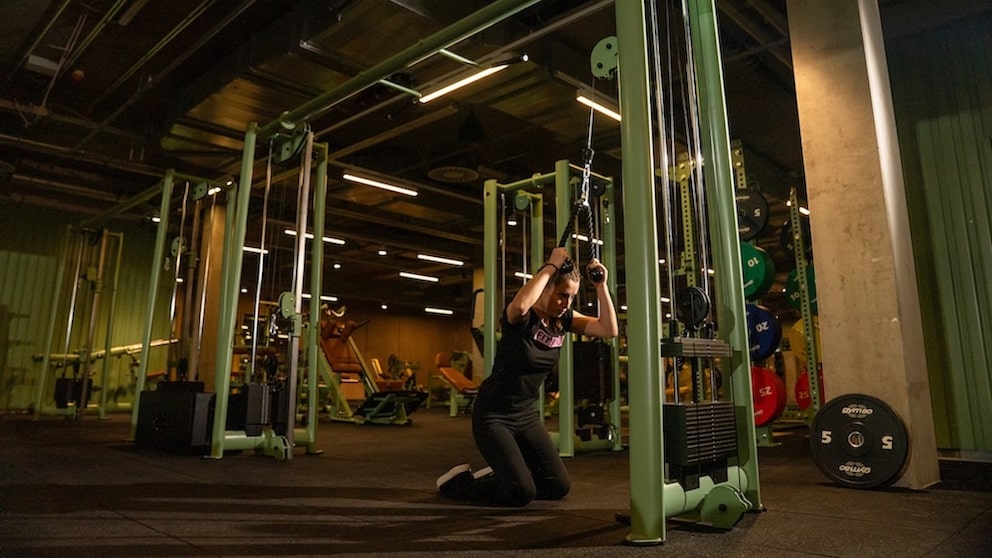
Feel free to leave the training mat hanging and stay on the ground—or better yet, get on your knees. If you should focus on just one abdominal exercise, it should be cable crunches. FITBOOK editor Michel Winges explains why this exercise is so effective and dispels the myth about whether it can actually be harmful to the discs.
The Advantages Over Other Abdominal Exercises
Constant Tension
What distinguishes an excellent muscle-building exercise from just a good one? The “time under tension.” It is a crucial factor for muscle growth, and this is where cable crunches have an edge over other floor exercises. While the resistance curve in regular floor crunches drops at the highest point, the cable ensures that the abdominal muscles are under load at every phase of the exercise.1
Progressive Overload
A second crucial factor for muscle growth is progressive overload. This can be quite challenging with floor crunches, as aside from increasing the number of repetitions, there are no other options—and no one wants to do 100 reps per set to stimulate muscle growth. With the cable, however, resistance can be precisely increased in small increments. For example, if you can do three clean sets of eight to ten reps, increase the weight by five to ten percent to continuously challenge the muscles.
More Six-Pack Than Core
Cable crunches are an isolated exercise for the rectus abdominis, the muscle responsible for the typical six-pack look. The obliques are secondarily engaged as stabilizers. However, the deep core muscles are hardly activated during the exercise. Cable crunches are great for muscle building, but do not replace a complete core workout.

8 Effective Cable Exercises for a Strong Upper Body
Leg Raises: How to Properly Perform One of the Most Effective Ab Exercises, According to Studies
Do Crunches Damage the Lumbar Spine and Cause Disc Herniations?
This question is hotly debated in sports science. Stuart McGill, one of the leading and frequently cited professors in spinal biomechanics, argues that repeated spinal flexion can damage the discs over time. However, this position is criticized by many scientists because it is mainly based on studies where the spines of dead pigs were bent thousands of times.2 The experimental conditions are far from human reality.
A central problem with these studies is that dead tissue functions fundamentally differently from living tissue. Healthy discs are nourished through a process called imbibition. When the spine moves, nutrients are absorbed, and the used fluid is released. This self-repair mechanism is entirely absent in cadaver studies. Additionally, the muscles of the spine were removed in these experiments, significantly altering the biomechanics, and the number of bending cycles does not correspond to a normal training program. Those who do crunches typically perform a few sets of ten to twenty reps and then wait days before repeating the exercise.
Nevertheless, it would be too simplistic to dismiss McGill’s research entirely. For people with existing back problems or poor execution technique, crunches could indeed be stressful. Genetics also plays a role: some people are naturally more prone to disc issues than others.3 For these groups, McGill recommends alternatives like the plank, the bird-dog, or the so-called McGill curl-up—exercises that strengthen the core without bending the spine.4 For healthy individuals without pre-existing conditions, current research does not provide convincing evidence that properly performed crunches—even on the cable tower—are harmful.
The Correct Execution
Assume Position
- Attach a rope to the top carabiner of the cable tower (if the height is adjustable, choose the highest setting).
- Grab the rope and kneel about half a meter to a meter away from it.
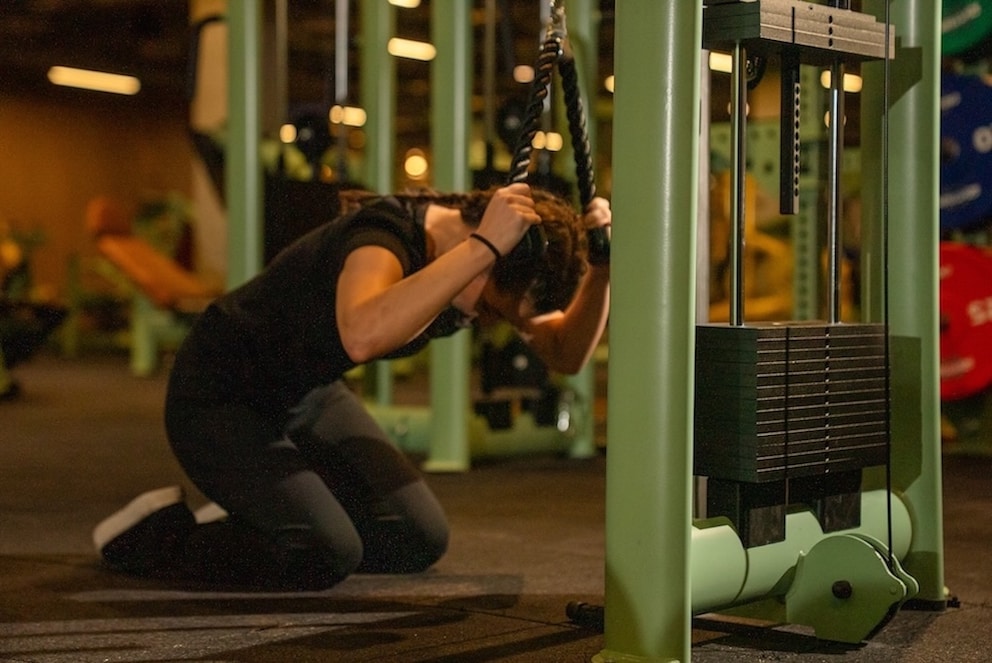
- Bring the rope past the side of your head so that your hands are at temple height and your arms form a 90-degree angle.
- In the starting position, the upper body is slightly leaned forward.
Movement Execution
- Begin to curl the upper body forward and downward in a controlled manner, as if drawing your chest toward your knees—and exhale. The movement comes solely from the abdominal muscles; the hips remain largely still, and the arms hold the rope in position.
- The lowest point is reached when the distance between the ribcage and pelvis is maximally reduced. Pause briefly and consciously tense the abdominal muscles.
- Then slowly and controlled, return to the starting position.