

May 18, 2026, 11:19 am | Read time: 5 minutes
Summer is just around the corner, and you’re starting to look for the best exercises for visible abs? Or have you realized that abs are essential for health too? Either way, FITBOOK has taken a closer look at the exercise, scientifically demonstrating that it could indeed be the best ab exercise, and we show variations that suit every fitness level.
Follow the FITBOOK channel on WhatsApp now!
The Correct Execution
The Beginner-Friendly Version
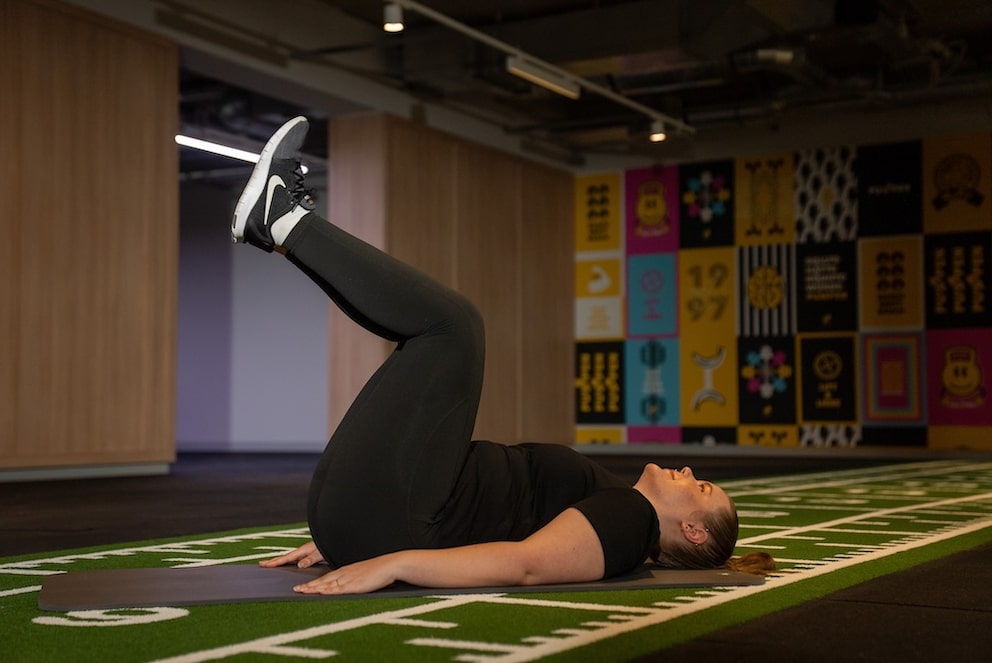
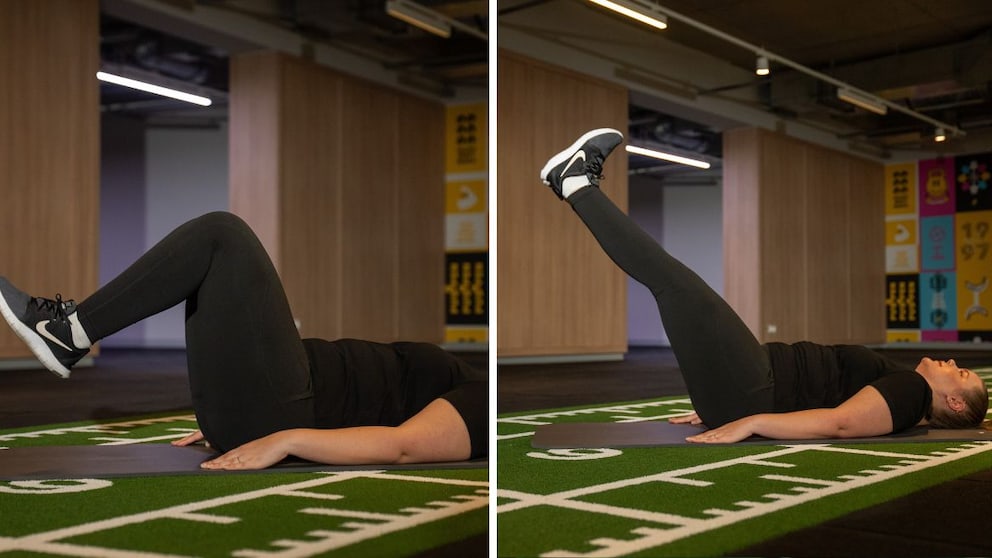
First, lie on the floor, on a mat or towel, with your back flat, avoiding an arch. How you position your hands depends on how much support you want. Especially as a beginner, you might place your hands under your buttocks or near the tailbone. This tilts your pelvis backward and presses your lower back flat against the floor. If you feel confident and want to make the exercise more challenging, simply place your arms at your sides with palms facing down.
Hand Positioning for Back Pain: When pressing your back flat, you might experience some back pain. If back pain occurs, you can place your hands directly under the natural curve of your lower back.
Tighten your abs as if you’re pulling your belly button toward your spine. Then, with an exhale, raise your bent legs in a controlled manner. Raise your legs until they are approximately perpendicular to the floor. During the downward movement, take a few seconds and lower them so that your heel almost touches the floor without actually doing so. If you notice your back lifting during the deep movement, only go as low as your back remains flat on the floor.
Why Avoid Arching the Back? When the back is arched, the abs lose tension, and the load is transferred to the lower back.
The More Challenging Variation
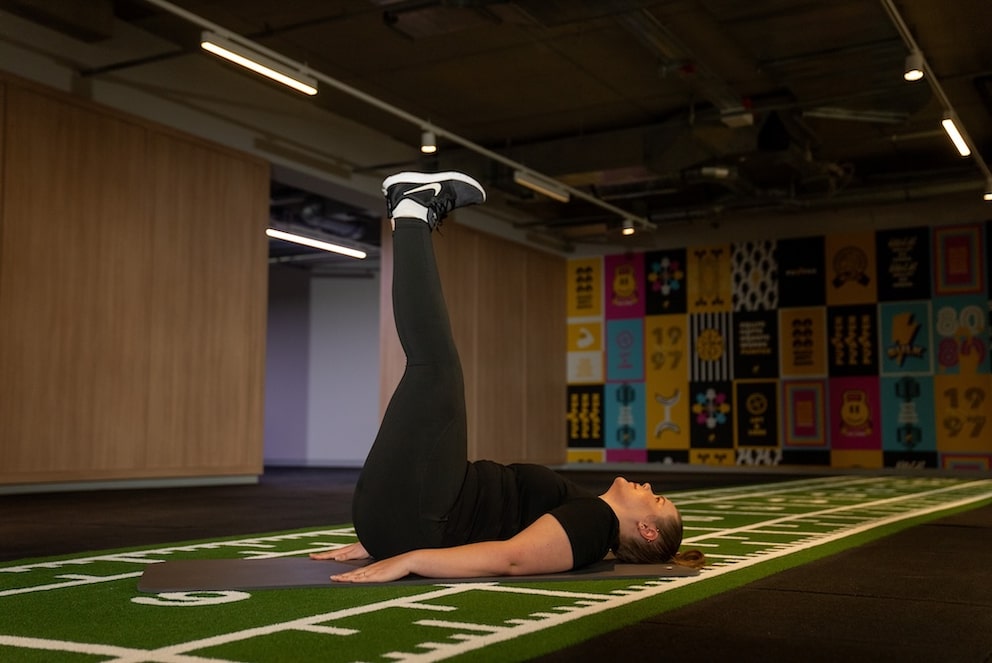
The more challenging version differs only in that you try to keep your legs straight throughout the entire exercise.
Hanging Leg Raises
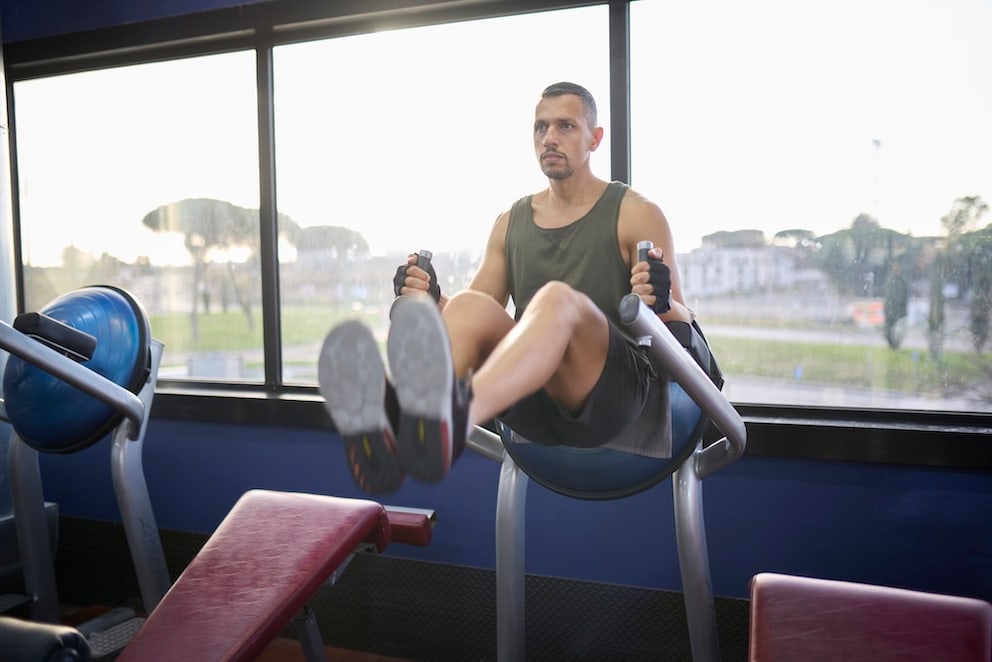
The Hanging Leg Raises are performed on a device (dip station or “Captain’s chair”) instead of on the floor. Get into the starting position so that your arms are extended on the pads, your hands grip the handles, and your back is pressed against the pad while your feet hover above the ground. Tighten your core and lift your legs straight up until they rise parallel to the floor. Also, make sure not just to lift your legs but to actively roll your pelvis. This is easier if you imagine pulling your pubic bone toward your belly button.
The pubic bone is located at the front, lower part of the pelvis.
As with the floor variations, you should lower your legs slowly. Since you can quickly turn into a human pendulum during the exercise, you should stop briefly at the lowest point to prevent swinging.

Common Mistakes in Ab Workouts–and How to Do Them Right

2 Exercises for a Strong Core
The Most Effective Ab Exercise?
To the delight of all six-pack enthusiasts, there are now numerous studies that have scientifically compared the efficiency of various ab exercises. Looking at the results of these studies, it is noticeable that Hanging Leg Raises consistently perform above average.
In the studies, this exercise regularly achieves top scores in muscle activation and is therefore considered one of the most effective methods for targeted muscle building in the core area. For example, a study by the American Council on Exercise found that leg raises on the dip station achieved the highest activation of the oblique muscles compared to all other exercises tested.1 Even for the rectus abdominis, this variation ranks second, surpassing popular exercises like crunches or sit-ups.
Also interesting: Are crunches outdated? What studies show about effective core training
A study by Dr. Stuart McGill–arguably the world’s most respected spinal biomechanist–also confirms the high effectiveness of leg raises.2 McGill examined several ab exercises and compared how much the respective muscles are engaged. The result was clear: Hanging Leg Raises produced the strongest engagement of the abdominal muscles. Hanging Leg Raises thus performed best among all exercises studied. This can be explained mainly by the strong mechanical tension. Since the abdominal muscles must actively roll the pelvis against the weight of the legs, an intense growth stimulus is created that far exceeds the load of many other exercises.
However, there is one golden rule: If you manage to keep your lower back absolutely stable and actively roll your pelvis, Hanging Leg Raises are unbeatable. But as soon as you notice that you’re arching your back or need momentum, the exercise becomes ineffective for the muscle and more dangerous for the discs.
Muscles Engaged
Leg Raises are an excellent exercise for the entire core musculature. The focus is primarily on the rectus abdominis, which remains under high tension throughout the entire range of motion. When the exercise is performed on the dip station or in the hanging variation, the obliques are also heavily engaged, as they must perform significant stabilization work. The hip flexor complex (especially the iliopsoas) also plays an indispensable role, initiating the movement of the legs and ensuring the transfer of force between the lower and upper body.
Beyond pure muscle building, Leg Raises also offer benefits for general athleticism. Due to the high mechanical load created by the long lever arm of the legs, core stability is greatly enhanced. Core stability not only improves posture in everyday life but also boosts performance in complex foundational exercises like squats or deadlifts, where a stable core serves as protection for the spine. In the hanging execution, you also benefit from increased grip strength and improved shoulder stability.