


March 21, 2026, 4:59 pm | Read time: 6 minutes
To make progress in weight training, muscles should regularly be exposed to new stimuli. If not, it leads to the dreaded training plateau feared by many strength athletes. FITBOOK editor Nuno Alves tries to vary the method he uses to challenge his muscles in the gym every few months. One training method I have tried myself is inspired by U.S. fitness expert Jeff Cavaliere. His approach focuses on performing effective repetitions. What exactly is behind it and how fitness professor Stephan Geisler assesses the method.
Breaking Out of the Repetition Routine
Three sets of twelve repetitions is a widespread concept in strength training. The problem here: Many amateur athletes stick to it–and sometimes for years. If the weight lifted also remains the same or changes only slightly, progress stalls. I also address this in my book, “Highway to Health – In 7 Steps to a Healthy Long Life,” which will be published on January 4, 2027.
Of course, any form of weight training–even a monotonous one–is still better than none, but most would surely be pleased with progress and a more defined body. For this, it is important to make the training as varied as possible and to constantly challenge the muscles so that they respond with adaptation: hypertrophy (muscle growth), strength gain, and endurance. What predominates depends on many factors and ultimately on the chosen method.
In my search for new variations, I came across a video by Jeff Cavaliere, whom I know from an episode of Andrew Huberman’s podcast. In it, the fitness expert describes a method that is both effective and efficient. At its core, it relies on intense repetitions to muscle failure and short recovery breaks between sets, which Cavaliere combines with a selection of five different exercises for a specific muscle group. Essentially, it is a high-intensity training–also known as HIT. The goal is to achieve a total of ten to 20 effective repetitions per exercise. In his workouts, Jeff Cavaliere ensures that a muscle is challenged with a total of 100 effective repetitions. Based on Jeff Cavaliere’s method, I have derived the following structure for myself.
The Concept of Effective Repetitions
Phase 1: Warm-up and Preparation
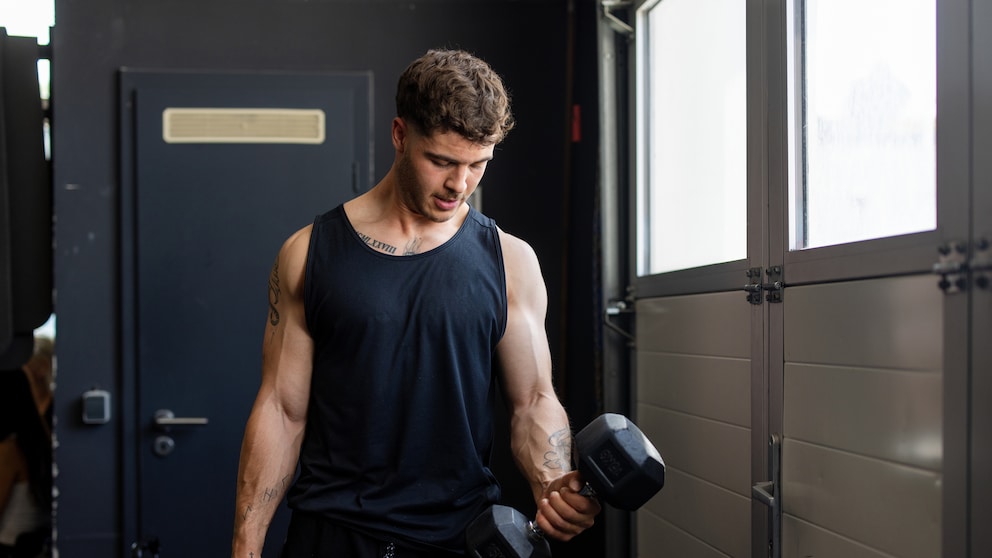
After a brief full-body warm-up, the actual training begins with a warm-up process using lighter weights to prepare the muscles for the upcoming load. In my case, for bicep curl training, this involves two six-kilogram dumbbells, with which I do about 20 repetitions. The warm-up serves to increase blood circulation and stimulate metabolic processes to create better conditions for muscle contraction. Overall, a warm-up minimizes the risk of injury. This phase is crucial as it prepares the body for intense training and enhances muscular performance. An effective warm-up not only improves overall performance but also increases muscle elasticity and promotes neuromuscular coordination.
Also interesting: What to do to regenerate muscles after intense strength training
Phase 2: High-Intensity Repetitions
After the warm-up, there is a two-minute break before moving on to the core of the method. The weight is chosen so that muscle failure occurs within eight to twelve repetitions. This is reached when you can no longer perform another repetition with proper technique.
Ideally, you should have no so-called reps in reserve. This refers to the number of repetitions you could theoretically still perform cleanly. If you’re unsure which weight is right, you should rely on experience or experimentation.
The Core of the Training Method at a Glance
- Repetitions are performed until complete muscle exhaustion.
- Only 15 seconds of rest are allowed between sets.
- The first set serves as a warm-up and is not included in the total count.
- Counting of effective repetitions begins with the second set.
- The exercise is repeated until a total of ten to 20 repetitions are achieved–excluding the warm-up and the first set.
Since I always aim for a total of 20 reps, a typical exercise for me looks like this:
- Set 1: As many repetitions as the muscle can handle. As described above, this should typically be about eight to a maximum of twelve repetitions.
- 15 seconds rest
- Set 2: Again, perform as many repetitions as possible until the muscle is exhausted and you have no reps in reserve. Usually, you can only manage about four to six repetitions.
- 15 seconds rest
- Set 3: follows the principle of Set 2
- 15 seconds rest
- Continue in the same pattern until a total of 20 effective repetitions are reached–without counting the repetitions of the first set.
Also interesting: These muscles should not be neglected during training
Possible Variations
- Use a higher weight and achieve the 20 repetitions within more sets accordingly.
- Extend the last set to muscle failure after reaching 20 repetitions.
- After reaching 20 repetitions, take another 15-second break and add another set with half the weight to muscle failure.
Which Exercises Are Suitable for the Method of Effective Repetitions?
Basically, all exercises that can be performed safely and without significant risk of injury are recommended, such as on cable machines, equipment, or with dumbbells. For example:
- Shoulder press with dumbbells
- Lateral raises
- Bicep curls
- Tricep pushdowns on the cable machine
- Leg curls
- Leg extensions
- Butterfly
- Chest press
But bodyweight exercises can also be suitable, provided you reach the point of fatigue within twelve repetitions, such as with pull-ups, tricep dips, or push-ups.

Wrestler Reveals How to Train for an Ideal Muscular Chest

How Many Repetitions Are Ideal in Strength Training?
When Not to Use the Method of Effective Repetitions
Certain exercises can be dangerous when training to muscle failure, including:
- Bench press with a barbell
- Back squats with a barbell
In these cases, I advise against using the method or only doing so with a spotter–someone who, for example, ensures safety during the bench press. Even though Jeff Cavaliere still includes them in his videos, the risk of collapsing under the weight is too high for such exercises.
My Personal Experience with Effective Repetitions
As mentioned at the beginning, I make sure to regularly vary my workout. With the method of effective repetitions–in my case always 20 reps–I trained for about six weeks. My conclusion: During this period, I was able to gain muscle mass and simultaneously increase my strength in the targeted muscles. An additional advantage of this method is the time saved due to the short breaks between sets, which made the entire workout noticeably more efficient.